The Webster Covent Garden Redefines the London Hotel as Drawing Room
In a city of grand lobbies and impersonal corridors, a new Holborn address embraces intimacy, terrazzo and the radical pleasure of feeling at home.

A Businessman from Harrogate and the Problem of London Hotels
The lift doors opened on the ninth floor, and the man in the trench coat smiled. He had come down from Harrogate for a fortnight, he explained, and for years had struggled to find a London hotel that felt like more than a place to sleep. This time was different. He had dined in the restaurant nearly every evening. He had lingered. The word he used was "inviting", spoken with the quiet relief of someone who had finally found what he was looking for.
The Webster, which opened its doors in Covent Garden opposite Lincoln's Inn Fields, is designed around that exact friction: the difficulty of making a city hotel feel like somewhere you might actually want to stay. Not merely efficient or impressively large, but genuinely welcoming. It is a balance that most London properties abandon in favour of marble atriums and underused lounges. Here, the reception is small, the interiors layered with texture, and the atmosphere closer to that of a manor house than a conventional urban address.
Location as Literary Backdrop
The hotel stands a two-minute walk from Holborn station, ten from Tottenham Court Road, and faces the green expanse of Lincoln's Inn Fields. The square itself carries weight: it served as the moody setting for Charles Dickens' Bleak House, and that sense of place, thick with history and quieter than the bustle of Covent Garden proper, seeps into the building. You are in the city, but not entirely of it.
The Webster is the debut property of a new hotel brand built around what it calls "analogue pleasures", a phrase that could tip into marketing speak but here translates into something tangible: books, conversation, the kind of space that encourages you to sit still. A second outpost is planned for Times Square, New York, in 2028, though the London original feels firmly rooted in its surroundings.
Red Deer and the Architecture of Magical Realism
The interiors are the work of Red Deer, a London-based architecture firm that describes its approach as "magical realism". Lucas Che Tizard, co-founder and lead architect, speaks of creating spaces that feel familiar but punctuated by gentle surprise. Bespoke terrazzo, hand-painted murals, tactile fabrics, a mohair headboard. The magic, he suggests, lies in discovering something slightly unexpected within a space you already feel at home in.
The check-in desk is bijou, a deliberate nod to the small boutique hotels of the 1970s. There are no intimidating entryways, no vast lobbies that swallow guests whole. Instead, the hotel unfolds at a domestic scale, with 167 keys distributed across rooms that feel more like bedrooms in a well-appointed house than standardised hotel units. The relationship with Lincoln's Inn Fields, the energy of Holborn, the idea of a hotel as a creative meeting place, all of these shaped the character of the building, from the terrace that connects the property to the square to the joinery in each guestroom.
The King Deluxe and the Art of the Longer Stay
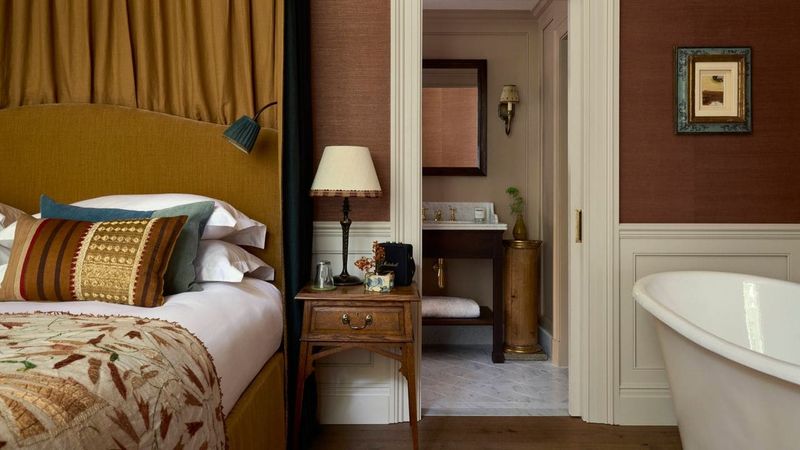
Of the three room categories, the King Deluxe with a park view makes the strongest case for what the hotel is trying to do. The joinery is bespoke, designed for guests who arrive with more than a carry-on and plan to stay longer than a night. The minibar is stocked with Torres crisps, Form protein bars, sweets that gesture towards wellness, and the kind of provisions that pair well with tea, coffee or something stronger.
The bathroom is generous, tiled in a contemporary pattern, stocked with Malin + Goetz. It is not trying to be a spa, but it is more than functional. The room feels considered, not decorated according to a template rolled out across dozens of properties. You could live here for a week and not tire of it.
Carmelina's and the Hidden Energy of Carla's
Down a set of steps to the right of the entrance sits Carmelina's, a restaurant with enough character to sustain a life independent of the hotel. The space is moody, intimate, with low ceilings, wood-clad walls, an open kitchen, velvety green booths and a black-and-white tiled floor that reads as nostalgic without tipping into pastiche. Petal-shaped chandeliers hang overhead. The effect is more New York than London, a compliment in a city where Italian restaurants too often default to a familiar shorthand of exposed brick and Edison bulbs.
The menu is overseen by head chef Simone Serafini and restaurant manager Francesco Patti, and it is rooted in Italian cooking without leaning on cliché. Towards the back, cloaked behind a discreet entrance, is Carla's, a bar helmed by Peppe Corallo. The space has a 1990s energy, the kind that encourages conversation with strangers. The cocktail menu is thoughtfully constructed, each drink nodding to the rituals of Italian family dining: the woody scent of the cabinet that holds special-occasion glassware, the remedy concoction for a cold or a bad day.
The standout is La Conserva, a martini variation that feels fragrant, refreshing, built around strong basil notes. It is an ode to the late-summer Italian ritual of jarring and preserving fresh tomatoes, translated into liquid form. It is worth visiting Carla's for that drink alone.
The Lounge and the Rhythm of the Day
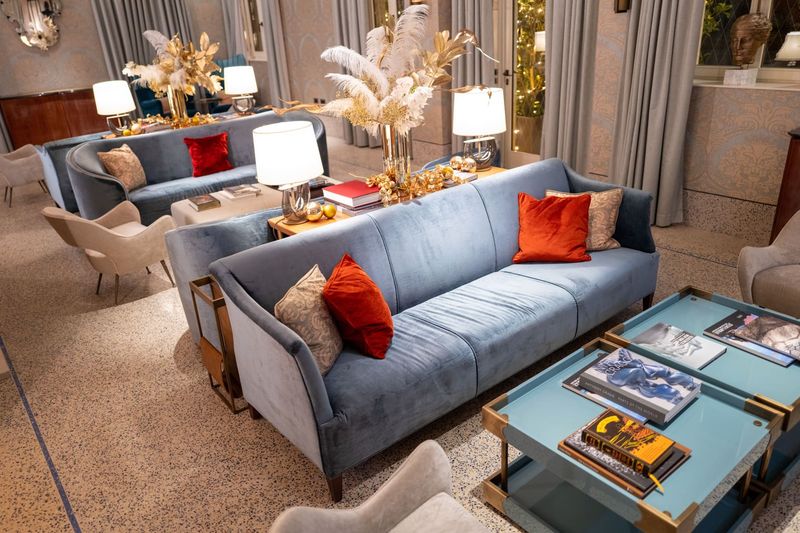
Just off reception is a lounge that shifts character as the day progresses. In the morning, it is studious: a place to read, work, sit with coffee. By evening, it becomes more animated, filled with conversation and the kind of spontaneous gathering that cannot be designed, only encouraged. The furniture and materials provide the setting, but the guests continually reshape the atmosphere.
Che Tizard notes that seeing people inhabit a space in their own way is enormously satisfying as a designer. The lounge offers enough intimacy to carve out a corner for yourself, yet remains sociable, open to the possibility of connection. It is a rare quality in a city where hotel public spaces tend to be either too grand to feel comfortable or too small to accommodate more than a handful of guests.
The Verdict on Slowness
The Webster feels quietly creative, and its proximity to literary landmarks, the shadow of Dickens and the legal history embedded in Lincoln's Inn Fields, lends the property a sense of inspiration that does not need to be announced. There is a casual refinement to the design and atmosphere, a quality that naturally encourages a slower pace. You find the time to sit with a book. You stay for another drink. You talk to a stranger, and the conversation lasts all evening.
In a city that often equates hospitality with scale and spectacle, The Webster makes the case for something smaller, more textured, more human. It is a hotel that feels like a drawing room, and that is no small achievement.