Where Madrid's New Wave of Luxury Unfolds Beyond the Palace Gates
The Spanish capital's hospitality scene is shedding its grand-dame predictability for something quieter, stranger, and infinitely more compelling.
The City That Stopped Trying to Be Paris
Stand at the corner of Calle Barco and Gran Vía on a July evening, and you will hear almost nothing. This is improbable. Gran Vía is Europe's second-busiest shopping street, a river of tourists and taxis and neon that never quite goes still. Yet three floors above the pavement, on the private terrace of a rooftop suite, the silence holds. The Telefónica building watches from across the way. A plunge pool catches the last copper light. Inside, amenities carry the scent of a custom fragrance blended for this address alone, a collaboration between the hotel's founders and perfumer Francisca Manzini. Hôtel du Temps Madrid opened after eight months of renovation by Yoan and Jen Marciano, who left their storied Parisian property to raise their children here. Thirty-one rooms, seven of them suites with living rooms and windows that frame the street below. Retro atmosphere, deliberate warmth, the sense that someone actually lives here.
This is the tenor of Madrid's new luxury: not louder, not shinier, but quieter and more particular. The city has always had its grand dames, its belle époque palaces where kings inaugurated ballrooms and film stars honeymooned. Those remain. But alongside them, a different breed of property is emerging, one less interested in replicating Europe's well-worn luxury playbook and more attuned to intimacy, provenance, and a certain studied informality that feels distinctly Spanish.
A Palace, Reimagined
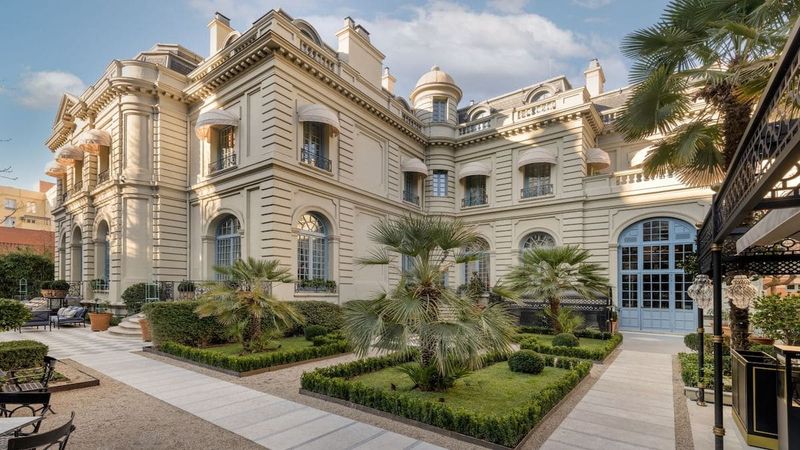
The Palace returned in 2025 after a complete overhaul by Ruiz Larrea Arquitectura, interiors by Lázaro Rosa-Violán. Four hundred and seventy rooms and suites, making it the largest luxury property in the capital. The Neptuno Suite recreates the feeling of a mid-20th-century bourgeois Madrid home: restored marble fireplace, wood panelling, Art Deco furniture, wallpaper above the headboards, Frette linens, Le Chemin by Byredo in the bath. Portuguese chef Nuno Matos oversees La Cúpula, the hotel's social heart, where the menu leans on local produce, simple preparations, tradition honoured rather than deconstructed. Pork tenderloin with clam sauce, excellent beef Wellington meant for sharing. The cocktail culture that defined the original Palace lives on in La Cúpula's bar and in 27 Club, the renovated and legendary space where drinks are mixed with the same seriousness they were a century ago.
It is a love letter to Madrid, yes, but one written in a script legible to anyone who has spent time in the city's older neighbourhoods, where elegance is assumed rather than announced.
The Icon That Opened in 1886
Gran Hotel Inglés arrived in 1886 as Madrid's first hotel with a restaurant, electric lighting, telephones, and en-suite toilets with running water on every floor. Extravagance, then. Now, forty-eight rooms and suites designed with an Art Deco sensibility, bathtubs custom-made and flown in from Canada, beds dressed in 500-thread-count Egyptian cotton, an extensive pillow menu. Lobbyto serves Madrid cuisine with an avant-garde edge; the cocido madrileño is worth the detour. There are brunch shows with live music, English tea service, swing and rock-and-roll nights. Le Max Club, the spa, includes a high-tech gym, treatment cabins in collaboration with French brand Sisley, and a hot tub. The botanical treatment menu is a small ritual of precision and care.
The hotel is an icon because it was first, but it endures because it refuses to calcify. Luxury here is not static; it adapts, incorporates, remains curious.
The Ritz That Will Always Be the Ritz
Mandarin Oriental's Madrid property will forever be known simply as the Ritz, the one inaugurated by King Alfonso XIII in 1910, the one where Grace Kelly and Prince Rainier honeymooned, where Mata Hari and Salvador Dalí held court. It reopened in 2021 after a remodelling by Rafael de La-Hoz and French interior designers Gilles & Boissier, who also shaped the Baccarat Hotel New York. The most striking intervention was the recovery of the Palm Court's glass vault, concealed for eighty years, and the opening of enormous doors that connect the hotel, physically and emotionally, to the Museo del Prado. The museum is so close you can almost touch it.
Other corners reveal themselves slowly. The Beauty Concept spa, with its indoor pool and fitness trainers. The Pictura cocktail bar, its counter lined with gilt-framed oils, a place where hours dissolve. Deessa, chef Quique Dacosta's restaurant, earned two Michelin stars in two years. The hotel garden, a rare oasis, where eating Dacosta's paella under Madrid's eternal blue sky has become a defining experience. The Ritz is the Ritz because it holds its history lightly, because it understands that luxury is not preservation but evolution.
A Private Club in a Photographed Tower
For more than a century, the Edificio Metrópolis has defined Madrid's skyline. Much photographed, much admired, elusively inaccessible. Now, following a renovation project led by Marta Seco and Sandro Silva's Grupo Paraguas, the landmark has reopened as Club Metrópolis. Eight floors house an international private members' club, a nineteen-room boutique hotel, and seven restaurants, with twice-weekly experiences planned. Hotel guests receive club membership and all-area access for the duration of their stay. Lázaro Rosa-Violán's interiors bring coherence to the building, shaping it as a single contemporary house where luxury lies in discretion, in belonging, in time shared rather than time purchased.
From the Spa de Langostas restaurant to the rooftop overlooking the city, from the intimacy of the rooms to La Galería's languid mood, Club Metrópolis offers a new way to experience Madrid: not as a visitor passing through, but as a temporary member of a closed world that happens to be open.
The Bohemian Retreat on Gran Vía
Brach Madrid occupies an elegant, belvedere-topped seven-storey building finished in 1922, smack in the middle of Gran Vía. It is Evok Collection's second opening outside France, designed by Philippe Starck. Reception is upstairs. The ground floor houses the bar, restaurant, and patisserie, which flow into each other, fostering a brasserie feel. The low-lit restaurant has woven-leather ceilings, double lampshades, mahogany-panelled walls. Chef Adam Bentalha's menu roams the Mediterranean, from the Middle East (challah, za'atar-drenched suckling lamb shoulder) to the Iberian peninsula with Spanish produce (red tuna, Bellota ham). Fifty-seven rooms and suites, a few with sun-trap terraces, feature jatoba-wood joinery and are warmed by pinks, oranges, terra-cottas, flashes of moss green. La Capsule spa is decked in white and floaty curtains, very Delano Miami circa the 1990s, with a twenty-metre pool clad in cream marble, biohacking equipment including a hyperbaric chamber, and treatments ranging from facial electrostimulation to Chinese massage.
It is luxury as theatre, but theatre that does not take itself too seriously.
The Temple of Encounters
Nômade Temple Madrid structures itself around the idea of "Halfway to Somewhere", a desire to foster encounters between travellers, artists, neighbours, creators, and the local community. Ninety-three rooms and suites, including two penthouses, all decorated with personality. Wallpaper, mirrors, brightly coloured sheets, vintage-inspired pieces mixed with bold contemporary silhouettes. Forget rustic minimalism. The property offers a rooftop bar and pool, a speakeasy, a nightclub, and cultural programming at Monopol of the People, a versatile wellness and gathering space. In the basement, GÖN House of Healing spa is the picture of understated elegance, staffed by therapists who will make you forget you are in the heart of one of the world's most bustling cities. Café Libre, next to the eclectic lobby, is a space designed to make guests and visitors feel at home, perfect for tapas, a few beers, a light bite, right on street level.
It is a hotel that refuses to be only a hotel, that insists on being a meeting point, a cultural node, a place where something might happen.
What the New Wave Means
Madrid's luxury hospitality is no longer defined solely by its belle époque palaces or its Michelin-starred dining rooms. It is being redefined by properties that understand luxury as access, as belonging, as the feeling that you have been let in on something. The new wave is intimate where the old was grand, particular where the old was universal, rooted where the old was aspirational. It is luxury that does not announce itself, that does not need to.
This shift reflects a broader change in how travellers, particularly those with means and curiosity, approach cities. They are less interested in being tourists and more interested in being temporary residents. They want the rooftop suite with the silent terrace, the private club in the photographed tower, the bohemian retreat where the chef roams the Mediterranean and the spa feels like a secret. They want to feel that they have discovered something, even if that discovery has been carefully curated.
Madrid is obliging. The city has always had a genius for making the grand feel intimate, for turning formality into warmth. Its new hotels are simply an extension of that genius, a recognition that luxury in the 21st century is not about excess but about specificity, not about opulence but about care.
The Geometry of Spanish Luxury
There is a geometry to Spanish luxury that differs from the French or the Italian or the English model. It is less about perfection and more about generosity, less about restraint and more about abundance, less about the single perfect gesture and more about the accumulation of small, considered ones. A custom fragrance. A rooftop pool in silence. A glass vault recovered after eighty years. A menu that roams the Mediterranean without apology. A spa in a basement that feels like a refuge. A club in a tower that was always there but never open.
Madrid's new hotels understand this geometry. They are not trying to be Paris or Milan or London. They are trying to be Madrid, which is to say they are trying to be generous, specific, warm, surprising, and entirely themselves. In a landscape of increasingly homogenised luxury, this is no small thing.
The Spanish capital has always been a city of encounters, a place where the grand and the intimate coexist, where formality and informality blur, where the palace and the neighbourhood bar are both essential. Its new wave of hotels simply makes that coexistence explicit, turning it into an experience you can book, a room you can inhabit, a silence you can stand in three floors above Gran Vía while the city hums below and the Telefónica building watches and the light turns copper and you realise, with a small shock of recognition, that you are exactly where you want to be.