Rome Reimagined Through Celluloid and Velvet at Experimental Roma
In a former banking palazzo near Via Veneto, French design meets Italian cinema in a hotel that transforms architectural formality into theatrical indulgence.
A Stage Set in Stone
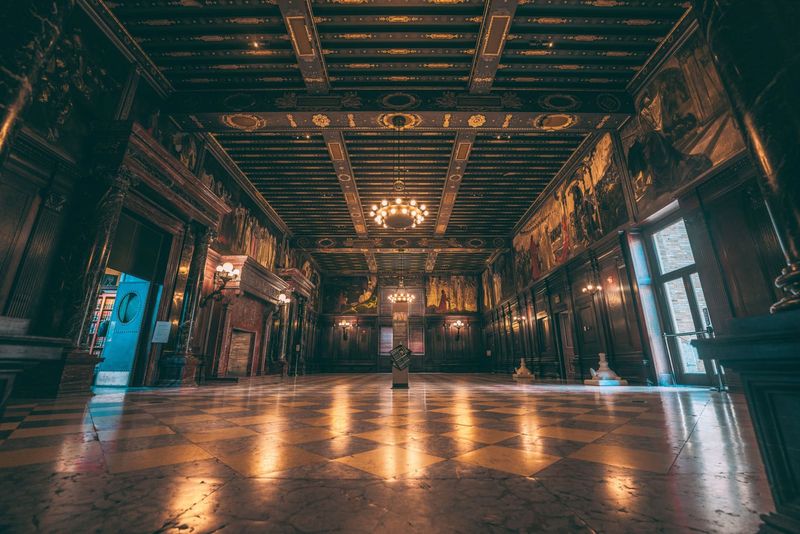
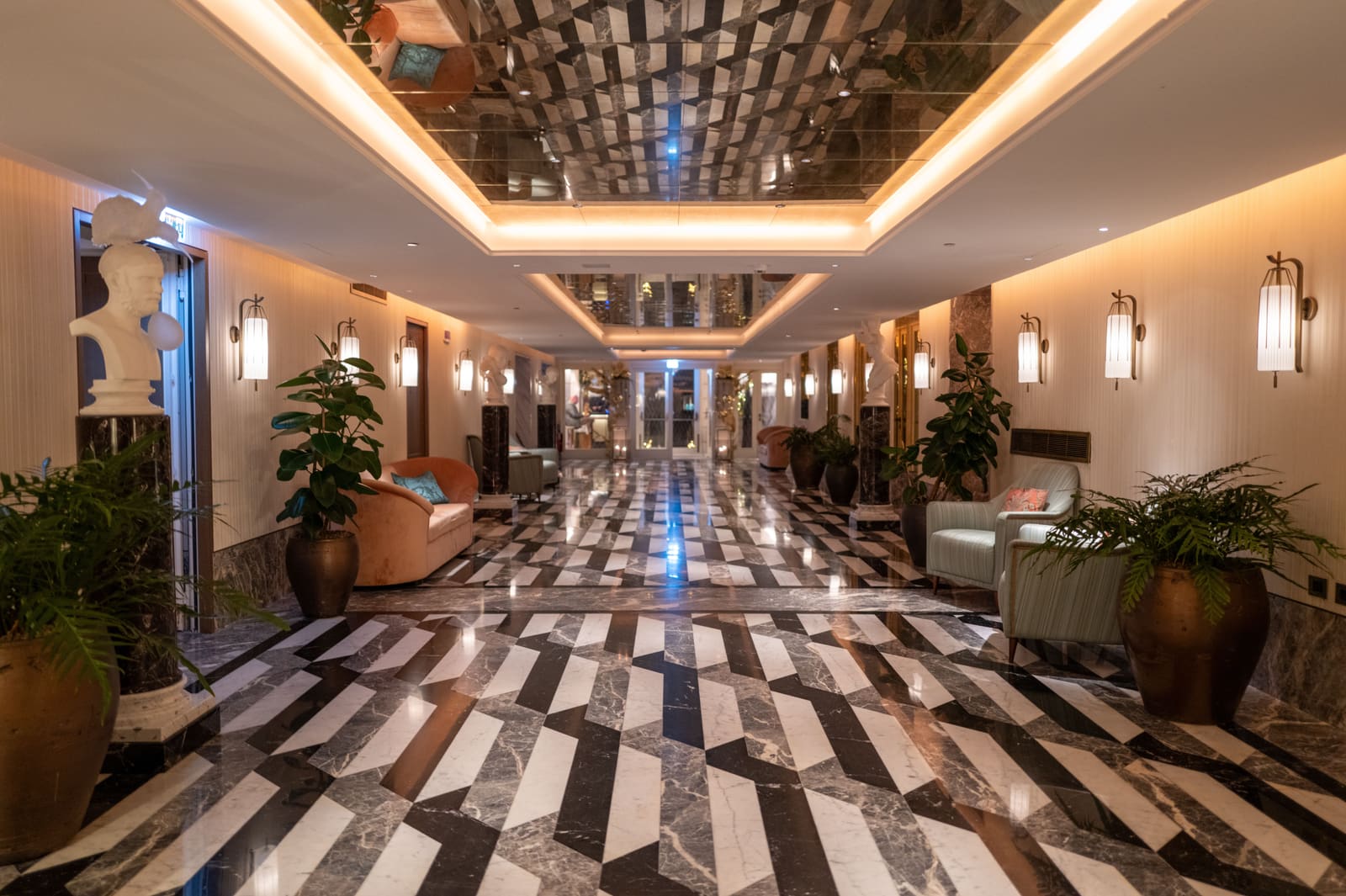
The doorway still bears the weight of institutional gravity: carved scrolls, Umbertine solemnity, the kind of entrance that once welcomed bankers in morning coats. Inside, however, the narrative shifts entirely. Ochre bleeds into terracotta, then into burnt orange, the walls changing hue every few metres as though lit by different stages of Roman sunlight. A geometric chandelier fashioned from chrome tubing hangs overhead, unmistakably 1970s, whilst bas-reliefs in the lobby conjure the city's ancient strata. This is Experimental Roma, the French hospitality group's largest project to date: 82 rooms carved into a former 19th-century bank in the Ludovisi district, where formality has been coaxed into something altogether more theatrical.
The Experimental Group built its reputation on Parisian cocktail bars before expanding into boutique hotels across Europe and the United States. Their Roman outpost, however, represents a departure in scale and ambition. Here, the group handed the entire vision to Rodolphe Parente, a Paris-based architect and interior designer tasked with reconciling the building's fortress-like DNA with the brand's irreverent sensibility. The result is a study in contrasts: a palazzo that honours its bones whilst embracing vaudeville spirit, a space where Bernini's sculptural legacy coexists with disco-era metal fringing.
Location as Narrative
The Ludovisi neighbourhood might seem an unlikely canvas for a brand that trades in youthful energy. Grand palazzos line the streets, interspersed with embassy buildings and financial institutions. Yet the district's apparent formality conceals a more layered character. Via Veneto, that tree-lined boulevard once thick with paparazzi and celebrity, lies five minutes to the right of the hotel entrance. The Spanish Steps are ten minutes in the opposite direction. The Trevi Fountain and Pantheon sit within a quarter-hour walk.
The streets radiating from the hotel pulse with a quieter vitality: elegant coffee shops where espresso is pulled with ceremony, father-and-son tailors whose workshops smell of wool and steam, jewellery ateliers where goldsmiths bend over their benches in full view of the pavement. Across the road, the Swiss Cultural Institute programmes contemporary art exhibitions, science lectures, and concerts. A stroll through Villa Borghese park leads to the Galleria Borghese, where Caravaggio's David with the Head of Goliath hangs alongside Bernini's Apollo and Daphne, their marble skin still impossibly alive after centuries.
Cinema as Blueprint
Parente spent three years on the project, much of it in Rome itself: walking, observing, collecting pieces. Cinema became his primary lens. Fellini's La Dolce Vita, filmed on nearby Via Veneto, offered its blurred boundary between life and spectacle. Pier Paolo Pasolini's grittier portraits of working-class Rome provided texture. Paolo Sorrentino's La Grande Bellezza contributed its sense of overwhelming, almost decadent beauty.
"I never translated a scene literally," Parente has noted. "It was about carrying an atmosphere, so that the hotel feels as if it had always been there and you could imagine American actors from the 1950s sipping a Negroni at the wood-panelled bar."
The colours he chose are hot and unabashedly Roman. Doorway arches and ceiling cornices echo the Palazzo Altemps. In the Ludovisi e Cadore restaurant, a cluster of globe lights mimics the flash of paparazzi cameras. The effect is kaleidoscopic without tipping into chaos: depth, drama, and a brash sense of fun held in careful balance.
Art also serves as narrative thread. Parente collaborated with Rome-based curator Maurizio Faraoni to weave the city's creative history into the interiors. Cy Twombly works, rooted in the artist's decades-long relationship with Rome, hang in the junior suite. Framed photographs document Christo and Jeanne-Claude's 1974 wrapping of a stretch of the Aurelian Walls at Porta Pinciana in fabric, an audacious intervention that married classical heritage with contemporary provocation. That spirit, classical design treated with irreverence and imagination, animates the entire property.
The Rooms: Theatre in Miniature
The 82 rooms vary in size and shape, but the design vocabulary remains consistent. Almost every element was conceived by Parente's studio and fabricated in Italy. Red and orange draped headboards, inspired by the Stanza degli Uccelli in Villa Medici, bring a theatrical flourish above the beds. Gold domed uplights evoke ancient Rome's architectural drama. Vanity tables in the bathrooms feature distinctive 1970s-style metal fringing, a disco-era wink.
Other pieces pay homage to Italian design masters. Each room contains a bespoke freestanding wardrobe-bar crafted from Formica, a nod to Ettore Sottsass's postmodern vocabulary. The gold-polished bedside tables recall the sculptural lounge furniture of Milanese designer Gabriella Crespi. Room 216, on the second floor, looks out towards the Swiss Institute's neon light installations and surrounding palms. Those seeking outdoor space might consider the junior suite with balcony or the deluxe terrace room, where Rome's rooftops unfold in layers of ochre and terracotta.
Dining as Performance
Ludovisi e Cadore, the hotel's restaurant, heightens the sense of being on a film set. Big banquette seating, marble tables, and gilded lamps create an atmosphere of mid-century elegance. Chef Giovanni Passerini's menu balances unmistakably Roman dishes with broader Italian and Continental influences. Trippa alla romana arrives in rich tomato sauce, its offal tenderness a testament to the city's nose-to-tail tradition. Fettuccine ai regaje features pasta ribbons slicked with giblet ragù. Beef tartare is served with chips, a Francophile flourish. Amberjack comes dressed with sesame and citrus, the fish's firm flesh offset by brightness.
The lunch menu runs shorter and more accessibly priced, with fried artichokes accompanied by mint sauce and mi-cuit mackerel paired with escarole and mustard vinaigrette. It is the kind of midday meal that rewards those who linger rather than rush.
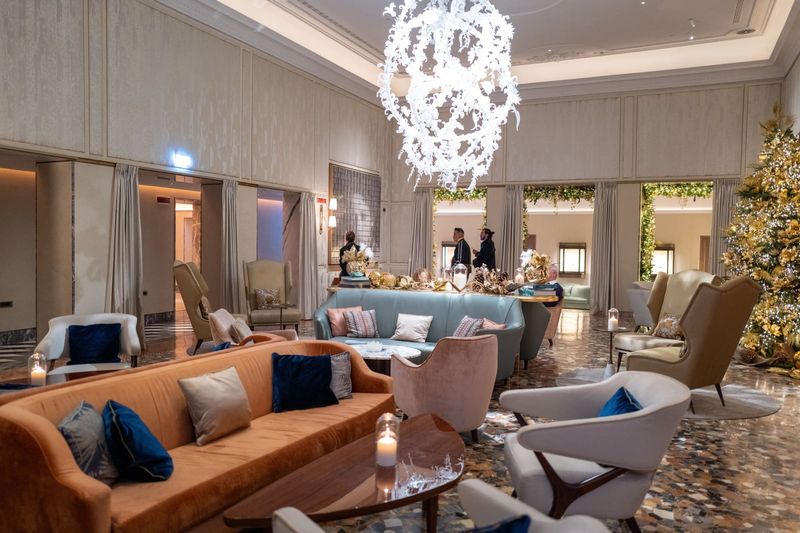
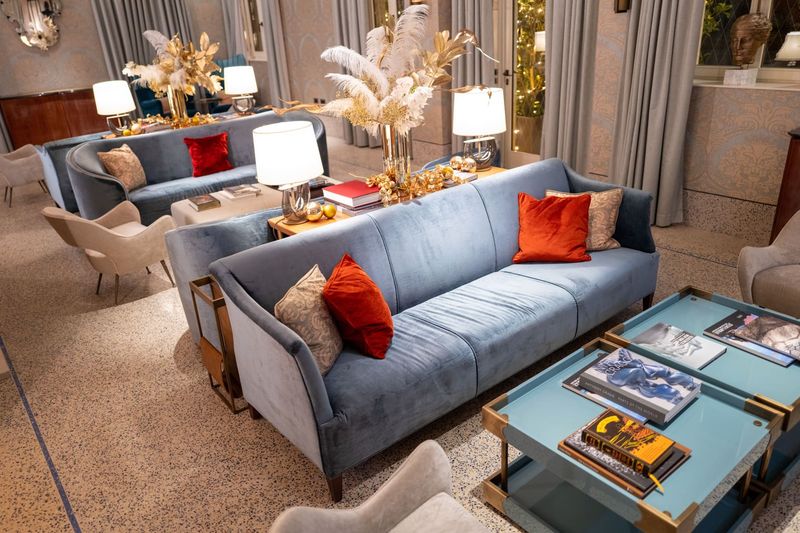
Tucked to the left of the entrance steps, the Experimental Cocktail Club channels Fellini's glitz in intimate quarters. Velvet lounges and marble tables are arranged beneath curtains draped just so over wooden windows. The signature cocktail list includes Experience No. 1, built on Puglian vodka, elderflower cordial, lemon juice, basil, and lemongrass. Bartender Luca Leone can also craft bespoke drinks tailored to individual preferences. Local wines, French champagne, and ales round out the drinks menu.
Bar snacks are executed with precision: slivers of fried bread topped with thick butter and Cantabrian anchovies, their salt and richness perfectly calibrated, and supplì, those deep-fried tomato and mozzarella rice balls that constitute a Roman street-food staple. Here, they arrive golden and molten, the kind of snack that makes a second round inevitable.
The Rooftop: An Urban Oasis
During the warmer months, the rooftop garden terrace becomes the property's social heart. An intimate swimming pool is ringed by cream-coloured sunbeds, whilst lunch is served at tables shaded by striped parasols. The setting feels both exclusive and unhurried, with sightlines stretching towards Villa Borghese and, in the distance, the Colosseum. It is the kind of space that invites long afternoons: a swim, a glass of something cold, the slow turning of pages in a novel.
The Synthesis
What Experimental Roma achieves is a delicate calibration. The inherent risk in assembling such a bold collection of colours, textures, and references is that the whole might fracture into pastiche or overwhelm the senses. Yet Parente's vision holds. The ochres and oranges feel native to Roman light. The 1970s chrome and disco fringing coexist comfortably with ancient bas-reliefs and Umbertine cornices. The Fellini glamour never tips into costume.
This is a hotel that understands Rome's elasticity: a city that is simultaneously museum and living organism, where antiquity and modernity occupy the same piazzas without contradiction. Experimental Roma does not attempt to resolve that paradox. Instead, it inhabits it, creating a space where a guest might sip a Negroni beneath a Twombly, then step outside to find goldsmiths bent over their benches in the afternoon sun. The city's layers become the hotel's layers, each one legible but never simplified.
In the Ludovisi district, where embassies and palazzos still project institutional authority, this former bank has been transformed into something altogether more generous: a stage set, a refuge, a love letter written in celluloid and velvet. It rewards those who arrive with curiosity rather than a checklist, who understand that luxury need not whisper when it can sing.