Where a Cambodian King Once Welcomed Guests, a Modernist Retreat Still Whispers
Behind a white wall in Siem Reap, a 1960s royal villa has been reborn as a sanctuary of terrazzo pools, monochrome suites, and the kind of silence that follows temple visits.
A Wall That Hides More Than It Reveals
The gate gives nothing away. Along the main road that leads towards Angkor, a long white wall runs unbroken, and behind it sits a villa that once hosted princes and dignitaries in an era when modernism meant something different in Cambodia. The building was commissioned in 1962, the work of French architect Laurent Mondet, who drew single-storey pavilions in white cement with stone accents and two pools shaped like nothing else in Siem Reap. It was called Villa Princière then, a state guesthouse for King Norodom Sihanouk, and it occupied a plot in the French Quarter where royal parks meet leafy boulevards.
Today the property is known by another name, and the suites number 24, and the columned corridors still frame views of frangipani and monstera. The city beyond the wall moves at the pace of tuk-tuks and night markets, but inside, the rhythm is slower, more deliberate, shaped by proximity to temples that predate the villa by eight centuries.
The Architecture That Chose Curves Over Columns
Mondet's design arrived at a turning point. The early 1960s saw Cambodian architects and their French counterparts experimenting with what became known as New Khmer architecture, a movement that rejected colonial pastiche in favour of expressive concrete, open-air pavilions, and curvilinear forms that responded to the tropical climate. Villa Princière exemplifies that shift: long covered walkways, minimal ornamentation, a circular dining room that once served the royal family between 1962 and 1965, and those two pools, their edges softened by decades of use.
The villa changed hands over the years, fell into disrepair, and was eventually restored in 2002. The most recent renovation, completed by Kerry Hill Architects, preserved the building's minimalist skeleton while updating interiors. Armchairs in the restaurant gave way to sweeping banquettes. The palette remains earthy: dusty browns, stark whites, bold blacks. In the suites, a touch of orange appears here and there, a nod to the saffron kasaya robes worn by Buddhist monks.
Five suites have been upgraded to include private swimming pools, and two new categories have been added: a Junior Pool Suite and a Two-Bedroom Family Pool Suite. The look is pared back, warmed by natural light, and careful not to tip into sterility.
Ten Minutes from Angkor, a Lifetime from Noise
The villa sits just ten minutes from the UNESCO-listed temples of Angkor, a proximity that shapes the rhythm of a stay. Most guests rise early, when the light is softer and the heat has not yet settled, to trace a "petit circuit" through Bayon, with its big-block carvings of smiling faces, or Ta Prohm, where enormous tree roots wind through mossy ruins. By mid-morning, they return to the villa's cool interiors and the ritual of cold towels scented with lemongrass.
Downtown Siem Reap is a short tuk-tuk ride away. The night market stirs up street food and cold bottles of beer. The Made in Cambodia Market and Kandal Village offer lacquered homeware, silk scarves, silverware. But the villa's design, and the service that comes with it, make it easy to stay put. For those who venture further, boat trips on the Amanbala vessels head out to the floating village of Chong Kneas on Tonlé Sap, Cambodia's largest freshwater lake, where life unfolds on water.
A Menu That Moves Between Continents
Breakfast arrives on an oversized menu that lists traditional Khmer dishes alongside avocado toast, chia pudding, and eggs cooked to order. Bor Bor Bangkear, a rice porridge with bean sprouts, spring onion, and stir-fried prawns, is worth trying. At dinner, the kitchen moves through Khmer salads such as pomelo with prawns or chicken with banana blossom, and plates of Cambodian beef lok lak, served with a fried egg, pepper sauce, and steamed rice. Western options include carbonara, pizza, and fish fingers for children.
The bar occupies a room that once served as King Sihanouk's personal dining space between 1962 and 1965. Retro photographs line the walls. Afternoon tea is served here. When the humidity drops, tables by the pool become the preferred spot for a pre-dinner drink. Cambodian gin comes with a tumbler of tonic for topping up.
Restoration as Ritual
The villa places as much emphasis on stillness as it does on activity. The spa offers four treatment rooms, a dedicated yoga studio, and therapies that weave together Khmer healing traditions with organic blends. The latest refresh introduces hydrotherapy facilities for the first time: hot and cold plunge pools, a sauna, and bespoke wellness journeys centred on restoration and recovery. The gym is compact but equipped with Technogym machines, and personal trainers are available with 24 hours' notice.
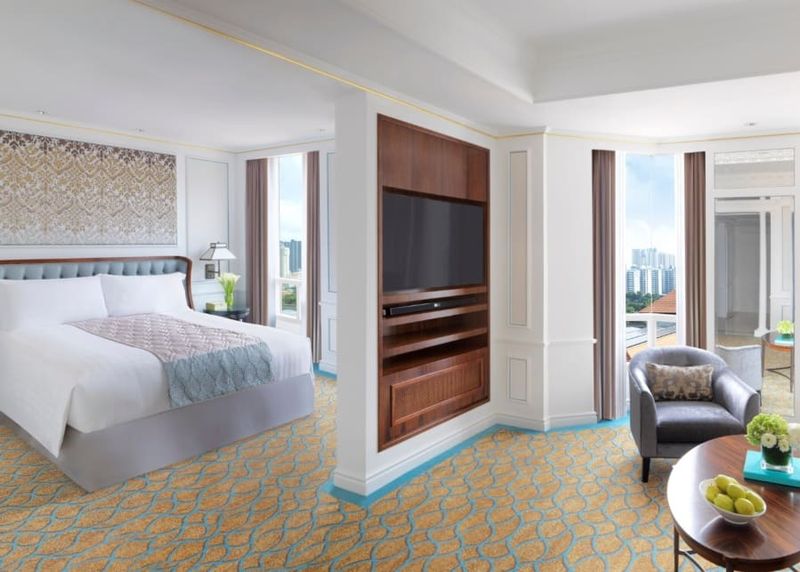
The suites follow a familiar monochrome scheme, with enough warmth to keep them from feeling too stark. The outdoor spaces, shaded by mature trees, are designed for lingering. The pools, with their time-worn edges, remain the heart of the property.
A Cocoon That Knows Its Place
Siem Reap is a city of contrasts: ancient temples and bustling markets, quiet lanes and honking motorbikes. The villa does not compete with any of it. Instead, it offers a retreat that honours its mid-century bones and the era in which they were built. The low-slung pavilions, the circular dining room, the pools that curve rather than corner - all of it feels like a deliberate act of preservation, a refusal to erase what came before in favour of something louder or newer.
For guests who come to Siem Reap for the temples, the villa provides a place to return to when the heat and the history become too much. For those who come for the villa itself, the temples are a backdrop, a reason to rise early and a reminder that some things outlast the structures built to honour them. Either way, the white wall along the main road keeps the noise at bay, and behind it, the rhythm remains unhurried.