Where Luxury Lives in Singapore
Between colonial grandeur and rainforest seclusion, a constellation of five-star sanctuaries rewrites the grammar of indulgence.
The Architecture of Escape
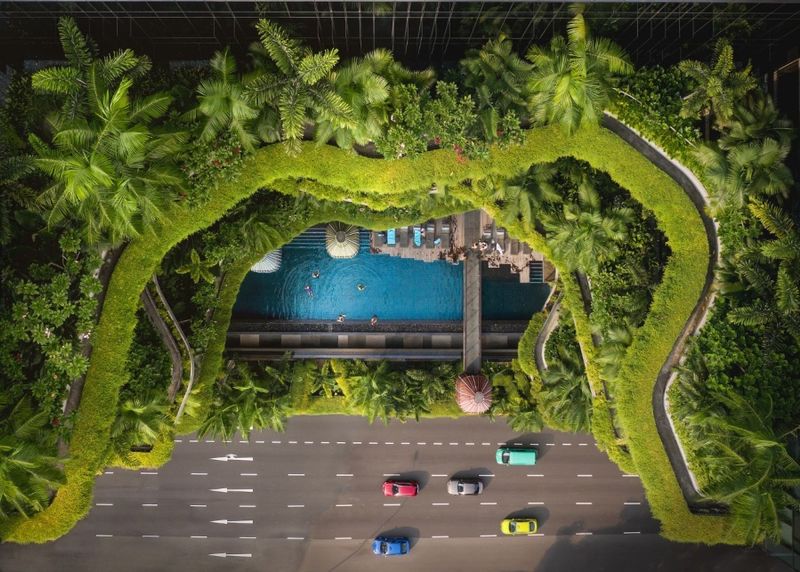
There is a moment, late afternoon on the Cloud Terrace at Pan Pacific Orchard, when the light slants through twelve thousand square metres of vertical greenery and the city below dissolves into something softer. The hotel earned its place on the Prix Versailles list of the world's most beautiful properties not through ostentation but through a careful choreography of steel, glass, and living plants. Four nature-inspired terraces ascend the twenty-three-storey facade, each one a distinct ecosystem. Forest gives way to Beach, Beach to Garden, Garden to Cloud. The cantilevered balconies jut out like suspended stages, framing views that oscillate between skyline and canopy.
This is architecture as argument: that luxury need not be sealed away from the natural world but can exist in conversation with it. The 343 rooms and suites include poolside lofts and balconied retreats where afternoon tea arrives with champagne, a ritual the hotel extends through the end of 2026 as part of its 'A Time to Chill' programme. The lagoon pool at the Beach Terrace has collected awards; the St. Gregory Spa offers treatments that feel less like maintenance and more like restoration.
Singapore has always understood that a great hotel is a form of urban theatre. What distinguishes the city's current crop of five-star properties is not opulence alone but the precision with which they calibrate experience. Some lean into heritage, others into design innovation. A few manage both.
Heritage as Living Medium
Frasers House, rebranded under the Luxury Collection banner, sits in Bugis where artisan guilds once clustered. The hotel does not merely reference this history; it weaves it into programming and decor. Peranakan motifs surface in bespoke furnishings across 406 rooms and suites. The Presidential Suite is opulent in the classical sense, but even the Classic Rooms carry traces of the neighbourhood's layered past. Complimentary walking trails and sensory journeys thread guests through the Sultan Mosque, Haji Lane, and the district's constellation of galleries. Bugis MRT station connects directly to the property, collapsing distance.
At Man Fu Yuan, Cantonese cuisine is refined without being precious. LUCE offers seafood and Italian plates that resist easy categorisation. The Lobby Lounge stages afternoon tea with cocktails inspired by the streets outside. Nearly a thousand square metres of event space accommodate gatherings that range from intimate to ceremonial.
The Fullerton Hotel occupies a different register of heritage. The building's prominence on the skyline is matched by its reputation, a structure so embedded in the city's visual lexicon that it functions almost as punctuation. The Loft Suites are two-storey duplexes with high ceilings, separate living and dining zones, and balconies that overlook the bay. These are not rooms but residences, scaled for lingering.
The Barracks Hotel on Sentosa inhabits a restored British artillery outpost. Leather furnishings, rattan accents, and marble tiles conjure colonial Singapore without pastiche. Poolside rooms open directly onto the water via balcony. Guided heritage tours unpack the island's military and social strata. The property understands that history is not a static backdrop but a medium that can be inhabited and interrogated.
The Geometry of Seclusion
Equarius Villas, tucked into Sentosa's rainforest fringe, operates on a different principle. The villas are surrounded by dense greenery, insulated from the island's tourist corridors. Rihanna stayed here in 2013, drawn perhaps by the same quality that defines the property now: a sense of remove. The free-form pool meanders through the landscape. Two-bedroom villas come with private lap pools. The architecture is low-slung, designed to defer to the canopy rather than compete with it.
Sofitel Singapore Sentosa Resort & Spa perches on a cliff above Tanjong Beach. The hotel marries Parisian sensibility with tropical context, a fusion that could tip into incoherence but instead achieves a kind of cosmopolitan ease. The Imperial Suite layers east-meets-west interiors with views that sweep 360 degrees across the South China Sea. The property's elevation grants it a vantage that feels both intimate and panoramic, a rare combination.
Urban Anchors
Four Seasons Hotel Singapore occupies a prime stretch of Orchard Boulevard, balancing accessibility with tranquillity. Two outdoor pools, an award-winning spa, and a fully equipped fitness centre anchor the property. The rooms are spacious, angled to capture either skyline or greenery. The Club suites, styled with colonial echoes, include full marble bathrooms and private bars. This is a hotel that understands the value of restraint, offering luxury without the need for constant declaration.
The St. Regis Singapore leans into maximalism. Crystal chandeliers, private art collections, and lush red fabrics create an atmosphere of deliberate grandeur. The property hosted Kim Jong Un during his 2018 summit visit, a testament to its geopolitical cachet as much as its hospitality. The presidential suite commands a premium, but the larger guest rooms and penthouses hold their own. The Drawing Room serves afternoon tea that has become something of an institution, a ritual that folds seamlessly into the Orchard Road experience.
The Ritz-Carlton, Millenia Singapore is perhaps best known for its views. Rooms are built around expansive windows that frame the Marina Bay skyline. Marble bathrooms feature palatial tubs positioned beneath those windows, a design choice that has generated countless Instagram posts. Colony, the hotel's restaurant, stages buffet breakfasts that capitalise on morning light. The property understands that in a city as vertical as Singapore, perspective is a form of currency.
New Narratives
The Clan Hotel, located in Far East Square, draws on the history of clan associations that once defined Cross Street in the 1800s. The neighbourhood has transformed from shophouses and docks into a district of skyscrapers and entertainment venues. The hotel positions itself as a space for kinship, a modern articulation of hospitality rooted in collective identity. Rooms are outfitted with bathtubs scaled for long soaks; the design language is contemporary but inflected with nostalgia.
Marina Bay Sands requires no introduction. The infinity pool on the fifty-seventh floor remains one of the most recognisable images in global hospitality. The SkyPark hosts Ce La Vi, a lounge and restaurant where cocktails are served against a backdrop that feels vertiginous. The property's wow factor is undeniable, but its location - central, connected, impossible to ignore - is equally significant. This is a hotel that functions as landmark, a piece of urban infrastructure as much as a place to stay.
The Calculus of Choice
What unites these properties is not a single aesthetic or philosophy but a shared commitment to specificity. Each hotel has identified a particular register of luxury and pursued it with discipline. Some offer seclusion; others, centrality. Some traffic in heritage; others, in innovation. The best among them understand that a five-star experience is not a checklist of amenities but a coherent argument about what hospitality can be.
Singapore's hotel landscape rewards curiosity. The city is compact enough that distances collapse, yet diverse enough that each district offers a distinct texture. Bugis feels different from Sentosa, Orchard Road different from Marina Bay. The hotels that thrive here are those that respond to their context rather than imposing a formula.
In a city where efficiency is often mistaken for the whole story, these properties remind us that luxury is also about time - the permission to linger, to notice, to let a moment stretch. Whether that moment unfolds on a cantilevered balcony above Orchard Road, in a cliffside suite overlooking the South China Sea, or in a heritage suite where history is not preserved but lived, the architecture of escape remains the same: a threshold crossed, a world remade.