Fifty-Three Generations at the Foot of Fuji
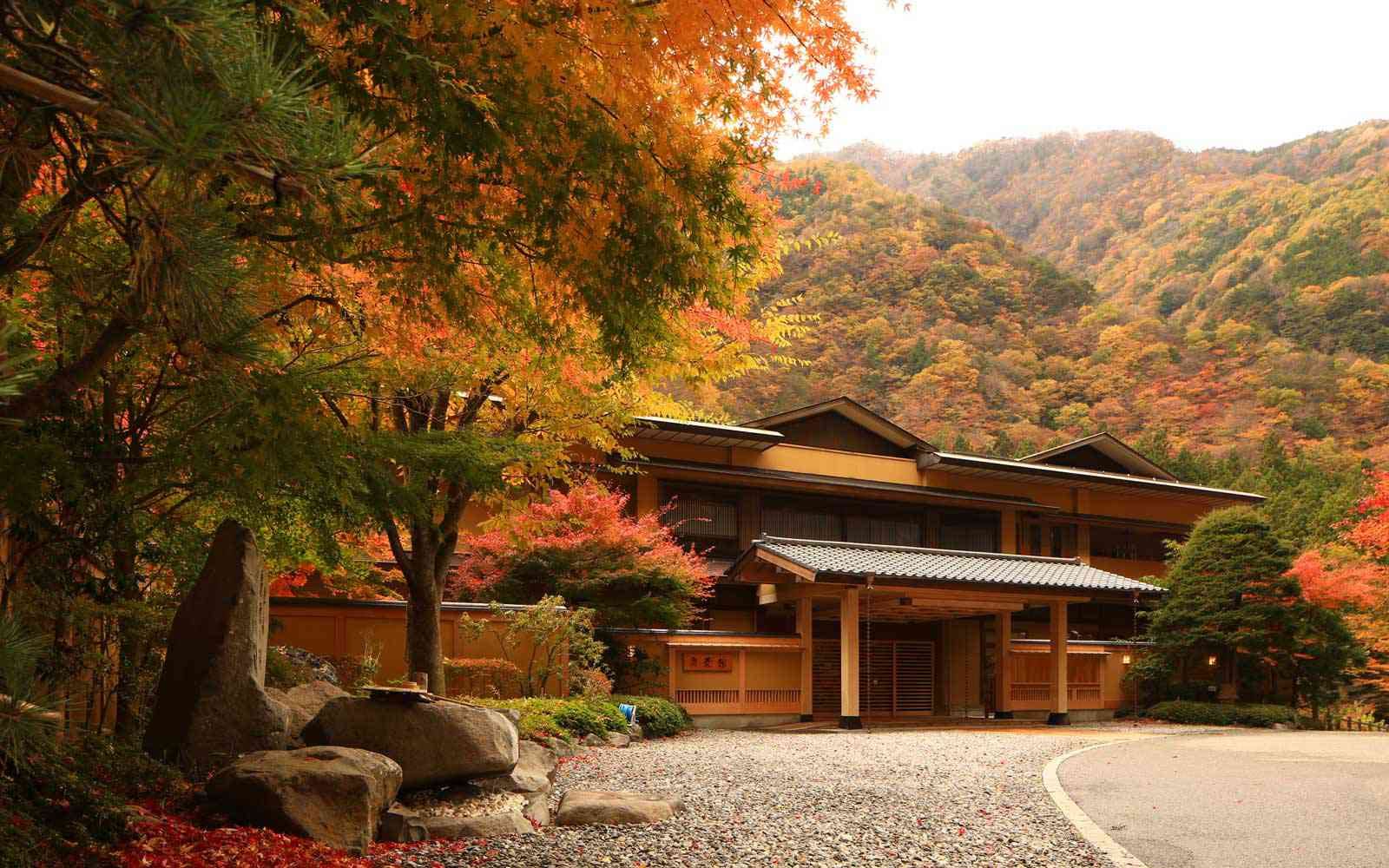
Inside Nishiyama Onsen Keiunkan, where hospitality has flowed unbroken since the seventh century.
The Measure of Time in Mineral Water
There is a particular quality to thermal water that has been running through the same channels for thirteen hundred years. At Nishiyama Onsen Keiunkan, tucked into the mountains of Yamanashi Prefecture within sight of Mount Fuji's snow-draped shoulders, the springs emerge at the same temperature today as they did when the Fujiwara clan first claimed this pocket of forest in 705 CE. The ryokan that grew around those springs has remained in continuous operation ever since, its stewardship passed down through fifty-three generations of a single family, making it the oldest hotel in continuous operation anywhere on earth.
The arithmetic is almost incomprehensible. Fifty-three generations means that when the current proprietors tend to guests, they do so under the weight of more than a millennium of inherited knowledge about how to fold a yukata, how to time the serving of kaiseki courses, when to replenish the wooden buckets in the bathing rooms. It means that the recipes for certain pickles have been refined across centuries, that the placement of stones in the garden has been deliberated by ancestors who lived before the Crusades, before the Mongol invasions, before the printing press.
What Endures
The architecture itself has been rebuilt many times. Earthquakes, fires, and the ordinary entropy of wood and paper structures have required periodic renewal. But the site remains constant, and with it the orientation of the main building toward the mountain, the path from entrance to bathing pavilion, the relationship between interior and exterior space that defines traditional Japanese hospitality. The current structure, while incorporating modern safety standards and discreet climate control, adheres to principles of spatial arrangement that predate the shogunate.
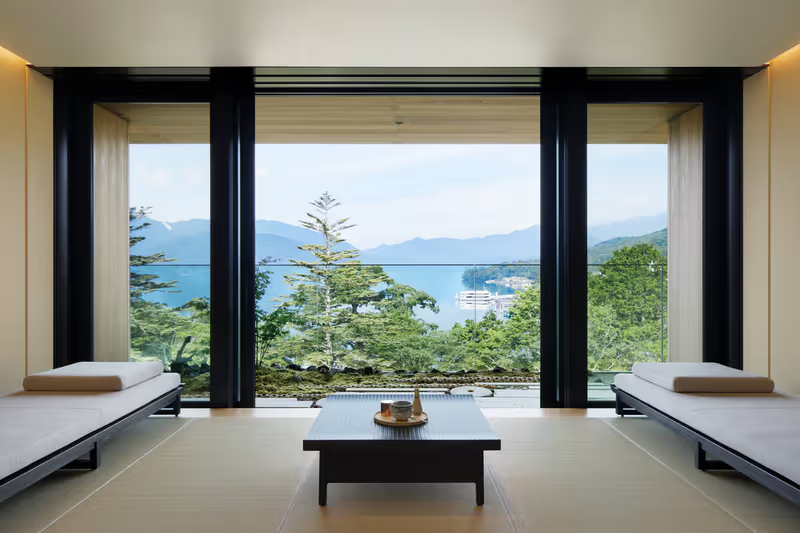
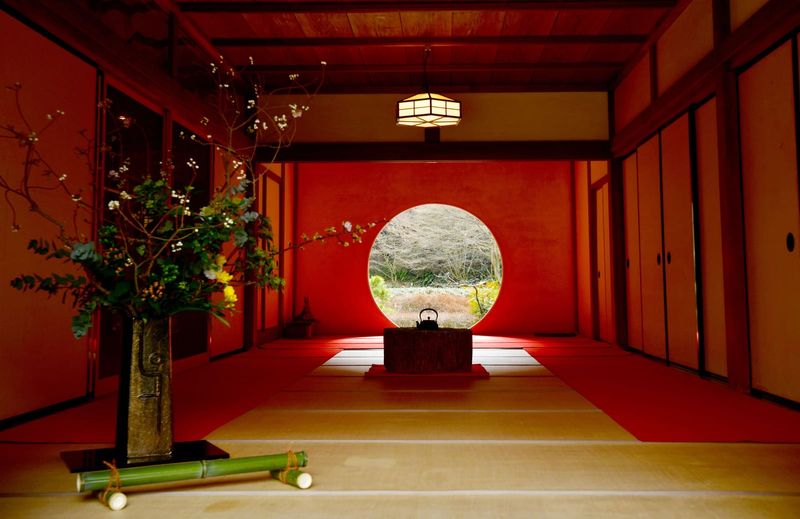
What has been preserved is not a museum but a living practice. Guests still arrive by winding mountain roads, still remove their shoes at the threshold, still move through rooms where the only ornamentation may be a single scroll and a branch of seasonal foliage. The onsen baths remain the heart of the experience, fed by the same geothermal aquifer that first drew pilgrims and travelers to this remote location more than a thousand years ago.
The Physics of Continuity
Family succession in Japan follows patterns distinct from Western primogeniture. The ie system, which prioritizes the continuity of the household over strict bloodline inheritance, has allowed Nishiyama Onsen Keiunkan to adapt across eras of dramatic social change. When no biological heir was suitable or available, the family adopted successors, sometimes from branch families, sometimes from talented apprentices who married into the line. The result is a form of institutional memory that is both genetic and cultural, a hybrid inheritance that privileges skill and dedication over mere lineage.
This flexibility has been the engine of survival. Through the isolationist Edo period, the Meiji modernization, the devastation of the Second World War, and the subsequent economic transformations of contemporary Japan, the ryokan has remained operational by calibrating tradition with pragmatism. Rooms now include subtle electrical outlets and WiFi, though these concessions are tucked behind shoji screens. The kaiseki meals still follow seasonal rhythms, but accommodate dietary restrictions that previous centuries would not have contemplated.
The Geography of Seclusion
Yamanashi Prefecture sits in the embrace of mountains, a landscape of steep valleys and volcanic soils. The region's hot springs are a byproduct of the same tectonic restlessness that built Mount Fuji, and the mineral content of the water at Nishiyama Onsen Keiunkan is said to benefit circulation and ease muscle tension. Whether the therapeutic claims are empirically validated matters less than the ritual of immersion itself, the act of lowering oneself into water that has traveled through deep stone, heated by the planet's core.
The ryokan's remoteness, once a barrier to all but the most determined travelers, has become an asset in an age of overtourism. There are no tour buses idling outside, no crowds queuing for selfies. The journey itself becomes a filter, selecting for visitors willing to trade convenience for authenticity. The roads narrow as they climb, the air cools, the noise of contemporary life recedes.
What Guests Inherit
To stay at Nishiyama Onsen Keiunkan is to participate, however briefly, in a continuum. The tatami mats beneath bare feet have been woven using techniques refined over centuries. The wooden tubs in the bathing rooms are replaced when necessary, but their dimensions and joinery follow templates older than any living craftsperson. The meals arrive in lacquerware that may be new but is indistinguishable in form from pieces used by travelers in the Kamakura period.
This is not cosplay or historical reenactment. It is the persistence of a way of being that has found a narrow ecological niche in the modern world, sustained by visitors who seek not novelty but depth, not stimulation but stillness. The ryokan does not advertise itself as the world's oldest hotel. That designation, conferred by Guinness World Records, is a fact it neither hides nor exploits. The longevity is simply the outcome of doing the same thing well, without interruption, for longer than most nations have existed.
The Inheritance of Attention
Fifty-three generations is not merely a number. It represents a chain of teachers and students, each link forged through years of observation and imitation. The current proprietors learned from their predecessors not through manuals or training seminars, but through the daily repetition of tasks: how to greet a guest, how to arrange a meal, how to maintain the quality of the bathwater. This knowledge is largely tacit, embedded in muscle memory and aesthetic judgment rather than written down.
In an era of rapid obsolescence, where business models are disrupted and entire industries vanish within a generation, Nishiyama Onsen Keiunkan stands as a counterexample. Its survival suggests that certain forms of value are durable precisely because they change slowly, because they are rooted in place and practice rather than scalability and innovation. The ryokan will never franchise. It will never go public. It will, in all likelihood, continue to welcome guests one small group at a time, for as long as the springs flow and the family line continues.
The mountain will still be there. The water will still rise from the earth, heated and mineral-rich. And somewhere in the quiet rooms, a guest will lower themselves into a wooden tub, aware or unaware that this simple act has been repeated, in nearly the same way, for more than thirteen centuries.