Where the Vines Meet the Bed: Seven Wine Estates That Teach You to Read Terroir
The best vineyard stays offer more than a glass and a view. They immerse you in harvest rhythms, winemaking decisions, and the singular logic of place.
The Vines Resort & Spa, Uco Valley, Argentina
The Andes rise in a jagged silver line beyond the vineyards, their peaks still streaked with snow even as the February heat ripens Malbec clusters on the vine. At The Vines Resort & Spa, the landscape is less a backdrop than a participant. The resort occupies 1,500 acres in the Uco Valley, subdivided into hundreds of privately owned parcels where would-be vintners from Sydney, São Paulo, and Stuttgart tend their own rows and make their own wine. The project began in 2005 as an experiment in distributed winemaking, and it has since become a living laboratory for anyone curious about the decisions that separate one bottle from another.
The WineCamp programme runs during harvest, late February through April. Guests pick grapes alongside the vineyard crews, hand-sort fruit on steel tables, taste fermenting juice straight from the tanks, and climb barefoot into shallow bins to stomp clusters into pulp. The day ends with an asado cooked over open wood fires, the smoke drifting across the vines as the sun drops behind the mountains. Outside harvest season, a blending session allows you to taste barrel samples and hand-bottle your own Uco Valley cuvée, adjusting proportions of Malbec, Cabernet Franc, and Merlot until the balance feels right.
Les Sources de Caudalie, Bordeaux, France
The idea of vinotherapy began here, in the vineyards of Château Smith Haut Lafitte, where the family that owned the estate noticed that the hands of grape harvesters remained unusually soft despite weeks of manual labour. Les Sources de Caudalie opened in 1999 as the world's first Vinothérapie Spa, a wellness concept built around grape polyphenols, vine sap, and the crushed seeds left over from pressing. Treatments include barrel baths infused with red-vine extract, crushed Cabernet scrubs, and wraps made from grape marc.
The spa is the most visible expression of the estate's philosophy, but wine threads through the rest of a stay as well. La Grand'Vigne, the hotel's two-Michelin-starred restaurant, pairs its menu with Bordeaux and beyond, and guests can arrange private tours of Château Smith Haut Lafitte's cellars and production spaces. The estate itself is a Graves Pessac-Léognan Grand Cru Classé, producing both Cabernet Sauvignon-led reds and whites built on Sauvignon Blanc and Sémillon.
Four Seasons Resort and Residences Napa Valley, California
Rows of Cabernet Sauvignon vines thread between the guest rooms at Four Seasons Resort and Residences Napa Valley, planted in 2001 and farmed organically long before the resort opened in 2021. Elusa Winery sits just steps from the main building, making this one of the few luxury hotels in Napa where you can walk from your room to a working crush pad in under a minute.
The vineyard tours here are not performative. Guests can follow the winemaking process from vine to barrel, taste samples drawn directly from French oak, and participate in a blending experience that involves adjusting proportions of different lots until the final wine feels balanced. Those dining at Auro, Calistoga's only Michelin-starred restaurant, can expect a seven-course tasting menu paired with wines selected by the resort's beverage team. Throughout the year, Auro also hosts six-course winemaker dinners built around notable Napa producers.
Rosewood Castiglion del Bosco, Montalcino, Italy
The estate at Castiglion del Bosco has been producing Brunello di Montalcino since the early 1900s, and in 1967 it became one of the 25 founding members of the consortium established to protect the wine and codify its production standards. At the time, Brunello was still a relatively obscure regional expression of Sangiovese; today it is one of Italy's most tightly regulated and prestigious reds.
The property spans nearly 5,000 acres of woods, farmland, olive groves, and vineyards, with 153 acres devoted to Sangiovese. The winery remains on-site, a short walk from the hotel's suites and restored farmhouse villas. Guests can tour the cellars, taste barrel samples, and learn about the five-year ageing requirement that distinguishes Brunello from other Tuscan reds. The estate's own wines are poured at the hotel's restaurant, where the menu follows the seasons and the philosophy of the surrounding countryside.
Mont Rochelle, Franschhoek, South Africa
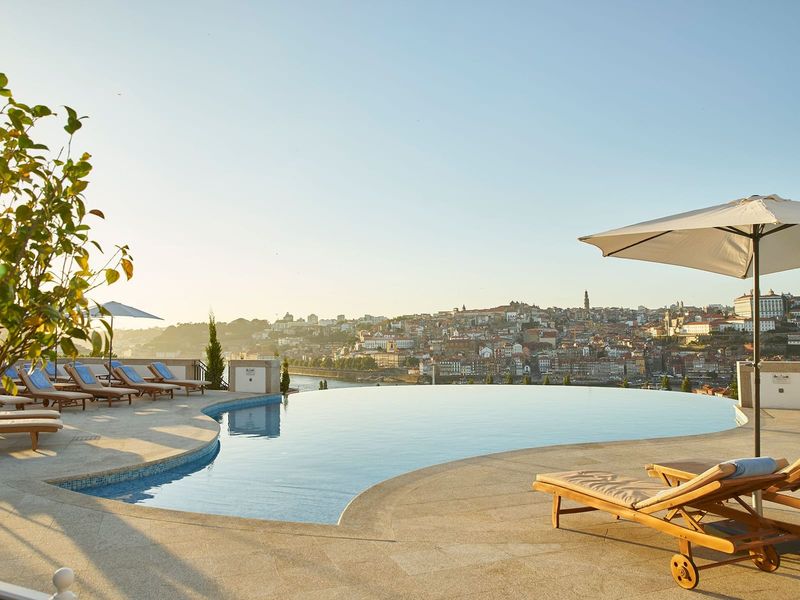
The Franschhoek Valley unfolds below Mont Rochelle in a patchwork of vineyards, orchards, and Cape Dutch farmhouses, the mountains rising steeply on either side. The 26-room hotel sits above the estate's own vineyards, which produce Sauvignon Blanc, Chardonnay, Syrah, and Cabernet Sauvignon. A pool overlooks the vines, and terraces are positioned to catch the afternoon light as it moves across the valley floor.
The wine programme offers both casual tastings and more structured encounters. Complimentary vineyard and cellar tours run daily, followed by tastings of the estate's portfolio. Private sessions for up to eight guests take place in the cellar, surrounded by bottles and barrels. On select dates, winemaker Michael Langenhoven leads a tour through the historic 1850s cellar before a five-course dinner designed to pair with Mont Rochelle wines.
Hotel Marqués de Riscal, Rioja Alavesa, Spain
Frank Gehry's titanium-clad hotel rises above the vineyards and stone cellars of Marqués de Riscal like a sculpture dropped into the Rioja countryside. The winery itself was founded in 1858 and helped introduce Bordeaux-style winemaking techniques to the region, becoming one of Rioja's most influential producers. The contrast between the historic cellars and Gehry's contemporary architecture is deliberate, a conversation between tradition and experiment.
The hotel offers a five-day winemaking masterclass that follows a vintage from harvest to blending. Guests pick grapes with the vineyard team, spend time in the laboratory and production spaces, and create a personalised blend that continues ageing in French oak after they leave. Eventually, 40 custom-labelled bottles are shipped home. The experience also includes vineyard lunches, rare vintages, a 16-course dinner, and a candlelit meal in the historic cellars.
The Wine House Hotel at Quinta da Pacheca, Douro Valley, Portugal
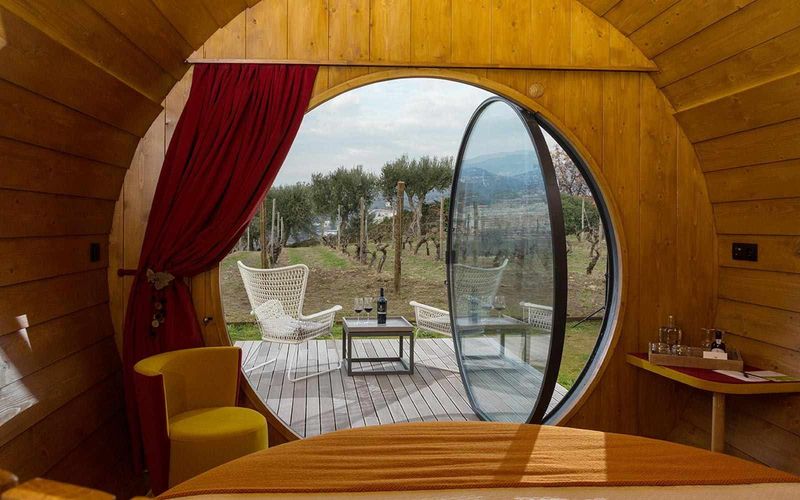
Quinta da Pacheca has been making wine in the Douro Valley for centuries, its terraced vineyards climbing the steep hillsides above the river. The hotel occupies an 18th-century manor house surrounded by vines, but its most recognisable rooms are enormous barrel-shaped suites set directly among the rows. The design is playful, yet the setting is serious: Pacheca remains a working winery producing both Douro table wines and port.
During the autumn harvest, guests can join the winery team in the vineyards to pick grapes, then climb barefoot into the traditional stone lagares used to crush them. The day includes a harvest lunch and a tour of the production spaces, offering an introduction to the labour-intensive methods that still define much of the Douro's winemaking. Even outside harvest season, wine remains central to a stay here, with cellar tours, tastings, and grape-based spa treatments available year-round.
Royal Champagne Hotel & Spa, Champagne, France
The hotel sits above the Marne Valley, looking out over the vineyard-covered hillsides that form part of Champagne's UNESCO World Heritage landscape. Royal Champagne does not produce its own wine; instead, it functions as a gateway into the region's network of grandes maisons and small family-run producers. The hotel's Guest Experience Makers arrange visits to both, tailoring itineraries to match your level of interest and experience.
The three-day One Day, One Grape programme digs more deeply into Champagne's principal grape varieties through visits and meetings with winemakers. Each day focuses on a single variety: Chardonnay, Pinot Noir, or Meunier. Even the guest rooms acknowledge the region's obsession: press the "Champagne Please!" button on the phone and a selection of cuvées can be delivered to your door, ideally to drink on a terrace overlooking the vines.
Why These Estates Matter
The properties on this list share a common characteristic: they do not treat wine as a luxury amenity to be consumed passively. Instead, they invite you into the process, whether that means picking grapes in Mendoza, stomping fruit in the Douro, or adjusting the proportions of a blend in Napa. In doing so, they reveal what terroir actually means, not as an abstract concept but as a series of choices made in response to soil, climate, slope, and tradition.
Wine tourism has expanded rapidly over the past two decades, but much of it remains superficial: a tasting, a tour, a bottle to take home. The estates above offer something different. They slow you down, involve you in the work, and teach you to read the landscape the way a winemaker does. By the time you leave, the wine tastes different, not because the liquid has changed but because you understand what it took to make it.