Where to Stay in Porto When the River Calls
From hilltop palaces to waterfront hideaways, Portugal's second city has perfected the art of wine-soaked hospitality.
The River Remembers Everything
Stand on any terrace overlooking the Douro at dusk and you will understand why travelers return to Porto with the devotion of pilgrims. The river bends through the city like a sentence mid-thought, its surface catching the last light while azulejo-clad buildings stack themselves against the hillside in defiant, beautiful disorder. This is not a place that whispers. Porto announces itself in tile and granite, in the clatter of cobblestones under foot, in the amber pour of fortified wine that has traveled down this very river for centuries.
At Global Chic Voyage, we have watched Porto transform from Portugal's gritty, undervalued sibling into a destination that understands luxury as something earned, not simply gilded. The hotels that matter here are not trying to erase the city's industrial past or its working-port soul. They are, instead, in conversation with it.
A Palace Built from Architectural Memory
Ricardo Severo constructed his yellow-walled residence in 1904 as a deliberate catalogue of Portuguese design, room by room. Walk through Palacete Severo today and you are reading a three-dimensional essay on the country's stylistic evolution: tile patterns from the south, woodwork echoing northern manor houses, stained glass that recalls Lisbon's Belle Époque confidence.
Designer Paulo Lobo restored the property with a light hand, adding twenty rooms in the original structure and a second building across the garden without overwhelming Severo's original thesis. Chef Tiago Bonito, who earned a Michelin star at Largo do Paço, now leads the kitchen here alongside sommelier Sara Godinho. The menu does not chase trends; it grounds itself in the Douro Valley's agricultural calendar and the Atlantic's daily catch.
French gallerist Géraldine Banier layers contemporary art throughout the interiors, creating a productive tension between the 20th-century ornamentation and the work of living artists. The spa relies on plant-based Olivier Claire products. The courtyard bistro, lined in traditional tile, serves lunch under a canopy of vines. This is a property that refuses to choose between preservation and progression, understanding that both can coexist if you respect the architecture's original voice.
The Center Holds, Playfully
Location always matters, but in Porto it matters more. The Editory Boulevard Aliados occupies two buildings facing the grand Avenida dos Aliados and the nightlife-dense Rua do Almada, positioning guests at the city's gravitational center. Local studio Ding Dong designed interiors that reject the usual heritage-hotel solemnity: sunshine-yellow walls, mint-green ceilings, velvet headboards with scalloped edges, red rotary telephones that may or may not connect to the front desk.
The sixty rooms feel like a knowing wink at mid-century optimism, complete with rubber ducks in the showers. In spring 2026, the hotel opened Gio Party & Pasta, an Italian concept with circus-themed murals by Portuguese artist Sofia Torres. On Friday and Saturday evenings, performers move among the tables while a DJ spins lounge sets. The energy is unserious in the best sense, a counterpoint to Porto's more reverential dining rooms.
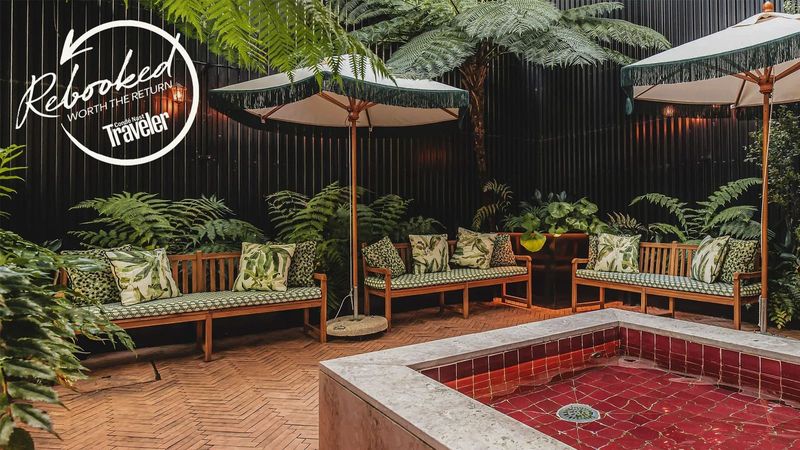
Outside, a black stone-lined heated pool offers a place to reset between excursions into the winding streets of Rua das Flores and the Ribeira District. The Editory understands that not every traveler wants to feel the weight of history pressing down on them at all hours.
The Five-Star Original
Entrepreneur Delfim Ferreira opened Infante Sagres in 1951 as Porto's first five-star hotel, and the property still carries that inaugural confidence. A modern restoration in 2024 by local firm Nano Design refreshed the interiors while preserving the intricate wooden paneling and tilework that made the hotel a landmark. The design draws inspiration from Luís Vaz de Camões, Portugal's greatest poet, though the connection is more atmospheric than literal.
Three sumptuous drawing rooms anchor the ground floor, each furnished with jewel-toned sofas and enough seating to accommodate a small literary salon. An elevated courtyard now holds a plunge pool and sundeck, additions that feel inevitable rather than forced. The eighty-five rooms vary in layout and decor, many featuring bold murals that offset crisp white linens. Breakfast unfolds in an ornate dining room or, in warmer months, across an internal courtyard.
Scarlett Wine & Food serves lunch and dinner with a menu that leans into local tradition: bolinho de bacalhau, the codfish cakes that appear on every respectable Portuguese table, and a wine list that reads like a Douro Valley syllabus. Turismo de Portugal still recognizes Infante Sagres as a five-star establishment, a designation that matters more here than in countries where stars are distributed with less rigor.
Across the River, a Wine Education
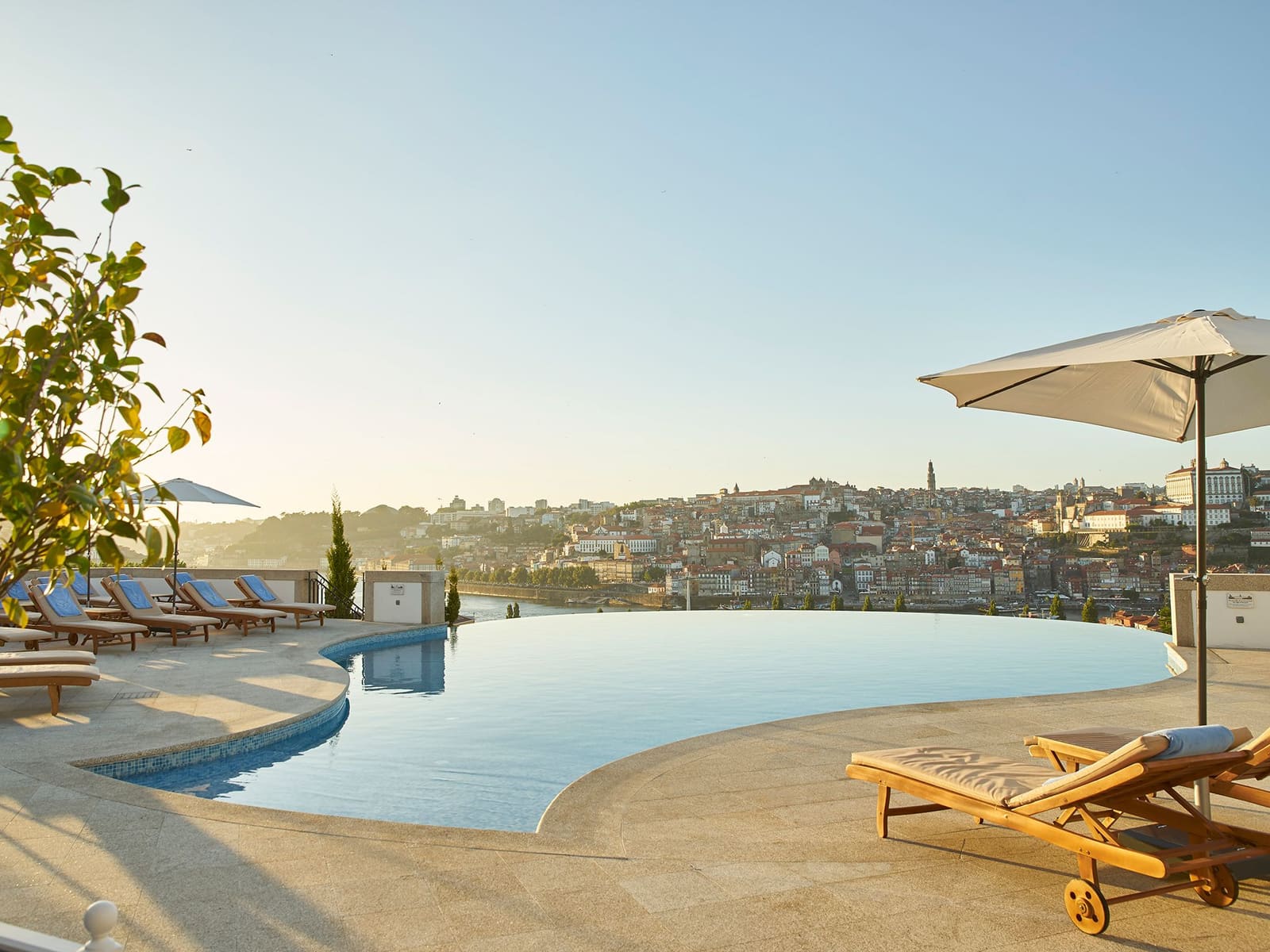
Vila Nova de Gaia is technically a separate municipality, but the distinction feels academic when you are standing on the terrace at The Yeatman, looking back across the Douro at Porto's layered skyline. The hotel arranges itself down the hillside in six stories, each floor stepping back to preserve views from every room. The decanter-shaped pool and terrace function as the property's visual signature, a place where the city becomes a panorama rather than an immersive experience.
Wine is not an amenity here but a philosophy. Images of vineyards line the walls. A cellar is available for tours between 4 p.m. and 6 p.m., and the staff approaches port education with the seriousness of sommeliers who have spent years in the Douro Valley. The Michelin-starred restaurant translates traditional Portuguese flavors through contemporary technique, a balance that requires confidence and restraint in equal measure.
For travelers who want proximity to Porto's port cellars without surrendering river views, The Yeatman offers an ideal vantage. You are close enough to walk to the city's historic center via the Dom Luís I Bridge, but far enough to return to a quieter, more contemplative atmosphere.
History You Can Sleep In
Casa da Companhia sits mid-block on Rua das Flores, one of Porto's most iconic pedestrianized shopping streets. Merchant nobleman Brás Brandão built the structure in the 16th century as a family home; it later served as headquarters for Real Companhia Velha, the port company. Staff honor this lineage with a bi-weekly "fire opening" of a port bottle, a theatrical ritual that doubles as an informal history lesson.
The design negotiates between the building's Renaissance bones and contemporary hospitality expectations. Gold-paneled windows and mirrors appear in all rooms, paired with minimalist furnishings and large marble bathrooms. Cathedral-view rooms offer a lookout over the city's sacred architecture; garden rooms provide a quieter, more introspective setting.
The outdoor swimming pool overlooks the cathedral, a juxtaposition that feels quintessentially Porto: sacred and secular, ancient and modern, all compressed into a single sightline. The restaurant occupies a space with terra-cotta walls and backlit wine shelves, serving fresh, local food that does not try to reinvent the region's culinary traditions so much as execute them with precision. The spa offers a retreat from the pedestrian traffic outside, though the building's thick stone walls already provide considerable acoustic insulation.
The Palace That Loved Literature
The Torel Palace dates to 1861 and reopened in 2020 after a careful restoration that preserved the original staircase and a stunning skylight. The family who built the palace reportedly loved literature, and the library bar pays homage with books appearing to fly off shelves toward the ceiling, a whimsical installation that could tip into kitsch but instead reads as genuine affection for the written word.
The newly opened French-style patisserie is named Florbela, after Portuguese poet Florbela Espanca, continuing the literary thread. Twenty-four rooms occupy the building, each balancing period features with modern comforts. The suites take a bold approach, placing giant mirrored bathrooms in the center of the room rather than tucking them away. Chandeliers hang by the outdoor pool, refracting sunlight in a way that feels more festive than ostentatious.
Restaurant Blind, a tribute to Portuguese writer José Saramago's novel Blindness, offers a ten- or twelve-course "Emotions" menu created by chef Vítor Matos. Each dish draws from childhood memories, a deeply personal framework that could feel inaccessible but instead invites diners into a sensory autobiography. This is cooking as narrative, and it requires the kind of sustained attention that Porto, at its best, demands.
A Corner Room on the Oldest Square
Gran Cruz House occupies a corner of one of Porto's oldest squares, overlooking the Douro with the confidence of a building that has seen centuries of river traffic. Seven boutique bedrooms spread across four floors, each inspired by a different port wine. The Pink Room evokes summer with bright colors and playful patterns, opening onto a balcony above the square. Three rooms face the square; the rest look out over the river.
The restaurant, Casario, is the property's anchor. Under chef Miguel Castro Silva, one of Portugal's most respected culinary voices, the menu divides into cold dishes and hot dishes rather than following conventional course structures. Salt codfish prepared gomes de sá-style arrives in a casserole with potatoes and vegetables. Sea bass comes with fennel orange sauce, a pairing that honors the country's Atlantic and Mediterranean influences.
The scale here is intimate, the kind of hotel where staff learn your name within hours and the breakfast room feels like a private club. For travelers who want to be embedded in Porto's historic core without sacrificing design or dining, Gran Cruz House offers a rare combination of location and culinary ambition.
Industrial Heritage, Reimagined
The Rebello sits on a bend in the Vila Nova de Gaia waterfront, past the docked Rabelo port boats that inspired its name. The hotel occupies four industrial buildings reimagined by interior designer Daniela Franceschini and brand designer Nat M. Waterman, transforming factory spaces into one hundred and three apartment-style suites. Each unit is clad in concrete, fitted with kitchens, and decorated with art by Portuguese makers.
River-view rooms create the illusion of floating on the Douro, a perspective that shifts depending on the time of day and the river's mood. The kitchens are functional, but the ground-floor restaurant Pot & Pan deserves attention. The name nods to the building's past as a kitchen utensils factory, and the menu reinterprets traditional Portuguese dishes with contemporary technique. Upstairs, rooftop bar Bello serves drinks and food with a more global outlook, though the real draw remains the sweeping view.
A wellness center and spa anchor the property, accessible through a wheat field that feels transported from the countryside. Treatment rooms, a gym, a sauna, and other amenities provide a counterbalance to the urban energy of Porto across the river. The Rebello appeals to travelers who want the autonomy of an apartment with the services of a hotel, a hybrid model that works particularly well for longer stays.
Why the River Still Calls
Porto's hospitality has matured without losing its rough edges. The city's best hotels understand that luxury here is not about erasure or smoothing over the past. It is about amplification, bringing the region's wine culture, architectural heritage, and culinary traditions into sharper focus. These properties do not compete with Porto; they collaborate with it, offering travelers a place to pause, pour another glass, and let the river's story become their own.