Where Ritual Meets Refuge: Indonesia's Most Coveted Sanctuaries
A new ranking reveals the archipelago's retreat landscape, where volcanic stone, rice-terrace vistas, and ancient Balinese cosmology still anchor hospitality.
The Measure of a Sanctuary
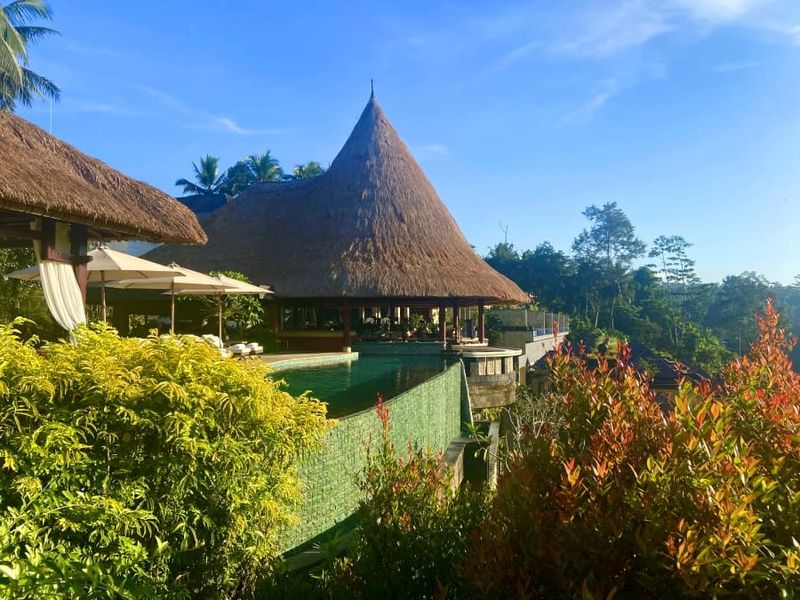
There is a pavilion in Ubud where the floor is polished teak, the roof is thatch bound by generations of the same family's hands, and the view frames nothing but the crowns of coconut palms and the distant ridge of Campuhan. No television. No mirror. Just the slow metronome of a ceiling fan and the smell of frangipani carried on air so humid it feels like cloth. This is not minimalism by subtraction but by intention, a spatial logic older than the resort that contains it.
The 2026 Readers' Choice Awards, an annual survey of tens of thousands of travellers, has once again turned its lens on Indonesia. The results sketch a hospitality landscape where volcanic stone, rice-terrace vistas, and the cosmological geometries of Balinese architecture remain central to how people define luxury. Ten properties emerged at the summit, their scores clustering within a single percentage point, a statistical whisper separating first from tenth. What they share is less a stylistic signature than a willingness to let place dictate form.
The Leaders
Mandapa, a Ritz-Carlton Reserve in Bali, claimed the apex with a score of 99.78. Positioned along the Ayung River in Ubud, the property integrates terraced rice paddies, a bamboo forest, and a village temple into its 60-villa layout. The architecture follows traditional Balinese spatial hierarchies: open-air pavilions oriented to cardinal directions, courtyards that serve as thresholds between public and private, and water features that reference the subak irrigation system still governing the island's agricultural rhythm.
Just beneath it, Raffles Bali scored 99.77. Perched on a Jimbaran Bay clifftop, the resort comprises 32 freestanding villas, each with a private pool and butler service. The design vocabulary here is more contemporary, employing floor-to-ceiling glass and travertine, yet the spatial planning still defers to the Balinese concept of tri hita karana, the harmony between human, nature, and the divine. Guests arrive through a sequence of courtyards and water gardens that slow the transition from road to residence.
The St. Regis Bali Resort in Nusa Dua followed at 99.76. The beachfront property, which opened in 2008, introduced the butler-for-every-suite model to the island and has maintained it through successive ownership changes. Its 123 suites and villas are set within gardens designed to mimic the layered canopy of a Balinese forest, with the beach accessed through a lagoon-style pool that occupies nearly two hectares.
The Ubud Contingent
Two properties in the central highlands underscored Ubud's enduring pull. The Laguna, a Luxury Collection Resort & Spa in Nusa Dua, took fourth place with 99.73, whilst COMO Uma Ubud secured sixth at 99.44. The latter, a 46-room hillside retreat, was among the first international brands to establish a foothold in Ubud in the early 2000s. Its design, by Singapore-based COMO Hotels and Resorts, emphasised natural materials, open pavilions, and a spa programme rooted in Ayurvedic and Indonesian healing traditions. The property also pioneered farm-to-table dining in the region, sourcing vegetables from its own organic garden and neighbouring smallholdings.
Ubud's appeal has always been layered. It is the island's cultural heartland, home to royal courts, dance troupes, and artisan guilds. But it is also a landscape of extraordinary verticality, where rivers carve deep gorges and rice terraces climb slopes in emerald staircases. The best properties here do not fight the topography; they inhabit it, building into hillsides rather than atop them, using elevation not for dominance but for perspective.
Cliff, Coast, and Hinterland
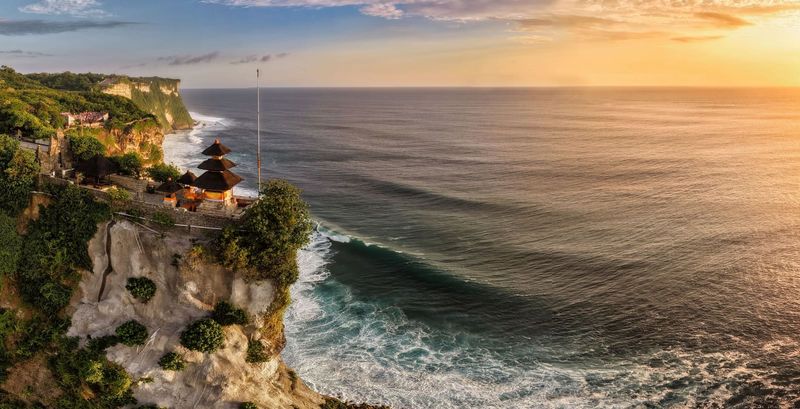
Alila Villas Uluwatu, ranked fifth with 99.49, occupies a limestone plateau on Bali's southwestern tip. Designed by Singapore's WOHA Architects, the resort is a study in horizontal planes and negative space, its pavilions and infinity pools cantilevered over a 100-metre drop to the Indian Ocean. The architecture here is unapologetically modern, yet it engages local craft: terrazzo floors incorporate Javanese river stone, timber screens reference traditional gebyok panels, and the resort's signature cabana pods, perched at the cliff edge, are clad in alang-alang grass thatch.
The Apurva Kempinski Bali, seventh at 98.85, takes a different tack. Located in Nusa Dua, the property is a contemporary interpretation of a Javanese water palace, with fountains, reflecting pools, and a multi-tiered lobby that recalls the royal compounds of Yogyakarta and Solo. The aesthetic is maximalist, leaning into gilded detail and grand scale, a counterpoint to the pared-back modernism prevalent elsewhere on the island.
Beyond Bali
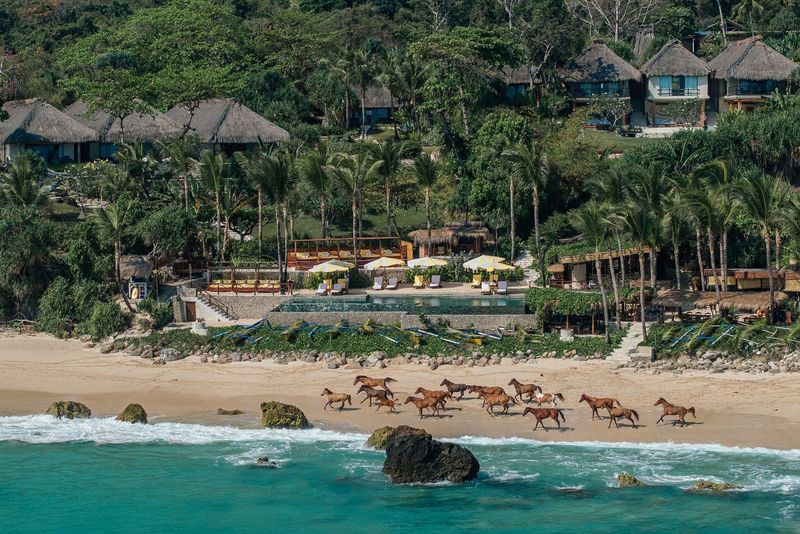
Two properties remind travellers that Indonesia's hospitality landscape extends well beyond its most famous island. NIHI Sumba, ranked eighth with 98.6, sits on the remote southwestern coast of Sumba, a three-hour flight east of Bali. The resort, which began as a private surf retreat in the 1980s, has become synonymous with a particular strain of barefoot luxury: thatched villas with plunge pools, open-air dining pavilions, and a near-total absence of technology. The property works closely with the Sumba Foundation, funding schools, clean water systems, and malaria-prevention programmes across the island.
Hotel Indigo Bali Seminyak Beach and Mulia Resort, ninth and tenth respectively, represent the more accessible end of the spectrum. Both are in Seminyak and Nusa Dua, areas developed for beach tourism in the 1970s and 1980s. They lack the dramatic topography or cultural immersion of the higher-ranked properties, but they offer proximity to Bali's international airport, extensive dining and spa facilities, and the kind of large-scale infrastructure that appeals to families and groups.
What the Numbers Reveal
The clustering of scores within a single point suggests that at this tier, differentiation is less about service standards, which are uniformly high, than about alignment between property and guest expectation. A traveller seeking cultural immersion will find it in Ubud; one after surf and solitude will head to Sumba; those prioritising convenience and beach access will choose Nusa Dua or Seminyak.
What unites the list is a shared commitment to place-making that goes beyond décor. These properties do not simply occupy land; they interpret it, translating local material culture, spatial traditions, and ecological context into a hospitality language that feels both rooted and refined. The stone is Balinese paras, not imported marble. The wood is teak from Java or ironwood from Kalimantan. The spatial logic follows centuries-old principles of orientation, hierarchy, and flow.
The Larger Context
Indonesia's tourism industry has spent the past decade recalibrating after a series of disruptions: volcanic eruptions, pandemic closures, and shifting visa regulations. The archipelago now receives approximately 15 million international visitors annually, with Bali accounting for nearly half. The government has signalled plans to develop alternative destinations, including Lombok, the Gili Islands, and parts of Sumatra, in an effort to distribute economic benefit and reduce pressure on Bali's infrastructure.
Yet Bali's dominance in this ranking is not accidental. The island has a mature hospitality ecosystem, a deep bench of trained staff, and a cultural infrastructure that has been welcoming outsiders for more than a century. It also has the regulatory frameworks, supply chains, and international connectivity that make large-scale resort development feasible. Replicating that elsewhere in the archipelago will require more than marketing; it will require decades of investment in roads, airports, water systems, and training institutions.
The Architecture of Arrival
One thread running through these properties is the choreography of arrival. At Mandapa, guests cross a suspension bridge over the Ayung River before entering the lobby. At Alila Uluwatu, the approach is a long, low-slung corridor that opens suddenly onto a cliff-edge vista. At NIHI Sumba, arrival is by boat or light aircraft, followed by a drive through villages and savannah. These sequences are not incidental; they are designed to create a sense of transition, a gradual shedding of the outside world.
This attention to threshold is deeply Balinese. Traditional compounds are entered through a candi bentar, a split gate that marks the boundary between profane and sacred space. Inside, a low wall called an aling-aling blocks the direct sightline, forcing visitors to turn and slow down. The best resorts borrow this logic, using landscape, architecture, and even sound to modulate the experience of entering.
Craft as Infrastructure
Several properties on the list have invested in preserving and transmitting local craft. Raffles Bali collaborates with artisans in nearby Celuk and Mas, commissioning silverwork and wood carving for its interiors. COMO Uma Ubud supports a cooperative of weavers in Tenganan, one of Bali's oldest villages, known for its double-ikat geringsing cloth. The Apurva Kempinski employs stone carvers from the village of Batubulan to maintain its exterior reliefs.
This is not philanthropy dressed as hospitality; it is a recognition that luxury, in this context, is inseparable from the continuity of knowledge. A resort can import Italian linens and French champagne, but it cannot import the accumulated skill required to carve a temple door or dye a length of silk using natural indigo. Those capacities exist only where they are practised, and they disappear when the economic incentive to practise them vanishes.
The Question of Scale
The properties on this list range from 32 to 123 rooms, a scale that allows for personalisation but also limits accessibility. A 60-villa resort can offer private butlers and bespoke itineraries; it cannot accommodate the volume required to make luxury hospitality a mass phenomenon. This tension between exclusivity and accessibility runs through Indonesia's tourism strategy. The government wants more visitors, more revenue, more jobs. But the properties that win international accolades are, by design, small, expensive, and selective.
There is no easy resolution. Larger resorts can achieve efficiency and lower per-night costs, but they often sacrifice the spatial generosity and craft detail that define the upper tier. The challenge is whether Indonesia can develop a mid-market hospitality model that retains some of the design intelligence and cultural engagement of its luxury leaders without requiring three-figure nightly rates.
What Endures
The 2026 ranking captures a moment, but it also reflects continuities. Several properties on this list have appeared in similar surveys for more than a decade. Mandapa, Raffles Bali, and The St. Regis Bali have maintained their positions through changes in ownership, management, and market conditions. This consistency suggests that the fundamentals, location, architecture, service culture, remain more durable than trend cycles or marketing campaigns.
It also suggests that Indonesia's appeal as a retreat destination is not subject to the volatility that affects other categories of travel. Business travel fluctuates with economic cycles. City tourism is vulnerable to political instability. But the desire for a well-made room in a beautiful place, where the architecture acknowledges its context and the service feels generous rather than intrusive, appears to be a constant. These properties have built their reputations on delivering exactly that, year after year, without drama or reinvention.
The pavilion in Ubud is still there, the teak floor still polished, the fan still turning. The view has not changed. Neither has the logic that placed the room where it is, oriented the way it is, built the way it is. That continuity, more than any score, is what keeps people coming back.