When Horses Become Healers: A Week of Ceremony and Release on Sumba
At the edge of Indonesia's wildest island, equine intuitive Candice Webster leads a retreat that asks travelers to surrender to the ancient intelligence of horses.
The Horse That Refused to Be Still
The session cannot begin. Hannah, a horse who has been limping all week from a leg infection, is suddenly electric with movement. She gallops circles in the sand school, her earlier lethargy completely vanished. The equine healer watches, unsurprised. Her husband stares, incredulous. This is not the same animal they've been observing for days. Something invisible has shifted in the air, and the horse has responded first.
At Global Chic Voyage, we've long understood that luxury travel's most profound moments resist tidy packaging. A private butler, an infinity pool overlooking turquoise swells, these are pleasures easily catalogued and replicated. But what unfolds in a sand ring at the edge of the Indonesian island of Sumba, where a horse begins to mirror emotions you haven't yet acknowledged, belongs to a different order of experience entirely.
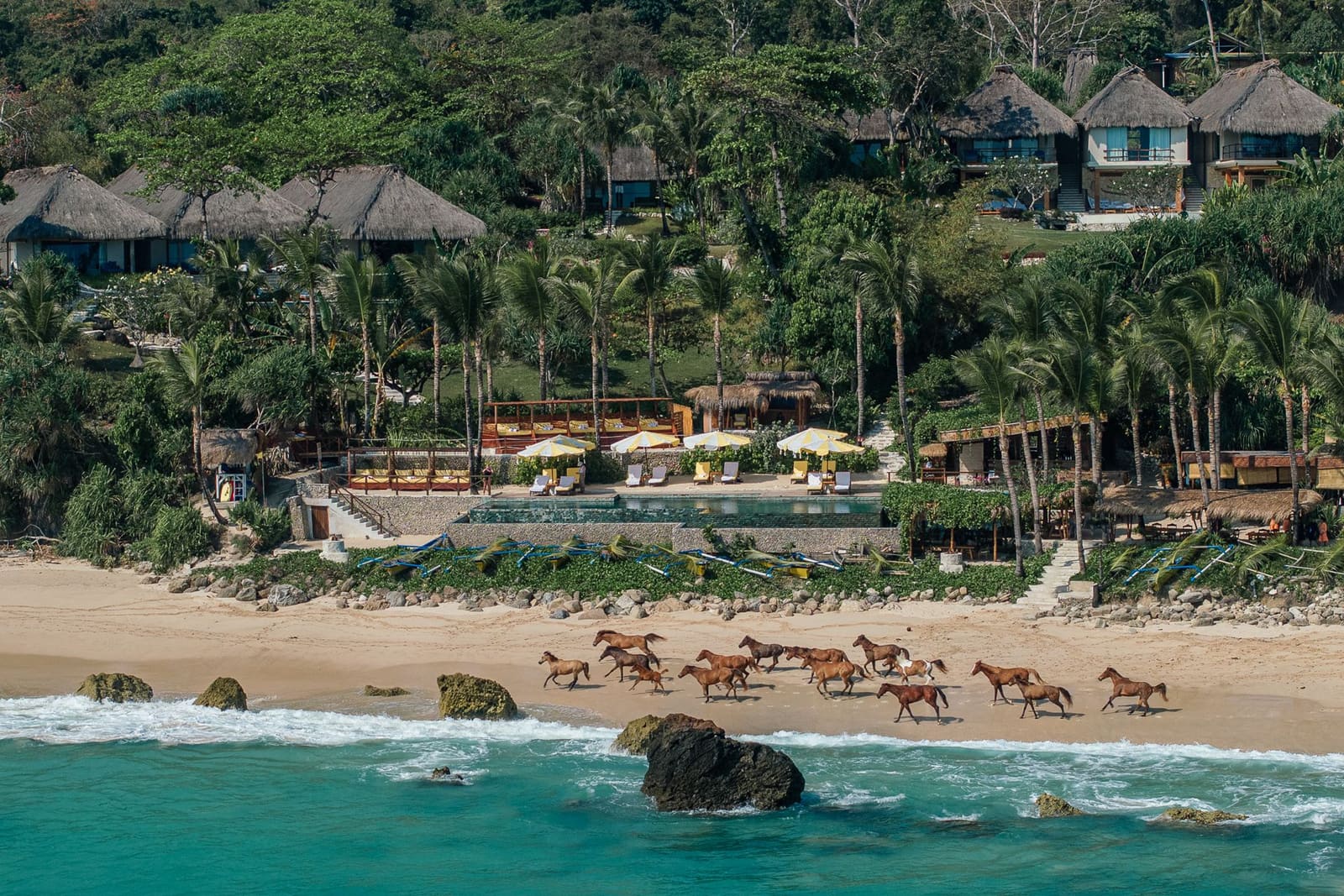
Nihi Sumba has built its reputation on world-class surf breaks and cinematic beach rides, drawing guests to its stretch of wild coastline where dense jungle gives way to blinding white sand. Yet the property's first collaboration with South African equine intuitive Candice Webster marks a departure from conventional resort programming. This is not horse yoga repackaged with a wellness gloss. This is ceremony, conducted in a valley where emerald hills cascade toward the sea and rescued horses are rehabilitated in a sanctuary an hour's ride from the main property.
The Practice of Reading Energy
Candice Webster arrives at Nihi with a reputation forged at her ranch in South Africa, where clients travel vast distances for what she calls "the medicine." Her Instagram following numbers over one million. Her work incorporates reiki, chakra healing, and the energetic presence of horses, whose behavior she interprets as a reflection of human emotional states. She has never conducted sessions outside her home ranch before. She has had no need.
The horses at Nihi's Nihioka sanctuary are not props. They are rescue animals, many bearing the scars of neglect, rehabilitated with the intention of eventual rehoming. Hannah, the galloping mare, was expected to pass away soon when the retreat group first met her. Today she moves with inexplicable vitality. Nicky, a younger horse with a mischievous streak, joins the session. He nibbles at hands, nudges objects, eats a hibiscus flower placed for ceremony. Webster observes his playfulness and notes what she perceives: a strong, playful energy from the person standing before him.
Then the tears begin. Not delicate, controlled weeping, but the kind of release that arrives unbidden and refuses to stop. Webster remains calm. She will go as deep as necessary, she says. She has consulted what she calls the dragons, and Mother Gaia. In any other context, this language might feel performative. But here, in a valley where the sound of waves carries faintly across the distance and the light falls in a particular slant through the palms, skepticism gives way to something more porous.
The Island Where Horses Bridge Worlds
To understand what happens in Webster's sessions, one must first understand Sumba itself. The island remains remarkably undeveloped, a 90-minute drive from the airport winding through dense tropical foliage before the landscape opens onto Nihi's dramatic shoreline. The property's tagline, "the edge of wildness," is not hyperbole. This is a place where day-old turtles wobble into the sea at sundown, where local boys race Sandalwood ponies bareback down the beach as the sky turns pastel, where farmers usher water buffalo into the shallows at dusk.
Horses hold a position of profound reverence here. In Marapu, the island's ancestral animist religion, these animals are not livestock but sacred vessels, living bridges between the human realm and the ancestral spirits. When a relative dies, the burial ritual involves the sacrifice of prized water buffalo, pigs, and horses to feed the mourning community and clear the path to the afterlife. Every drop of blood serves dual purpose: honoring creator spirits and transforming the animals into spiritual beasts of burden that carry the deceased's soul and earthly wealth into the ancestral realm. The Marapu faithful call horses "untamed nobles."
This cosmology saturates the island. To work with horses on Sumba is to engage with the very pulse of the place, its history and belief system made flesh. Nihi's onsite horse whisperer, Carol Sharpe, has overseen the equine program since 2013, leading mindfulness sessions and explaining the role horses have played in Sumbanese life for generations. She dedicates much of her energy to the sanctuary, rescuing neglected animals. Her own retreats, offered on request, incorporate beach rides, horse yoga, and early morning treks as the herd moves over misty sands to higher grazing grounds.
Webster's collaboration with Nihi weaves these elements together, but her ceremonies occupy a different register. They are not about riding or even touching horses in a conventional sense. They are about proximity, about what happens when a highly sensitive animal stands close enough to read the micro-expressions of your body and, in Webster's framework, the frequency of your unspoken grief.
What the Horses Unearth
The ceremony proceeds. Webster moves her hands over each chakra in turn, speaking in what she calls light language, a stream of unintelligible syllables. When she reaches the chest, the tears intensify. At one point, a great heat radiates from the feet, though Webster's hands are not making contact. The sensation is undeniable. The explanation, elusive.
Western wellness culture has a well-documented tendency to commodify spirituality, to strip sacred practices of context and repackage them as resort amenities. The critiques of Ayurveda's whitewashing are familiar and warranted. Yet what unfolds in the sand school resists easy aestheticization. Yes, Nihi offers extravagant indulgence: open-air massages, villas with two butlers, surprise rose-petal baths for no occasion. But the emotional release that occurs during Webster's sessions feels distinct from the cumulative effect of pampering. It is rawer, less transactional, harder to dismiss as the predictable result of relaxation and beauty.
Equine therapy has gained traction in recent years, with practitioners pointing to horses' profound sensitivity to body language and emotion. As prey animals, horses evolved to read the smallest shifts in breathing, posture, tension. They do not care about job titles or carefully rehearsed narratives. They respond to what is present, not what is performed. Whether one believes they detect something deeper, some energetic field beyond the visible, they have an uncanny ability to invite presence.
In another session with Carol Sharpe, a large bay Sandalwood horse named Hunter initially shies away from touch. The directive is to send him away by spinning a lead rope, a gesture that feels counterintuitive and uncomfortable. But within thirty minutes, Hunter follows untethered, stopping and starting and turning left and right under hands-free direction. Sharpe's interpretation is straightforward: if you can direct a horse, you can direct your own life. The metaphor is almost too tidy, yet the sensation of being followed by a thousand-pound animal responding to invisible cues is undeniably potent.
The retreat also includes a full moon gathering on the beach where guests share stories with surprising vulnerability. Strangers become confidants in a matter of days. There is something about the setting, the horses, the permission to let go of composure, that accelerates intimacy. Perhaps it is simply the luxury of being truly seen, a commodity rarer than marble bathtubs or private pools.
The Evidence Left in Sand
When Webster finishes working on the crown chakra, tapping the third eye, the neck, the head, or perhaps not tapping at all but only seeming to, Nicky gently rests his nose on the recipient's hair. The ceremony concludes. Webster surveys the sand ring. What was once smooth is now a chaos of craters. Hannah and Nicky have wheeled around and around, digging deep into the ground. The physical manifestation of excavation is startling. Old feelings, exhumed and released into the Indonesian daylight.
The crumpled papers covered in frantic scrawlings, all the negativity meant to be left behind, are set alight in a bowl. The smoke rises. The embrace that follows feels earned, not performative.
At sunset, the local boys gallop bareback down the beach on their Sumba ponies. Waves rear up twenty feet high before thundering onto the shore. A farmer ushers his buffalo herd into the shallows. The sky is painted in pastels. The scene is almost absurdly beautiful, the kind of tableau that risks sentimentality. Yet the emotional residue from the day's ceremony lends it weight. This is not simply a picturesque sunset. It is the closing of a ritual that began with a restless horse and ended with something like catharsis.
The Medicine of Being Witnessed
We return often to the question of what constitutes transformative travel. It is not merely the accumulation of stamps in a passport or nights spent in architecturally significant rooms. It is the willingness to be changed by a place, to allow its particular history and spiritual geography to penetrate the armor we carry. On Sumba, where horses serve as both companions to the living and guides for the dead, Webster's retreat mirrors that ancient respect. She trusts the animals to lead people toward parts of themselves they struggle to reach alone. Sharpe has dedicated years to rescuing those that have been neglected, honoring their capacity for healing even as they themselves are healed.
The medicine Webster speaks of may ultimately be the simplest and most elusive thing: the experience of being truly witnessed. You do not need to believe in energy fields or chakras or the dragons Webster claims to consult. You need only to believe in the power of a living creature responding to your unguarded self, in a place where that exchange is considered sacred rather than transactional. In a culture that prizes performance and curation, the opportunity to stand vulnerable before an animal that cannot be fooled is its own form of luxury, one that cannot be bought outright but only earned through surrender.
The horses at Nihi take a daily swim in the ocean, their dark bodies moving through turquoise water, manes slicked back. It is an image that lingers: the wildness, the care, the recognition that healing is not always gentle but often necessary. At the edge of the world, where the jungle meets the sea and ancient beliefs still shape the rhythm of life, a retreat unfolds that asks travelers to trust not just in the competence of guides or the comfort of accommodations, but in the intelligence of horses who have been reading human emotion for millennia. What they unearth is not always easy. But it is, perhaps, exactly what was needed all along.