Where Luxury Meets the Jungle Canopy in Bali
From cliffside sanctuaries to riverine retreats, the island's most exclusive resorts have mastered the art of disappearing into nature without sacrificing a single indulgence.
The Valley Where Kings Once Ruled
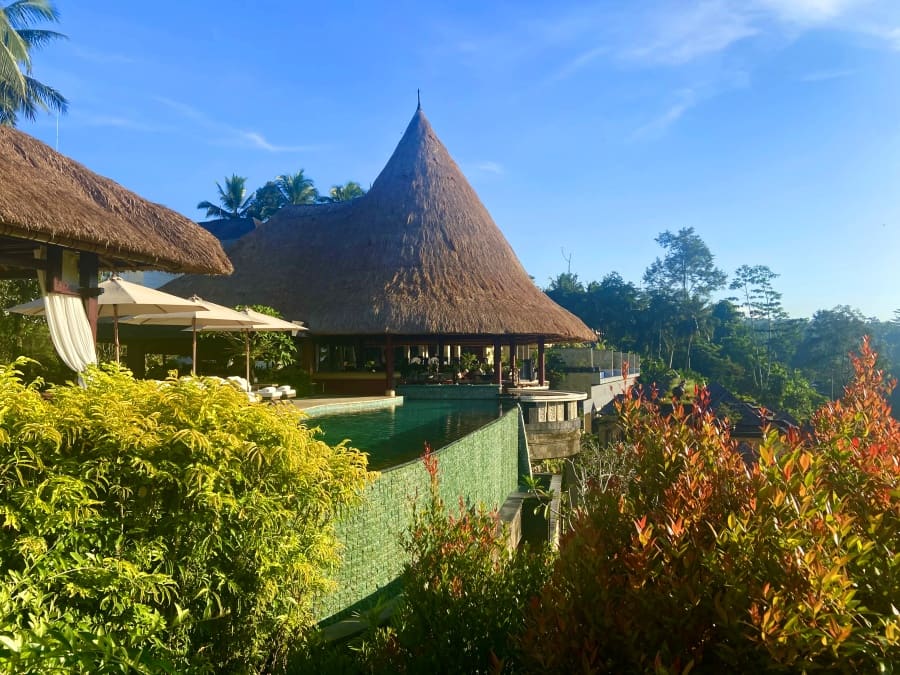
Above Ubud's sacred ravines, where the forest canopy meets the sky, a different kind of royalty has taken residence. The valley they call the "Valley of the Kings" still holds court, though the thrones now come with infinity pools and espresso machines. Viceroy Bali perches on this verdant precipice, forty pool villas cascading down the hillside like a carefully orchestrated waterfall of privilege. The views stretch uninterrupted across jungle so dense it swallows sound, leaving only birdsong and the distant rush of hidden rivers.
Five minutes from Ubud's market chaos, yet utterly removed from it, the resort offers the kind of seclusion that honeymoon itineraries are built around. Each villa unfolds as a study in indoor-outdoor living, where the boundary between climate control and tropical air becomes negotiable. Award-winning Apéritif Restaurant anchors the property's dining credentials, while CasCades Restaurant & Bar and Akoya Spa round out the amenities. There's even a squash court and helipad for guests whose idea of escape still includes competitive racquet sports and aerial arrivals.
The recognition as a leading honeymoon destination in 2025 speaks less to marketing and more to what happens when architecture, landscape, and service converge at altitude. Rooms start at approximately 1,100 USD per night.
A Footbridge to Nowhere, and Everywhere
Four Seasons Resort Bali at Sayan announces itself not with a grand porte-cochère but with a suspension footbridge that seems to float above the treetops. Lily ponds flank the walkway, their surfaces so still they mirror the sky. The drama of the arrival sequence is deliberate, a threshold between the world you left and the one you're entering, where two sacred rivers converge and the jungle presses close enough to touch.
Travel + Leisure named it the world's top hotel, a designation that carries weight in an industry not short on superlatives. The resort shelters just a handful of suites and villas, each with private plunge pools and soaking tubs deep enough to lose an afternoon. The scale remains intimate by design. Exclusivity here isn't performed; it's structural, built into the ratio of staff to guests and the density of foliage between accommodations.
Jati Bar occupies a jungle-facing perch where the forest becomes the entertainment, a living canvas that shifts with light and weather. The guest list over the years has included heads of state and reality television dynasties, drawn by the same promise: a place where privacy is the primary currency. Nightly rates begin around 1,050 USD.
Where Wellness Isn't Optional
COMO Shambhala Estate sprawls across twenty-three acres of steep Ayung River gorge, and the property defies easy categorization. Call it a resort and you miss the ayurvedic consultations. Label it a wellness retreat and you overlook the sumptuous accommodations and fine dining. The truth sits somewhere in the overlap, a holistic sanctuary where complimentary programming includes yoga, Pilates, Qigong, meditation, and aqua therapy in a twenty-five-meter hydrotherapy pool.
Natural springs bubble up on-site, their mineral-rich waters considered healing by locals and guests alike. The inclusion of these elements as standard rather than add-on experiences shifts the value proposition. You're not paying extra for transformation; it's woven into the stay. Recognition as a top wellness destination in 2025 reflects a broader industry shift toward preventive luxury, where pampering and health optimization share the same real estate.
The resort's position on the gorge means views that change with every step, perspectives that reveal new layers of forest and river. Starting rates hover near 800 USD per night, positioning it as accessible luxury within the wellness category.
Glamping for Grown-Ups
Capella Ubud takes the bones of camping and dresses them in silk. The property styles itself as a tented camp, though the Dutch colonial-inspired structures bear little resemblance to anything you'd carry in a backpack. A suspension bridge delivers guests to individual "tents" perched above Keliki Valley, each with private saltwater plunge pools and campfire setups for toasting marshmallows under the stars.
The welcome ritual includes a bag of camping essentials, a winking acknowledgment of the glamping conceit. But the tent metaphor dissolves quickly once you're inside, where luxury furnishings and full amenities make clear this is theatre, not survival training. Api Jiwa, the resort's signature restaurant, practices nose-to-tail dining with enough culinary ambition to anchor the experience beyond the novelty of canvas walls.
Travel + Leisure recognized Capella Ubud as the best resort in both Asia and Indonesia, validating the concept that adventure and indulgence need not operate on separate tracks. The property proves that experiential luxury can coexist with comfort when the execution is rigorous enough. Rates start around 1,100 USD nightly.
Temples by Another Name
Mandapa translates from Sanskrit as "temple," and the Ritz-Carlton Reserve property takes the designation seriously. Positioned along the Ayung River, embraced by rainforest, the resort's sixty suites and collection of villas function as a village-scale sanctuary. Many accommodations include private terraces; select villas feature their own pools. The design philosophy emphasizes connection to landscape, a conversation between built environment and the natural systems that predate it.
Dining options multiply across the property, from bamboo pods suspended over the river to bespoke experiences staged in rice fields. The menu at each venue leans into place-based ingredients and techniques, though the presentation skews formal. Forbes Travel Guide and Tatler have both weighed in with recent accolades, the former for overall experience, the latter specifically for wellness programming.
The riverside setting provides constant auditory texture, water over rock serving as ambient soundtrack. Rates begin near 1,500 USD per night, reflecting both the Ritz-Carlton pedigree and the reserve-level service model that comes with it.
Cliffs and Minimalism
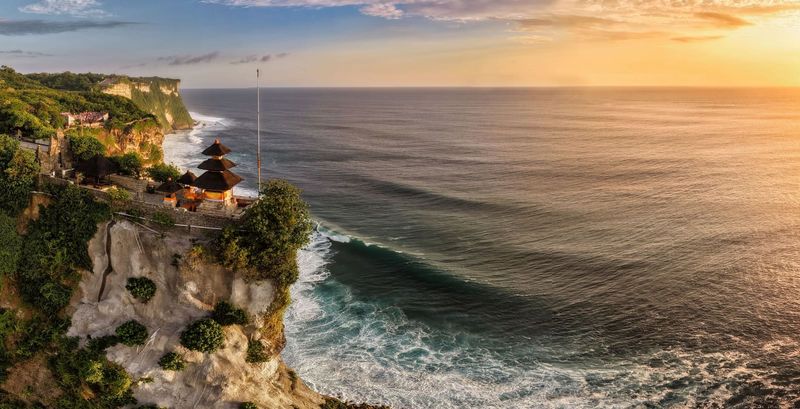
Alila Villas Uluwatu occupies a limestone plateau above the Indian Ocean, and the architecture makes no apology for its modernist bent. Clean lines, poured concrete, geometric pools, the aesthetic runs counter to Bali's ornate temple tradition. Yet the contrast works, the simplicity allowing the dramatic coastal geography to dominate every sightline.
This is an all-villa property, each unit appointed with twenty-four-hour butler service, private pools, and unobstructed ocean views. The one-bedroom configuration suits couples; the three-bedroom villas can accommodate events, including weddings, for guests who want their ceremonies framed by cliff and sky. Cabanas perch at the plateau's edge, cantilevered over the drop, offering front-row seats to sunsets that require no enhancement.
Fine dining and spa services round out the offerings, though the real attraction remains the setting itself. Uluwatu's southern coast delivers a different visual language than Ubud's river valleys, all horizontal expanse and crashing surf. Nightly rates start around 840 USD.
An Empire Remembered
Jumeirah Bali channels the Hindu-Javanese Majapahit Empire through its architecture, an all-villa resort designed as homage to a golden age. The aesthetic recalls water palaces and royal compounds, layered gardens and reflecting pools creating a sense of historical depth. Each villa includes a private pool and pavilion, the layouts generous enough to support the palace metaphor.
Talise Spa incorporates a Turkish Hammam, an unexpected cross-cultural gesture that expands the wellness menu beyond Balinese tradition. Three signature dining venues span the property: Akasa Restaurant & Bar occupies a clifftop perch; Segaran Dining Terrace emphasizes farm-to-table sourcing; Maja Sunset Lounge handles cocktails and small plates with panoramic ocean backdrops.
The resort positions itself for guests drawn to architecture and historical narrative, those who want their luxury contextualized within a deeper story. Rates begin around 630 USD per night, making it one of the more accessible entries in Bali's luxury tier.
Italian Precision on Indonesian Soil
Bvlgari Resort Bali occupies a stretch of Bali's southern coastline with the confidence of a brand that built its reputation on precision. The villas here operate at a scale that blurs into estate territory; the five-bedroom mansion includes its own elevator to the master suite, walk-in closets, private pool, gazebo, and garden extensive enough to require landscape maintenance as a full-time occupation.
Service standards match the physical grandeur. Helicopter tours, outer-island excursions, bespoke itineraries, nothing registers as impossible. The resort caters to guests for whom luxury is less about amenities and more about the seamless execution of whatever whim arises. The Italian design sensibility carries through every detail, from material choices to spatial planning, a European formality softened by tropical context.
Rates start near 1,850 USD per night, positioning Bvlgari firmly in the ultra-luxury bracket. The price reflects not just accommodation but access to a level of service infrastructure that operates invisibly until needed.
The Bay That Time Slowed
Four Seasons Resort Bali at Jimbaran Bay stretches along nearly five kilometers of white sand, an all-villa property where traditional Balinese architecture sets the visual tone. Thatched-roof pavilions, stone-walled courtyards, tropical gardens dense enough to ensure privacy between units, the design language speaks to vernacular building traditions adapted for contemporary comfort.
Villa sizes range up to four bedrooms, accommodating multi-generational travel without sacrificing the intimate scale that defines the Four Seasons approach. Healing Village Spa anchors the wellness offerings, while Sundara, the resort's dedicated beach lounge, provides an all-day oceanfront option for guests who prefer sand to pool decks.
Cultural programming runs throughout the property, opportunities to engage with Balinese traditions beyond the transactional. The calm bay setting means gentler surf than Uluwatu's dramatic coastline, a trade-off that families with young children often prioritize. Nightly rates begin around 910 USD.
The Calculus of Indulgence
Bali's luxury hospitality sector has matured beyond the simple provision of high-thread-count linens and attentive service. The properties commanding top-tier rates now compete on experience design, the orchestration of place, architecture, cuisine, and cultural narrative into something that reads as inevitable rather than constructed. The best resorts disappear their own effort, creating the illusion that the jungle simply organized itself into terraced pools and the cliffs naturally formed butler-staffed villas.
What emerges across these properties is a shared commitment to landscape integration. Whether perched above river gorges, cantilevered over ocean cliffs, or nestled into rice-field valleys, the architecture defers to topography. The luxury isn't imposed on the environment; it negotiates with it, finding ways to frame and elevate what was already present.
The price points reflect more than accommodation costs. They buy access to ecosystems carefully preserved, to staff ratios that allow genuine anticipation of need, to locations where permits and land access create inherent scarcity. In an island where budget guesthouses and luxury villas often share the same village, the differentiation comes down to density, both of guests and of experience.
Choosing Your Altitude
The decision between Ubud's highland retreats and the coastal resorts of Uluwatu, Jimbaran, and Seminyak often hinges on what kind of nature you want framing your indulgence. Ubud offers jungle immersion, river soundscapes, and proximity to the island's artistic and spiritual center. The coast delivers ocean horizons, surf rhythms, and easier access to beach clubs and sunset ceremonies.
Neither choice compromises on luxury. The same international hospitality brands operate at both elevations, bringing identical service standards to vastly different geographies. What changes is the sensory environment, the specific way light filters through forest canopy versus how it refracts off ocean surface.
For guests building longer Bali itineraries, the solution increasingly involves both. A week split between an Ubud river valley and an Uluwatu clifftop provides the full range of what the island offers at the luxury end. The resorts themselves often facilitate these splits, arranging transfers and coordinating experiences across properties within the same brand family.
Beyond the Villa Gate
The risk of staying at Bali's most exclusive properties is never wanting to leave them. When your villa includes a private pool, butler service, and views that justify their own Instagram accounts, the motivation to explore diminishes. Yet the island's cultural richness, its temple ceremonies and rice-terrace hiking trails, its artisan workshops and volcanic peaks, all exist beyond the resort gates.
The most successful luxury stays find balance, using the property as a base for wider exploration rather than a destination unto itself. Morning temple visits followed by afternoon spa treatments. Sunrise hikes up volcanic slopes, then sunset cocktails at your villa's infinity pool. The luxury becomes the frame rather than the entire picture.
Bali rewards this approach because the island operates at multiple registers simultaneously. Ancient spiritual practices coexist with contemporary design innovation. Traditional agricultural rhythms persist alongside global tourism infrastructure. The luxury resorts, at their best, create portals into this complexity rather than barriers against it, offering comfort and beauty as the foundation for deeper engagement with place.