The Cliffside Glamping Suites Redefining Seclusion Off Bali's Coast
On Nusa Ceningan, a tiny Indonesian island most visitors miss, one retreat has turned canvas and stone into a new language of luxury.
A Thin Ribbon of Land Between Two Seas
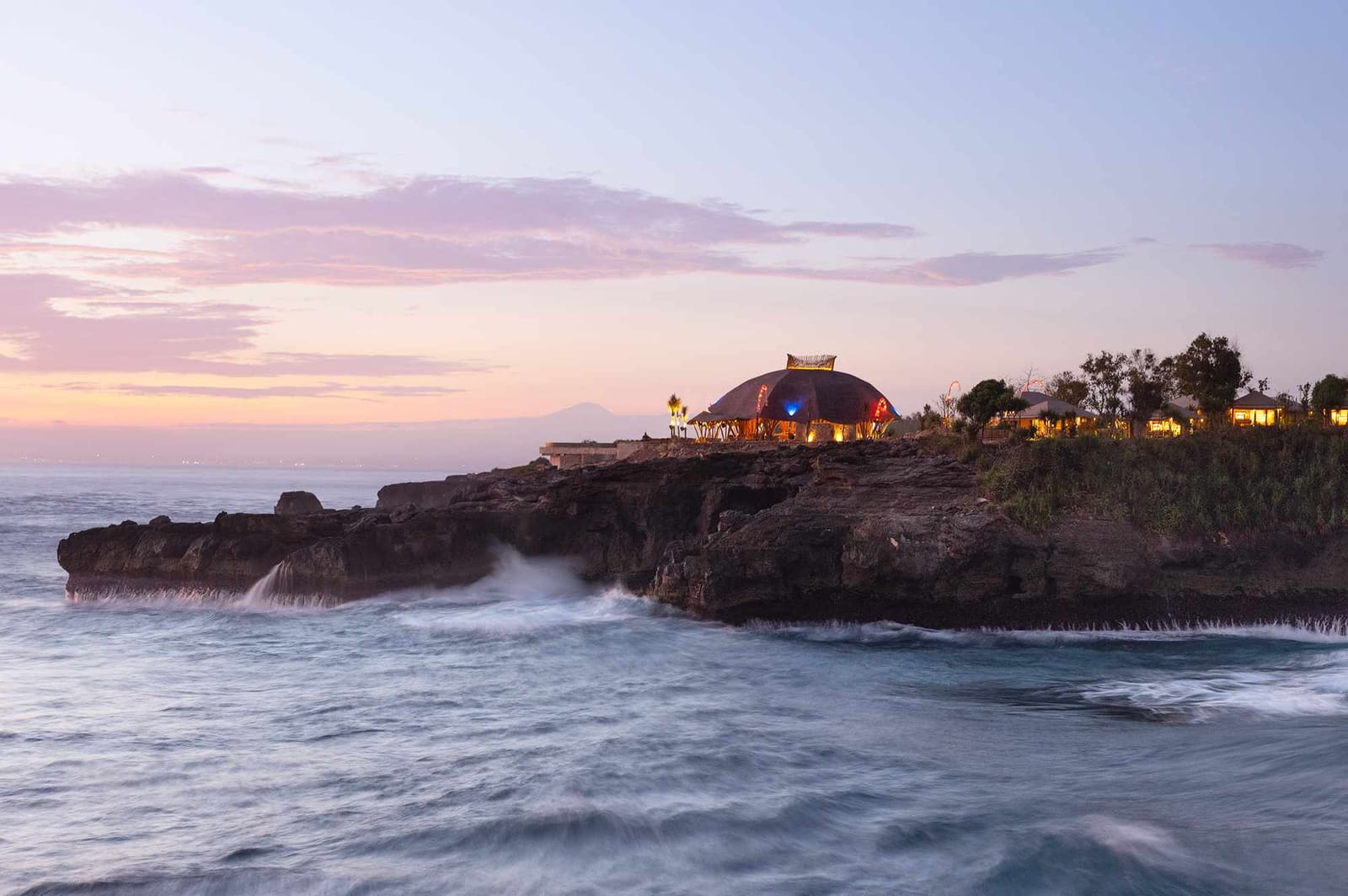
The boat cuts south from Sanur, threading past the mangrove edges of Serangan before the water opens into the deep channel that separates Bali from its smaller, quieter satellites. Nusa Ceningan is the sliver in the middle, a bridge island barely a square kilometer across, flanked by Nusa Lembongan to the west and Nusa Penida to the south. Most travelers pass through on scooters, pausing at the yellow bridge for a photo before heading onward. Few linger. Fewer still realize that tucked along its eastern cliffs, perched above a churning tidal passage, sits a glamping retreat that has quietly rewritten the script on what isolation can feel like.
Arna Suites and Ocean Lounge opened without fanfare, its design philosophy rooted not in grand gestures but in careful erasure. The suites themselves are hybrid structures: canvas tents stretched over hardwood frames, their interiors outfitted with king beds, rainfall showers, and glass walls that retract to let the wind through. The architecture does not announce itself. Instead, it recedes, allowing the cliff, the water, and the light to dominate. This is glamping stripped of safari nostalgia, rebuilt as a meditation on edge and exposure.
The Geography of Solitude
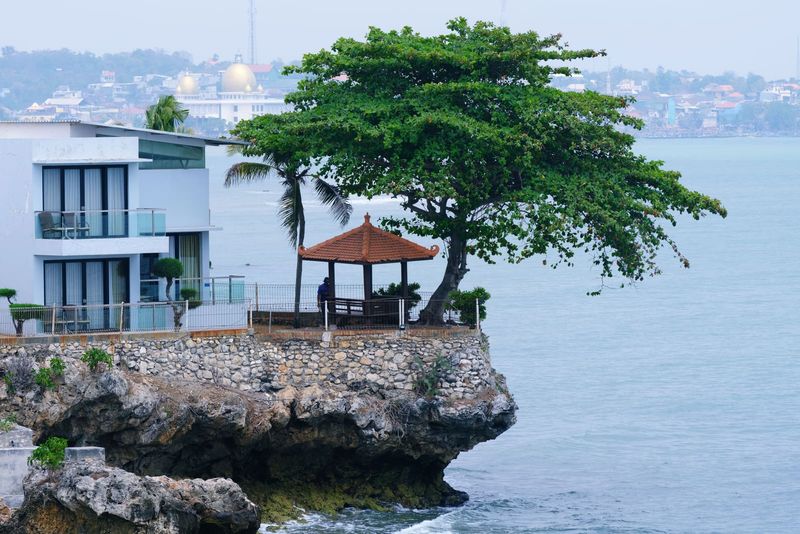
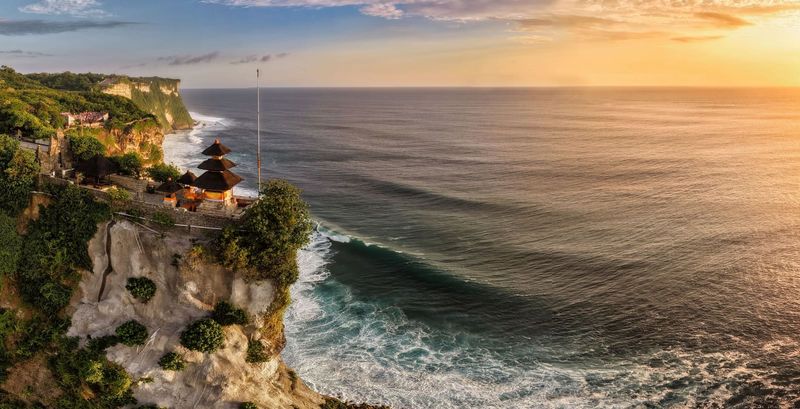
Nusa Ceningan occupies an unusual position in Bali's orbit. It lacks the beach clubs of Lembongan, the dramatic cliff temples of Penida, the surf lineups that draw seasonal crowds. What it offers instead is verticality and quiet. The island's eastern coastline is a jagged fault line where limestone meets ocean, and Arna Suites claims one of the steepest sections. The property descends in terraces, each suite cantilevered over the drop, so that standing on the private deck feels less like overlooking the sea and more like hanging suspended above it.
The island itself is small enough to traverse on foot in under an hour, yet its topography creates pockets of seclusion. Seaweed farms checker the shallows to the north, their bamboo grids visible at low tide. To the south, the coast turns wild, accessible only by scrambling down footpaths carved into the rock. Arna Suites sits at the threshold between the two, a fulcrum point where cultivation and wildness meet.
Canvas, Stone, and the Logic of Less
The design language at Arna Suites borrows from both Balinese vernacular and the minimalist glamping traditions of Africa and the American Southwest. The result is a hybrid that feels neither derivative nor overly referential. Each suite is anchored by a stone plinth that houses the bathroom and storage, with the sleeping area enclosed by heavy cotton canvas dyed in shades of ochre and charcoal. The materials are tactile: woven pandanus mats underfoot, linen curtains, teak furniture sanded smooth by hand.
What the design avoids is equally telling. There are no televisions, no air conditioning units humming in the background, no mini-fridges stocked with imported water. The suites are cooled by cross-ventilation, lit at night by lanterns and low-voltage LEDs, and insulated from the outside world by layers of fabric and the sheer distance from the road. The absence of mechanical noise allows other sounds to surface: the crash of waves against the cliff base, the rustle of palm fronds, the occasional call of a white-bellied sea eagle circling offshore.
The Ocean Lounge and the Ritual of Descent
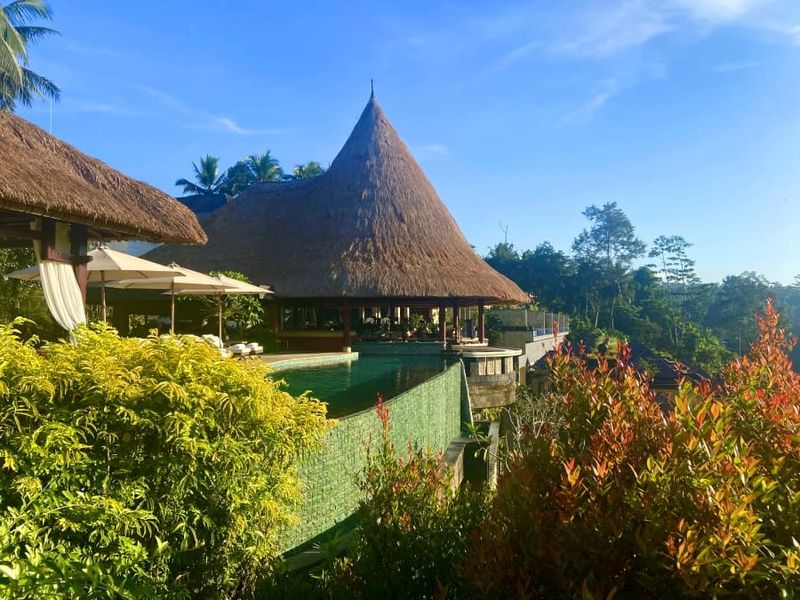
The Ocean Lounge is the property's communal anchor, a pavilion built at the lowest accessible point on the cliff, reached by a staircase that zigzags down through frangipani and bougainvillea. The structure is open on three sides, its roof thatched with alang-alang grass, its floor a polished concrete slab that stays cool even in midday heat. This is where meals are served, where yoga sessions unfold at dawn, where guests gather in the late afternoon to watch the light shift across the water.
The menu at the Ocean Lounge reflects the island's geography: grilled snapper caught in the channel that morning, sambal made from chilis grown in the terraced gardens behind the kitchen, rice from paddies an hour's boat ride north. The cooking is simple, ingredient-focused, and calibrated to the climate. Breakfasts lean toward tropical fruit, coconut yogurt, and freshly baked flatbreads. Dinners are longer affairs, paced to the rhythm of sunset, with courses arriving as the sky cycles through its nightly palette of coral and indigo.
What Seclusion Actually Costs
Arna Suites is not inexpensive, nor does it pretend to be. Nightly rates place it firmly in the luxury category, and the remoteness of the location adds layers of logistical complexity. There is no jetty on Nusa Ceningan; guests arrive by boat to Lembongan, then transfer by car across the yellow bridge. Supplies must be ferried in daily. Staff housing, water filtration, waste management - all the invisible infrastructure of hospitality - must be engineered from scratch on an island with limited resources.
Yet the property's small scale allows for a level of personalization that larger resorts cannot replicate. There are only six suites, which means the staff-to-guest ratio hovers near one-to-one. Meals can be tailored to dietary preferences without advance notice. Activities - snorkeling in the channel, guided hikes to hidden tide pools, visits to the seaweed farms - are arranged on request, not scheduled in blocks. The experience feels less like checking into a hotel and more like being lent a private corner of the island for a few days.
The Paradox of Escape
There is a tension at the heart of any retreat like this: the infrastructure required to deliver comfort in a remote location often undermines the very sense of isolation it promises to sell. Arna Suites navigates this paradox by making its systems as invisible as possible. Solar panels are tucked behind the kitchen building. Greywater is filtered and used to irrigate the gardens. Food waste is composted on-site. The goal is not to erase human presence entirely - that would be both impossible and disingenuous - but to minimize its footprint, to let the place feel wilder than it technically is.
This approach extends to the guest experience. There are no scheduled activities, no evening entertainment, no poolside DJs. The property offers structure only where it is needed - mealtimes, boat transfers - and otherwise leaves guests to their own devices. Some will find this liberating. Others, accustomed to the constant stimulation of resort life, may struggle with the quiet. Arna Suites is not designed to fill your time; it is designed to give you enough space to notice what fills it in the absence of distraction.
The Island Beyond the Property
Nusa Ceningan rewards exploration, though its attractions are subtle. The blue lagoon on the southern tip is a collapsed sea cave, its walls draped in moss, its water a startling turquoise. The secret beach - accessible only at low tide via a steep path - is a narrow crescent of white sand hemmed in by cliffs. The island's interior is a patchwork of small farms, roadside warungs, and family compounds, their gates decorated with offerings of woven palm and frangipani blossoms.
Walking the island, you begin to understand its logic. This is not a place shaped by tourism, not yet. The rhythms are still dictated by tide and season, by the cycles of planting and harvest. Arna Suites exists within this context, not apart from it. Staff members are drawn from neighboring villages. The property sources ingredients from local farmers and fishermen. The relationship is symbiotic, not extractive, and it shows in the way the retreat feels embedded in the landscape rather than imposed upon it.
The Question of What Luxury Means Here
Luxury, in the context of Arna Suites, is not about thread count or champagne brands. It is about proximity: to the ocean, to silence, to a version of time that moves at a different tempo. It is about the quality of light at dawn, the taste of salt in the air, the feeling of standing on a deck with nothing between you and the horizon but a few meters of empty space. These are difficult things to quantify, harder still to photograph, yet they form the substance of the experience.
The retreat does not attempt to compete with Bali's beachfront resorts or Ubud's jungle lodges. It occupies a different category entirely, one defined by restraint and specificity. This is not a place for families with young children or groups seeking social buzz. It is a place for people who want to be left alone, who find value in the absence of options, who understand that sometimes the most generous thing a place can do is get out of your way.