Where Hawaii's Volcanic Landscape Meets the Fairway
From sea cliffs to lava fields, the archipelago's courses trace a geology that refuses to be tamed.
The Lava Margin
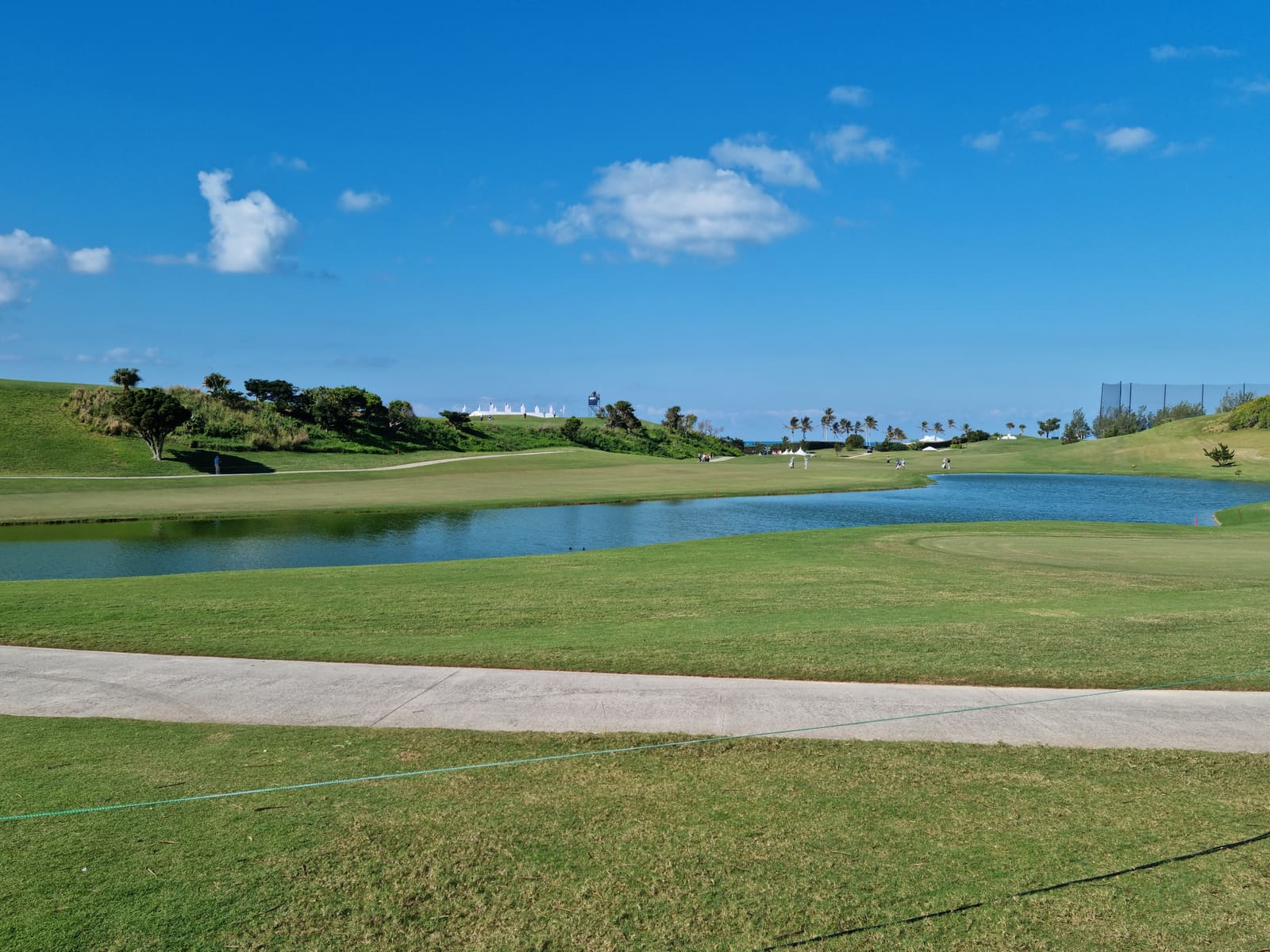
Stand on the sixteenth tee at Mauna Lani's South Course, on the Big Island's Kohala Coast, and the fairway appears to float. Black lava stretches in every direction - ʻaʻā and pāhoehoe flows frozen mid-tumble - interrupted only by corridors of manicured grass. The course was carved from the 1801 Kaniku flow, a river of basalt that once rolled to the sea. Here, golf is less a pastoral exercise than a negotiation with geology. Architects did not sculpt the land so much as thread routes through it, leaving the stone exposed, a reminder that beneath every blade of Kentucky bluegrass lies a mantle still restless.
Hawaii's courses sit atop the youngest landmass in the United States, built by shield volcanoes that continue to reshape the terrain. On the Big Island, where Kilauea and Mauna Loa remain active, designers have long worked within constraints set not by municipal codes but by magma. The result is a style of play unique to the archipelago: target golf across stone, where errant shots vanish into crevices and the rough is measured in centuries.
Wind, Water, and the Plateau Game
Altitude shifts the equation. Mauna Kea Golf Course, designed by Robert Trent Jones Sr. and opened in 1964, sits at roughly 200 metres above sea level, high enough that the trade winds arrive cooled and forceful. The third hole, a par three stretching over 230 metres, plays directly into the wind off the Pacific. Club selection becomes guesswork; a seven iron one day demands a four the next. Jones understood that Hawaii's weather is not backdrop but adversary, and he built accordingly - wide fairways to accommodate drift, greens angled to accept wind-assisted approaches.
On Kauai, the northernmost major island, courses contend with different forces. The Princeville Makai Golf Club occupies a basalt headland on the island's north shore, where cliffs drop 60 metres to the ocean. The seventh hole, a par three called "The Signature," requires a tee shot over a chasm to a green perched above Hanalei Bay. The wind here is not steady but gusty, funnelled through valleys carved by the Hanalei River. Golfers learn to read not the flagstick but the surface of the water below, watching for ripples that telegraph the next gust.
Kauai receives more rainfall than any other Hawaiian island, much of it concentrated on Mount Waiʻaleʻale, one of the wettest spots on Earth. The runoff feeds streams that bisect fairways and fill the island's famous taro paddies. Courses on Kauai's east side, including Wailua Golf Course, a municipal layout dating to 1930, embrace this hydrology. Greens drain quickly despite the deluge; the volcanic soil, porous and mineral-rich, swallows water as efficiently as it once swallowed lava.
Maui's Corridor and the Resort Calculus
Maui consolidated its reputation in the 1990s, when developers along the island's western and southern coasts commissioned courses designed to anchor luxury resorts. Kapalua, on the northwest tip, became synonymous with the PGA Tour's season-opening Sentry Tournament of Champions. The Plantation Course, designed by Ben Crenshaw and Bill Coore, sprawls across former pineapple fields, its fairways rolling like ocean swells. The eighteenth hole descends 75 metres from tee to green, a plunge that offers views of Molokaʻi across the Pailolo Channel.
South of Kapalua, in the resort corridor of Kaanapali and Wailea, courses multiply - Royal Kaanapali, Wailea Gold, Wailea Emerald - each vying for the attention of travellers who arrive with clubs in tow. The density raises questions about water use and environmental impact, debates that have intensified as drought cycles lengthen. Some courses have shifted to drought-tolerant grasses; others have reduced irrigated acreage, allowing rough areas to revert to native scrub. The tension between recreation and resource management is nowhere more visible than on Maui, where the tourist economy and the aquifer exist in uneasy equilibrium.
Yet the island's topography offers advantages. Haleakalā, the dormant volcano that dominates eastern Maui, creates a rain shadow that keeps the leeward coast dry and sunny. Courses here enjoy year-round playability, a selling point that has made Maui the archipelago's golfing hub. The trade-off is wind - consistent, strong, and capable of turning a mid-iron approach into a lottery.
Oahu's Municipal Tradition
Oahu, the most populous island, supports a parallel golf culture. Private resort courses line the windward and leeward coasts, but the island's municipal courses - Ala Wai, Pali, Kahuku - carry a different ethos. Ala Wai Golf Course, wedged between Waikiki and the Ala Wai Canal, is reputedly the busiest course in the United States, with tee times booked weeks in advance. The layout is flat, the fairways narrow, the rough indistinguishable from the adjacent park. It is golf stripped of pretence, a place where locals walk nine holes before work and tourists discover that Hawaii's links are not all oceanfront spectacle.
Further north, the Ko Olina Golf Club, designed by Ted Robinson, occupies land once used for sugarcane cultivation. The course integrates water features - lagoons, streams, waterfalls - that are both aesthetic and functional, serving as drainage for the low-lying terrain. Critics have called it synthetic, a Disneyfied version of Hawaiian golf. Defenders point to its accessibility and the fact that it has introduced thousands to the sport. The debate mirrors a larger conversation about authenticity in a place where tourism has long shaped the landscape.
The Architecture of Constraint
Hawaiian golf architecture is defined by what cannot be moved. On the mainland, designers reshape hillsides, import soil, reroute streams. In Hawaii, bedrock often lies centimetres below the surface, and environmental regulations restrict grading. The result is a style that works with, rather than against, the existing topography. Holes follow lava channels; greens nestle into natural amphitheatres; bunkers occupy depressions formed by ancient collapses.
This constraint has produced innovation. At Hualalai Golf Course, on the Big Island's Kona Coast, designer Jack Nicklaus preserved lava tubes and petroglyph fields, routing play around archaeological sites. The course functions as a kind of open-air museum, where golf becomes a vehicle for encountering history. Similar strategies have been employed at Turtle Bay Resort on Oahu's North Shore, where the Arnold Palmer-designed course skirts wetlands that serve as habitat for endangered waterbirds.
The environmental calculus extends to maintenance. Hawaii's isolation means that pests, once introduced, can devastate ecosystems. Superintendents wage constant battles against invasive grasses, insects, and fungi, often without access to chemicals banned under state law. Integrated pest management - biological controls, targeted treatments, cultural practices - has become standard. The irony is that golf, often criticised as ecologically damaging, has in some cases become a testing ground for sustainable land management in the islands.
Light, Time, and the Pacific Rim
Late afternoon light in Hawaii arrives at a slant, filtered through moisture and salt. It renders greens luminous, shadows sharp, and distances deceptive. This is the hour when courses reveal their character - when the geometry of a hole, invisible at midday, suddenly declares itself. Golfers who chase this light often find themselves lingering past the eighteenth, unwilling to surrender the day.
The archipelago's position in the Pacific also shapes the experience. Hawaii sits at a crossroads, a waypoint between continents, and its courses reflect this. Japanese design principles - minimalism, restraint, integration with nature - appear alongside American resort grandeur. The clientele is equally varied: Australians escaping winter, Canadians chasing warmth, Californians seeking proximity without a passport. The result is a golf culture that feels both rooted and transient, a reflection of islands that have always been a meeting place.
To play golf in Hawaii is to confront scale. The ocean, visible from nearly every tee, dwarfs human ambition. Volcanoes loom, indifferent. The wind rewrites every plan. Yet within these forces, the game persists - a small, stubborn assertion of order in a landscape that has never promised permanence.