Dressing for Vienna's Hotel Sacher: A Wardrobe Inspired by Klimt and Cake
As Austria's most storied hotel marks 150 years, its anniversary celebrations offer a masterclass in packing for old-world glamour.
The Anniversary That Rewrites the Dress Code
The entrance to Hotel Sacher Vienna now wears a pair of bright pink handbag sculptures, each one anthropomorphic and faintly surreal, the work of Austrian artist Erwin Wurm. They stand sentry on either side of the doors, a visual punchline that upends the solemnity you might expect from a property that has hosted King Charles and Grace Kelly. The installation is part of the hotel's 150th anniversary programme, a year-long engagement with contemporary art that includes a limited-edition Sacher torte box designed by American artist Kaws and another by Aerin Lauder, the latter adorned with golden flowers drawn from Viennese decorative arts. The gesture is deliberate: this is not a museum resting on damask laurels but a living salon, one that has always understood luxury as a conversation between past and present.
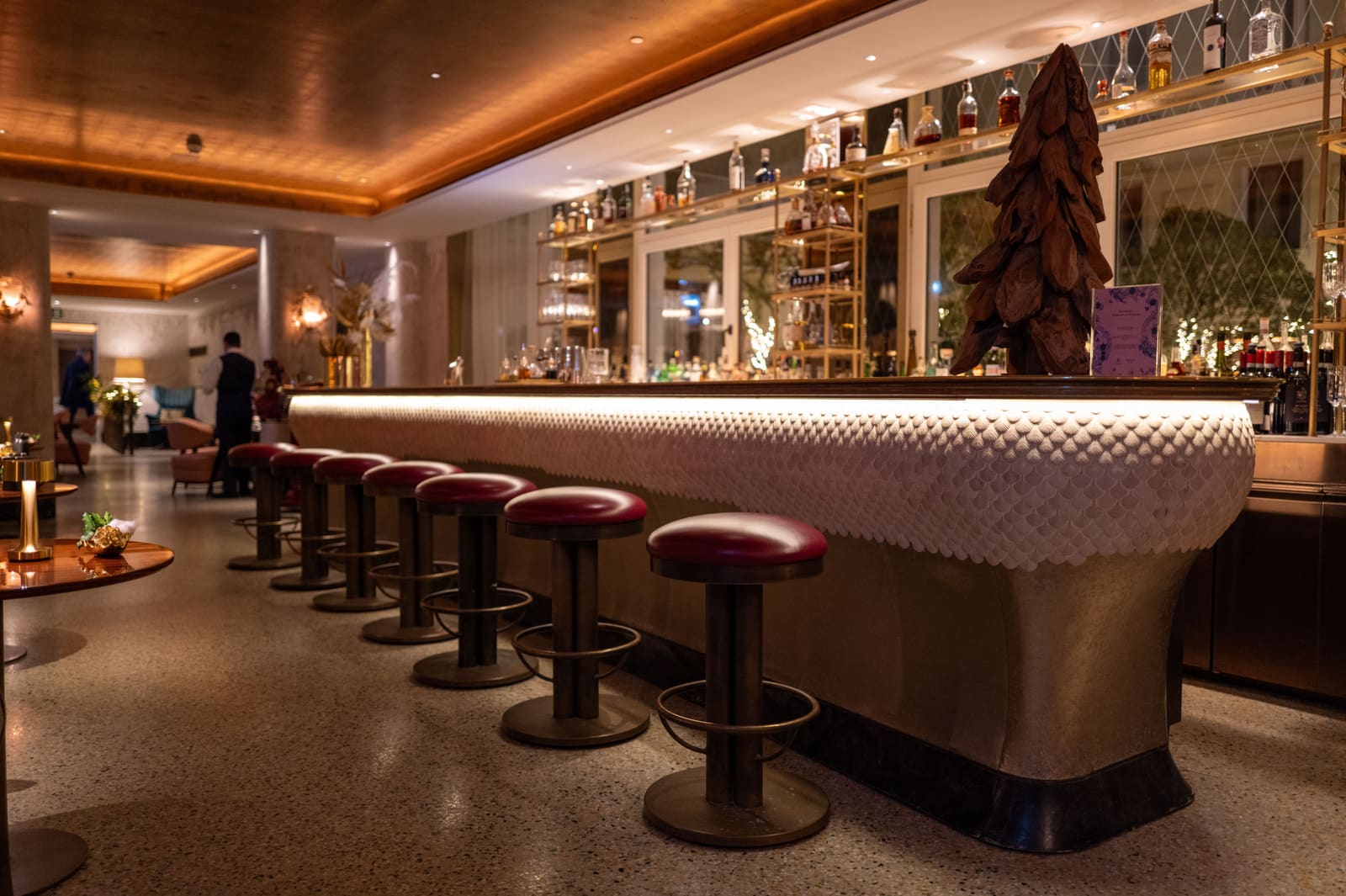
That conversation extends to what you pack. The hotel's ruby-red Rote Bar, its chandeliers casting pools of warm light across velvet banquettes, has long been the stage for Vienna's social theatre. Gustave Klimt was a regular, and his aesthetic remains the unspoken dress code: jewel tones, sequins, the kind of shimmer that holds its own under low light. The anniversary celebrations make that implicit rule explicit. If the hotel is commissioning artists to reinterpret its iconography, guests are invited to do the same with their wardrobes.
The Logic of Embellishment
Vienna's grand hotels operate on a different temporal register from their counterparts in London or Paris. There is less emphasis on minimalism, less anxiety about appearing overdressed. The city's decorative arts tradition, from Secession-era metalwork to the gilded excess of the Ringstrasse, has always favoured ornamentation as a form of intellectual engagement. A sequinned top or an embroidered jacket is not frivolous here; it is contextually literate.
An embroidered satin cropped top pairs with faux-leather trousers detailed at the seams, the combination formal enough for the Rote Bar but mobile enough for a walk through the Innere Stadt. The cropped silhouette nods to contemporary tailoring while the embroidery recalls the hand-worked textiles that once defined Viennese couture. A hand-embroidered floral gown in double crepe sablé offers a more overt reference to Klimt's canvases, where flowers and fabric merge into a single decorative plane. The gown's weight and structure mean it photographs well under the hotel's chandeliers, but it also moves with the wearer, a practical consideration in a space where you are as likely to be seated for hours over Tafelspitz as you are to be standing at a reception.
Accessories as Punctuation
The handbag sculptures at the entrance are not merely whimsical; they are a thesis statement. In Vienna, accessories have always carried symbolic weight, from the Chaine d'Ancre bracelet, a study in restrained metalwork, to the horsebit python shoulder bag, which reinterprets equestrian hardware through the lens of high craft. The former is quiet, the latter declarative, and both are legible within the hotel's visual vocabulary.
A metallic jacquard top-handle bag in puckered fabric catches light in a way that complements rather than competes with the hotel's interiors. The texture is deliberate: smooth surfaces can read as flat under the warm glow of period lighting, while a puckered or quilted finish creates micro-shadows that add depth. A clutch embroidered with a reproduction of Klimt's "The Kiss" is more literal but no less effective, particularly when carried into the Rote Bar, where the painting's gold leaf and mosaic patterns find their architectural echo in the room's own detailing.
Footwear in Vienna requires a different calculus than in other European capitals. The city's cobblestones are unforgiving, and its social rituals often involve long stretches on foot between opera house, café, and hotel. Heeled sandals with a rose motif offer elevation without precarity, the design referencing the floral patterns that recur throughout Viennese applied arts. Black leather sandals with a lower profile serve as an alternative for daytime, when the itinerary might include the Belvedere or the Naschmarkt before returning to the hotel for afternoon coffee and torte.
The Outerwear Question
Vienna in winter is a study in contrasts: overheated interiors and bitter winds that sweep down from the Alps. The solution is not a technical shell but a soft shearling jacket, the kind of outerwear that functions as both insulation and social signalling. Shearling has a long history in Central European dress, originally worn by rural populations and later adopted by urban elites as a marker of rustic authenticity. In the context of Hotel Sacher, it reads as both practical and aesthetically coherent, a piece that can be worn over an embroidered top without visual dissonance.
The jacket also solves a logistical problem: Vienna's grand hotels maintain their interiors at temperatures that can feel stifling after even a short walk outside. A shearling piece is easy to remove and drape over a chair without wrinkling, and its texture complements rather than clashes with the velvet and damask that dominate the hotel's public spaces.
Beauty Rituals and the Viennese Afternoon
The Sacher torte, with its dense chocolate layers and apricot glaze, is as much a ritual as a dessert. It is consumed slowly, often over the course of an hour, accompanied by Melange or Einspänner. The pace of Viennese café culture demands a certain kind of grooming: nothing that will smudge, nothing that requires constant adjustment. A rose-scented hand and body cream serves a dual purpose, offering hydration in a climate where central heating dries skin quickly while also functioning as a subtle fragrance that does not overwhelm in close quarters.
An eyeshadow palette in warm, muted tones aligns with the hotel's colour scheme, where reds and golds dominate. The logic here is not to match the décor but to avoid visual discord. A face that reads as too cool-toned or too stark can feel out of place in an environment designed around warmth and richness. The palette's shades, ranging from soft taupe to deeper bronze, allow for flexibility depending on the time of day and the formality of the occasion.
The Pendant as Heirloom
A two-butterfly pendant in gold and enamel operates on a different register from the rest of the wardrobe. It is not trend-driven or seasonal but rather a piece that could plausibly have been worn by a guest at the hotel in 1876 or 2026. The butterfly motif recurs throughout Viennese decorative arts, from Secession-era jewellery to the stained glass of Otto Wagner's buildings. Wearing it in the context of Hotel Sacher is less about making a statement than about participating in a visual tradition that spans more than a century.
The pendant also serves a practical function: it draws the eye upward, balancing the weight of a heavily embroidered gown or a textured jacket. In a room full of chandeliers and mirrors, where light is constantly in motion, a piece of jewellery that catches and reflects that light becomes part of the architecture.
Why the Anniversary Matters Beyond the Hotel
Hotel Sacher's decision to commission contemporary artists for its 150th anniversary is not merely a marketing exercise. It reflects a broader shift in how European heritage properties are navigating the tension between preservation and relevance. The Wurm sculptures and the Kaws torte box are not attempts to modernise the hotel's aesthetic but rather to place it in dialogue with contemporary visual culture. The strategy acknowledges that tradition is not static but rather a process of continuous reinterpretation.
For guests, this creates an opportunity to engage with the hotel on more than a transactional level. Packing for a stay at the Sacher is not about following a checklist but about understanding the visual and cultural codes that the property has cultivated over a century and a half. The wardrobe becomes a form of participation, a way of signalling that you recognise the conversation the hotel is having with its own history.
The Closing Ritual
The Rote Bar closes late, long after the opera houses and concert halls have emptied. The final hours are quieter, the crowd thinning to a handful of guests who linger over a last glass of wine or a slice of torte. The lighting softens, and the room takes on the quality of a stage set after the performance has ended. It is in these moments that the wardrobe choices made earlier in the evening reveal their logic: the sequins that seemed almost too much at dinner now catch the dimmed light in a way that feels exactly right, the embroidered jacket that felt formal at check-in now reads as comfortable, even intimate.
Vienna rewards patience and attention to detail, and Hotel Sacher is its most concentrated expression. The city's aesthetic is not about spectacle but about accumulation, the layering of texture and history until the whole becomes greater than its parts. Packing for a stay here is less about individual pieces than about understanding how they will interact with the space, the light, and the centuries of guests who have passed through the same doors. The bright pink handbag sculptures at the entrance are a reminder that even the grandest traditions can accommodate a sense of humour, but they are also a challenge: to dress not for the hotel as it was but for the hotel as it continues to become.