Where Literature Lives: Hotels Built for Readers Who Linger
From Alpine libraries to Caribbean writing desks, these properties understand that the best journeys begin with a book.
The Weight of a First Edition
In the Catskills, inside a Victorian estate that has weathered more than a century of New York winters, a first edition sits behind glass. The memoir belonged to Meta Lilienthal, suffragette and daughter of the family who built the house in the 1890s. Today, Hotel Lilien keeps that volume alongside others documenting local flora, the mountain range itself, the design choices of another era. The library remains the heart of the property, a space where antique spines and contemporary titles share the same shelves. The hotel has partnered with Brooklyn's Books Are Magic to curate a rotating selection of fiction and nonfiction, ensuring that guests encounter both historical weight and present-day voices during their stay.
The gesture speaks to a particular kind of hospitality, one that treats reading not as an amenity but as architecture. Across the world, a small number of properties have built their identities around this premise, constructing spaces where books dictate rhythm, design, and even the structure of the guest experience.
A System of Knowledge, Floor by Floor
In Midtown Manhattan, the Library Hotel has taken taxonomy as its organising principle. Each of the ten floors corresponds to a category within the Dewey Decimal System; each of the sixty rooms focuses on a narrower subject. The collection spans more than 6,000 volumes, with additional titles available in the 24-hour Reading Room, where coffee and tea are always on hand. The New York Public Library sits just outside, reinforcing the sense that the entire neighbourhood has been organised around the written word.
The approach borders on the theatrical, but it works because it commits entirely. There is no ambiguity about what kind of stay this is meant to be. Guests choose their room based on subject matter, aligning their accommodation with their intellectual curiosity or simply their mood. It is a hotel that asks you to declare your interests before you arrive, then surrounds you with them.
The Desk Where Bond Was Born
On Jamaica's northern coast, GoldenEye occupies a different kind of literary geography. Ian Fleming built the estate in 1946, naming it after a wartime intelligence operation. Between 1952 and 1964, he wrote all fourteen James Bond novels here, often retreating to his bedroom with the shutters closed against the lush Caribbean views he found too distracting to work beside. The original Fleming Villa remains part of the resort, his writing desk still positioned as it was, the garden and sea beyond unchanged in their essential character.
For those who arrive with a Bond novel in hand, the experience carries a strange doubling effect. The landscape described in the books is the same one visible from the terrace; the heat, the light, the particular quality of the air were all filtered through Fleming's prose decades ago. Reading here is less about escape than about superimposition, layering fiction back onto the geography that produced it.
The Alps, Intellectual and Vertical
In the Bavarian Alps, Schloss Elmau has built an entire cultural programme around the life of the mind. The sprawling retreat includes a bookstore named Food for Thought, multiple library spaces, and a calendar dense with author readings, literary festivals, political debates, and book presentations. Between thirty and forty such events take place each year, woven into a schedule that also includes concerts, spa treatments, and mountain hikes.
The property is divided into two main buildings. The original Hideaway houses the Silentium Library, which opens onto an outdoor terrace with views of the peaks. The newer Retreat building contains the Library Lounge and Bar, a cosier space designed for longer stays. The effect is cumulative: literature becomes not a single amenity but a recurring theme, encountered in different forms throughout the day.
Amsterdam, Signed and Shelved
At the Ambassade Hotel in Amsterdam, the literary archive is a living one. Since 1986, the property has invited authors to sign copies of their latest work and leave a note in the guestbook. The collection now holds more than 5,000 signed books from writers across seventy-six countries, including Umberto Eco, Salman Rushdie, Isabel Allende, and Jonathan Safran Foer. The volumes line the walls of the Library Bar, where guests can order a cappuccino or a cocktail and sit surrounded by inscriptions, marginalia, and the accumulated presence of decades of literary traffic.
The hotel occupies sixteen historic canal houses, and the architecture reinforces the sense of accretion. Each building has its own character, its own staircase, its own relationship to the water outside. The library feels less like a curated space and more like an organic accumulation, the result of thousands of individual gestures over time.
Where the Carousel Never Stops
In New Orleans, Hotel Monteleone has been operating since 1886, and its guest list reads like a syllabus. William Faulkner honeymooned here and later wrote portions of The Sound and the Fury during subsequent visits. Tennessee Williams completed The Rose Tattoo on-site. Ernest Hemingway referenced the hotel in his short story "The Night Before Battle." Truman Capote was such a fixture at the rotating Carousel Bar that he joked he had been born at the hotel, though in truth his mother only went into labour there before delivering him at a nearby hospital.
The property has since been designated a National Literary Landmark, with suites named after Faulkner, Williams, Hemingway, and Eudora Welty. The Carousel Bar remains the symbolic centre, its slow rotation a kind of temporal marker, a reminder that writers have always needed places to sit, drink, and watch the room turn.
Miami, Beyond the Ocean Drive Gloss
On Miami's Ocean Drive, The Betsy has constructed a literary programme that extends well beyond the usual hotel bookshelf. Every guest room includes a curated selection of titles. The 24-hour library offers a more immersive retreat, stocked with poetry, jazz histories, and contemporary fiction. In 2012, the hotel opened the Writer's Room, which has since hosted more than 1,500 writers and creatives for residencies. The property also maintains the Poetry Rail, a permanent installation featuring work by poets connected to Miami, and partners with the independent bookshop Books & Books for author talks and literary events.
The effect is to create a parallel infrastructure within the hotel, a second layer of programming that exists alongside the beach, the bar, and the rooftop pool. Guests can choose to engage with it or not, but its presence reshapes the atmosphere, adding weight and intention to what might otherwise be a purely aesthetic experience.
Princeton, Stacks and Nostalgia
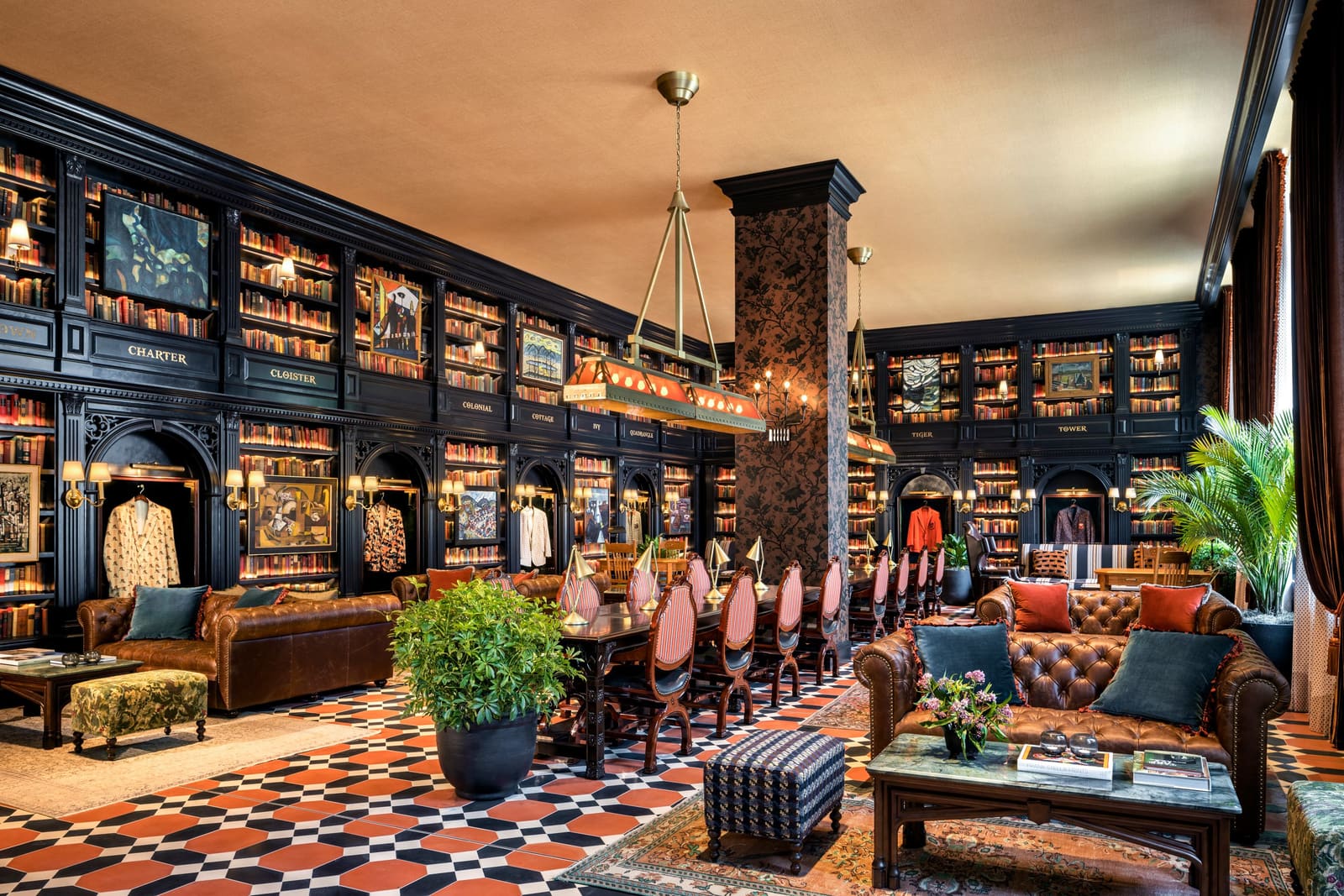
Graduate by Hilton Princeton leans into a specific fantasy: the version of university life where you spend afternoons in the library by choice, not obligation. The lobby is designed to evoke an old academic reading room, with towering bookshelves, leather seating, and vintage touches. The hotel occupies a restored 1918 building just off Princeton's campus, placing guests within walking distance of Firestone Library and the university's broader collection, which spans millions of volumes and rare materials.
The appeal is partly nostalgic, but it also taps into a broader desire for spaces that privilege quiet, focus, and the slow accumulation of knowledge. The hotel functions as a kind of gateway, offering a taste of that environment without requiring enrolment.
Grand Cayman, Fiction by the Glass
At the Kimpton Seafire Resort and Spa on Seven Mile Beach, the Library by the Sea occupies the lobby, a space that deliberately blurs the line between reading room and lounge. Guests are invited to choose a book and order a drink, with the cocktail menu inspired by celebrated works of fiction. The collection itself is eclectic, ranging across genres and eras, and the atmosphere is relaxed rather than reverent.
The approach reflects a different philosophy: that literature need not be sequestered or treated with undue solemnity, that a novel can be as much a part of a beach holiday as sunscreen or a swim. The space is designed for dipping in and out, for reading a chapter between meals, for letting a story unfold at the same pace as the afternoon.
What These Spaces Understand
The hotels on this list share a recognition that reading is not a passive act but a form of engagement, one that requires time, quiet, and a certain quality of attention. They have built their architecture and programming around that understanding, creating environments where books are not decorative but structural, where the presence of literature shapes the rhythm of the day.
Some lean into history, preserving the desks and rooms where famous authors once worked. Others build new traditions, curating collections and hosting events that bring contemporary writers into conversation with guests. A few do both, layering the past and present until the two become difficult to separate.
What they offer, ultimately, is permission. Permission to slow down, to read for hours without guilt, to let a story dictate the shape of a morning or an entire stay. In a travel landscape often defined by itineraries and efficiency, these properties insist on a different logic, one measured in chapters rather than miles, in the weight of a hardcover rather than the speed of transit. For those who still feel that particular thrill when surrounded by shelves, that logic is reason enough to book the room.