How Mexico City's Design Identity Finds Expression Inside One Hotel
At a reimagined property on Paseo de la Reforma, architecture firm Huber threads craft traditions into every surface.
A Language Spoken in Marble and Glass
The courtyard opens onto itself in the way certain Spanish Colonial buildings do, folding inward rather than announcing themselves to the street. Paseo de la Reforma hums just beyond the walls, but here the noise softens into something closer to a whisper. Red marble underfoot, quarried in Durango, catches the afternoon light. It is a material choice that says something about place - not imported travertine, not generic beige stone, but rock pulled from Mexican earth and polished to a sheen that reflects the city's own relationship with colour.
Mexico City has always understood design as a form of cultural argument. The capital does not simply adopt trends; it generates them, filters them through centuries of craft knowledge, and sends them back into the world transformed. This is a metropolis where street style rivals anything in Milan or Tokyo, where muralism is not merely an art movement but a civic language, and where the handmade carries weight that machine production cannot replicate.
Craft as Architecture
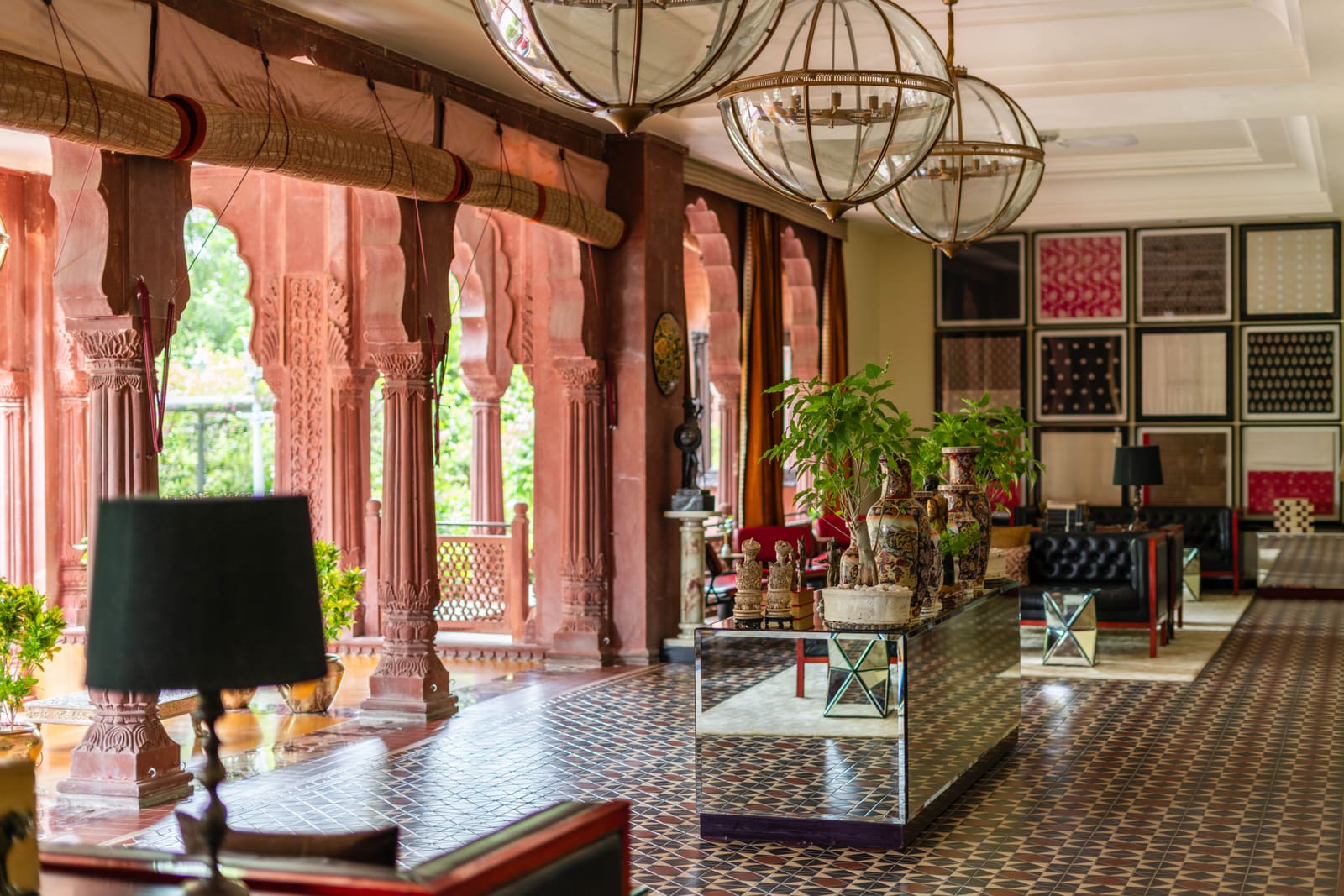
Mexican architecture firm Huber approached the reimagining of this landmark property with an eye toward that tradition. The brief was not to import a generic luxury vocabulary but to anchor the interiors in the specific craft centres that have sustained Mexican design for generations. Ceramics arrive from Guadalajara, where pottery techniques stretch back to pre-Hispanic times. Textiles come from Michoacán, a state whose weavers have perfected patterns that predate the Spanish conquest. Hand-blown glass, shaped by artisans whose workshops operate on the edges of industrial zones, filters light in ways that factory-made fixtures cannot.
This is not decoration for decoration's sake. It is an editorial stance, a deliberate choice to privilege local knowledge over global homogeneity. The interiors do not announce their provenance loudly, but they do not hide it either. The materials speak for themselves: rough-edged ceramics that bear the marks of the wheel, textiles whose irregularities reveal the loom's rhythm, glass whose slight variations in thickness catch and bend light unpredictably.
The Uniform as Manifesto
In the lobby, staff move through the space in uniforms designed by Kris Goyri, a Mexico City designer whose work has long interrogated the boundary between fashion and identity. The choice is significant. Many luxury properties default to European tailoring or bland corporate attire, a visual language that could belong to any city, any context. Here, the uniform becomes part of the design narrative, another layer in the argument that this place belongs specifically to Mexico City and nowhere else.
Goyri's approach to tailoring emphasises structure without rigidity, colour without excess. The garments do not costume the wearer; they frame them. It is a subtle distinction, but one that matters in a city where personal style is taken seriously, where what you wear is understood as a form of communication rather than mere covering.
Proximity to Green
The property sits near Chapultepec Park, one of the Western Hemisphere's largest urban green spaces and a site of layered historical significance. The park contains a castle, museums, lakes, and stretches of forest that offer reprieve from the city's relentless density. Proximity to Chapultepec is not incidental; it is one of the defining features of this particular stretch of Paseo de la Reforma, a corridor that balances commerce, culture, and nature in a way few urban arteries manage.
For visitors, this means the option to step out of the hotel's courtyard calm and into another kind of calm - one measured in hectares rather than square metres, where joggers and families and street vendors create a different rhythm. The park's presence reshapes the experience of staying in this neighbourhood, offering a counterpoint to the interior quiet the hotel provides.
Interior Courtyard Logic
The building's structure follows a logic common to colonial-era architecture: rooms arranged around a central courtyard, turning away from the street's noise and toward a shared, protected centre. It is a spatial grammar that predates modernism's glass-box transparency, one that prioritises enclosure and intimacy over exposure and display.
This arrangement has practical benefits - sound dampening, climate control, a sense of removal from the city's intensity - but it also carries symbolic weight. The courtyard model speaks to a particular understanding of luxury, one rooted in retreat rather than spectacle, in the pleasure of being hidden rather than seen. In a city as visually assertive as Mexico City, where murals shout from building facades and street art claims every available surface, the inward-facing courtyard offers a different kind of statement: the luxury of withdrawal, of choosing when and how to engage with the urban surround.
The Design Bar
Mexico City sets a high bar for visual coherence. Walk through neighbourhoods like Roma Norte or Condesa, and the attention to detail becomes apparent - not just in flagship boutiques or gallery spaces, but in corner cafés, independent bookshops, even the signage above taquerías. Design here is democratic, pervasive, expected. It is not the exclusive domain of the wealthy or the art-adjacent; it is a baseline standard, a shared civic expectation.
This context shapes how visitors experience the city's hospitality spaces. A hotel that might read as luxurious in another capital can feel anonymous here if it does not engage with local craft traditions, if its interiors could belong to anywhere. The decision by Huber to source materials from Guadalajara, Michoacán, and Durango is not simply about supporting local economies - though it does that - but about meeting the city's design expectations, about demonstrating that the property understands where it is and what that place demands.
Beyond Boutique
The property carries a name-brand affiliation, which typically signals a certain kind of standardised luxury: reliable service protocols, predictable amenities, a formula refined across dozens of global locations. Yet the courtyard structure and the emphasis on locally sourced craft push the experience toward something closer to boutique sensibility - smaller in feeling, more particular in its details, less concerned with replicating a global brand language and more interested in responding to this specific site.
This tension between brand consistency and local specificity is one that many international hotel groups navigate with varying degrees of success. Here, the balance tilts toward place. The comfortable beds and wellness amenities - pool, gym, spa - anchor the experience in familiar luxury territory, but the red Durango marble, the Michoacán textiles, the hand-blown glass from local workshops, and the Kris Goyri uniforms layer on a specificity that resists easy replication.
What the Materials Know
There is knowledge embedded in craft that cannot be transmitted through blueprints or specification sheets. The ceramicist in Guadalajara who shapes clay on a wheel knows things about form and balance that emerge only through repetition, through years of hands meeting material. The weaver in Michoacán working a backstrap loom understands tension and pattern in a way that cannot be reduced to algorithm. The glassblower shaping molten silica into lampshades carries techniques passed down through generations, refined in workshops where learning happens through observation rather than instruction manual.
When a hotel interior incorporates these objects, it is not simply acquiring decorative elements. It is bringing that accumulated knowledge into the space, allowing it to shape how light moves, how surfaces feel, how a room holds attention. The irregularities and imperfections that mark handmade objects - the slight wobble in a ceramic vase, the subtle variation in a textile's weave, the uneven thickness of blown glass - are not flaws but evidence of process, records of human decision-making that machine production erases.
The Street Beyond
Paseo de la Reforma remains one of Mexico City's grand boulevards, a thoroughfare that cuts diagonally across the city's grid, lined with monuments, corporate towers, and cultural institutions. It is a street that sees protests and parades, that functions as both transit corridor and public stage. The energy there is constant, sometimes overwhelming.
The hotel's courtyard model offers a threshold between that intensity and a more measured interior calm. It is not an escape - Mexico City is too present, too insistent, to ever fully disappear - but a modulation, a way of stepping back without leaving. For travellers who want to engage with the city's design culture, who plan to spend days moving through galleries and markets and studios, that threshold becomes essential. The courtyard is where you return, where you let the city's accumulated impressions settle before heading back out.