Where Ancient Hospitality Meets Vertical Ambition in Tokyo
The Japanese capital's accommodation landscape has evolved into a study in contrasts, where neighborhood-scale intimacy competes with soaring glass towers for the traveler's attention.
A City That Builds Upward and Inward Simultaneously
Stand on any corner in Nihonbashi and you'll notice something peculiar: a nine-story building wrapped in rust-colored balconies, each one brimming with greenery like a vertical garden suspended mid-air. This is Soil Nihonbashi, where architect Kiyoaki Takeda walked the surrounding streets cataloguing the potted plants residents keep on sidewalks, then reimagined that everyday practice as architecture. The result is a hotel with just 14 rooms across nine floors, where the lobby has been replaced entirely by a 20-seat pizzeria and check-in happens at a modest desk beside it.
The design philosophy here represents something larger happening across Tokyo's accommodation landscape. While other global cities chase height and spectacle, the Japanese capital has quietly cultivated a parallel tradition: hotels that embed themselves into neighborhoods rather than tower above them. Floor-to-ceiling windows frame natural light. Custom-dyed paper lamps cast warm shadows. Plants donated by neighbors grow both on balconies and inside rooms. A pocket-sized rooftop hosts a few tables and chairs beside herb gardens where eggplants and olives somehow thrive in the urban air.
This is not the Tokyo of neon and noise, though that version certainly exists a few train stops away. This is the city as it reveals itself to those willing to look closely at the small gestures, the human-scale interventions, the architecture that asks questions rather than shouts answers.
The Art Deco Filter Applied to Japanese Minimalism
In Shibuya, a different kind of transformation has taken place. When a certain boutique-scale property opened in 2002 on the lower floors of an office tower, its 57 rooms made it an anomaly in a city that equates luxury with altitude. The building presented challenges: massive structural columns, awkward floor plates, ceilings that varied wildly in height. The original designers worked around these constraints. Twenty years later, André Fu approached the same space and decided to treat architectural quirks as inspiration rather than problems to solve.
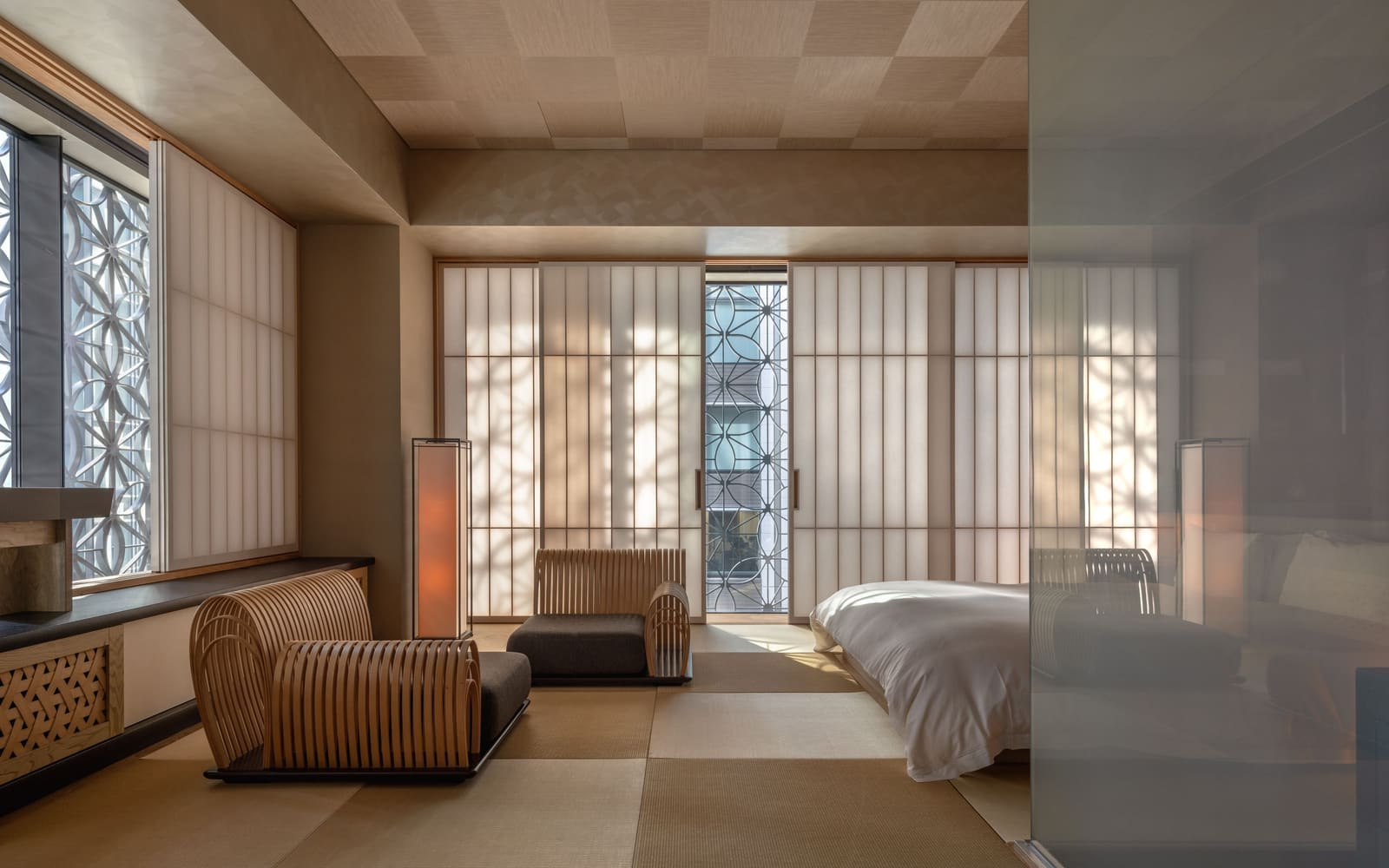
Round the lobby and a miniature rock garden appears through the window before the space opens onto a bright lounge under triple-height ceilings. Natural oak meets grey marble meets washi paneling. The effect reads as Art Deco filtered through a contemporary Japanese lens, faintly reminiscent of Alice in Wonderland but grounded in materiality rather than fantasy. Business travelers share the space with families and couples, all of them benefiting from Fu's decision to turn structural necessity into set pieces.
The crowd here reflects Tokyo's broader evolution as a destination. No longer solely the domain of business travel or guided tour groups, the city now attracts a more varied audience: solo travelers seeking cultural immersion, families drawn by safety and infrastructure, couples chasing romance in a setting that feels simultaneously familiar and foreign.
Intimacy as Luxury in Marunouchi
Not every luxury property in Tokyo subscribes to the grand entrance theory. In the quiet Marunouchi district, one particular property with just 57 guest rooms takes an opposite approach. There are no marble floors echoing with the click of heels, no grand staircase designed for dramatic arrivals. Instead, interiors stress a lounge-like atmosphere that prioritizes intimacy over spectacle. Cushy upholstered chairs, plush sofas, thick area rugs, smooth wooden floors. The design feels cut from a more relaxed cloth, though the service standard remains uncompromised.
This represents a conscious decision to let Tokyo's energy remain outside. The booking is about sitting back, about exhaling, about creating a buffer between the traveler and the city's relentless pace. Other hotels bring more flavor, more edge, more obvious personality. This one offers consistency, predictability, the comfort of knowing exactly what awaits behind the door.
The approach won't suit everyone. Travelers seeking immersion in Tokyo's chaos will find this too removed, too subdued, too insulated. But for those who need a counterbalance to the city's intensity, the strategy makes perfect sense. Luxury here is defined not by spectacle but by the quality of silence, the depth of comfort, the space to think clearly.
Kabuki Theater as Interior Design Inspiration
Ginza has always been Tokyo's most polished shopping district, where luxury brands cluster along wide boulevards and weekend afternoons bring crowds dressed as though heading to opening night at the opera. A newer property here takes playful cues from the Kabukiza Theater around the corner. Muted greens and persimmon oranges drawn from the theater's iconic curtain carry through 273 rooms. The yellow-and-green entrance nods to ginkgo trees lining surrounding streets. Bold, graphic interiors deliver serious comfort at a price point well below Ginza's luxury competition.
The real differentiator hides behind a mirrored door in the lobby: Kobikicho Club, an authentic "snack" bar where karaoke continues until 1 a.m. It's an unexpected amenity in a district known more for high-end department stores than late-night revelry, but it speaks to a broader trend in Tokyo hospitality. Hotels are no longer content to simply provide beds and bathrooms. They're becoming cultural interpreters, offering guests access to experiences that might otherwise require local knowledge or language skills.
The snack bar tradition occupies a specific place in Japanese nightlife: intimate, convivial, slightly nostalgic. Transplanting it into a hotel lobby makes it accessible to travelers who might feel intimidated by the prospect of finding and entering such an establishment on their own. Whether this represents cultural preservation or cultural commodification depends largely on execution and intent.
Sanctuary Above the Neon Chaos
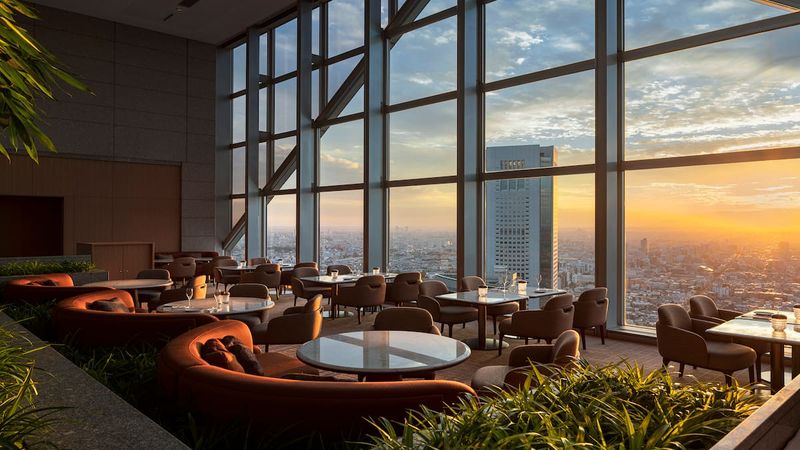
Across the 38th to 43rd floors of a tower in Akasaka, a different philosophy takes shape. Here, 211 rooms combine nature-inspired interiors with subtle local touches: revived Japanese crafts, upcycled moss artwork, meditation beds, spa-like bathrooms. An indoor pool ringed with plants offers views that make the city feel distant despite being directly below. Staff dress in minimalist gear and maintain a friendly, helpful, laid-back manner that avoids the stiffness sometimes associated with luxury hospitality.
Sustainability runs through every detail. No single-use plastics. Recycled glassware. Water-saving showers. An initiative encouraging guests to leave behind one item for charity. These aren't afterthoughts or marketing gestures but fundamental design principles, integrated from the beginning rather than retrofitted later.
The approach raises interesting questions about what luxury means in an era of environmental awareness. Can a hotel be simultaneously indulgent and responsible? Can guests enjoy comfort without guilt? The property suggests yes, though the answer requires rethinking certain assumptions about what luxury requires. Marble flown from Italian quarries gives way to locally sourced wood. Elaborate floral arrangements are replaced by living plants that clean the air. Excess is redefined not as abundance but as thoughtful sufficiency.
The Cinematic Legend Reimagined
In Shinjuku, a tiered tower inspired by architect Kenzo Tange achieved a peculiar form of immortality when it appeared in an Oscar-winning screenplay in the early 2000s. That air of enchantment has persisted through a 19-month closure and thorough renovation. The graceful reinvention retains its subtly moody, slightly traditional, forest-imbued quality while ramping up contemporary residential-style luxury. Original artworks hang alongside new commissions from the same Japanese talents, creating continuity across decades.
The renovation faced a delicate challenge: how to refresh a property that had achieved iconic status without alienating the patrons who loved it precisely as it was. The solution involved respecting the initial vision while acknowledging that tastes and expectations evolve. What felt cutting-edge in 2001 might read as dated in 2026 without careful intervention.
Walking through the renovated spaces, you sense the tension between preservation and progress. Certain elements remain untouched because they define the property's identity. Others have been subtly updated, improved in ways that only become apparent through use. A light fixture casts a warmer glow. A sofa offers better lumbar support. The changes are individually small but cumulatively significant, like aging gracefully rather than attempting to reverse time.
The Bubble-Era Set Piece in Akasaka
Some hotels wear their history more openly. In the Akasaka district, near the Roppongi border, a lobby serves as a vast bubble-era set piece: soaring double-height ceilings gridded with geometric lights, warm wood paneling, a glowing staircase. At 3 p.m., pilots and cabin crew roll carry-ons past families at the check-in counter while business travelers head for the Club Lounge upstairs. Women linger over afternoon tea in the Atrium Lounge.
Renovated rooms lean into subdued Japanese modernism. Origami-inspired geometric patterns. Custom carpets with cherry blossom motifs in grey, soft pink, and indigo. A wine-colored cast-iron teapot for tea. The aesthetic walks a line between nostalgia and contemporary taste, acknowledging the building's 1980s origins without being trapped by them.
The location offers proximity to multiple neighborhoods. Roppongi's restaurants and bars sit within walking distance. Suntory Hall is two minutes away, making this the obvious choice on concert nights. Toranomon Hills and Azabudai Hills are both accessible on foot for shopping and dining. The property functions as a hub, a base camp from which to explore various facets of Tokyo rather than a destination unto itself.
Copenhagen Chic Meets Yoyogi Park
In the neighborhood bordering Yoyogi Park, a property that began as an event venue and planning service has expanded its hotel offerings based on overwhelming popularity. "Copenhagen-chic" defines the prevailing style. For entry-level rooms, views of the park rather than backstreets make a significant difference; when square footage is limited, visual access to sky and trees creates a feeling of spaciousness.
Colorful pieces of art on various walls deserve special attention. All were created by artists with special needs through a not-for-profit initiative, and all are available for purchase. It's a gesture that goes beyond decoration to become a statement about who gets to participate in the cultural conversation, whose work gets displayed, whose creativity receives validation and economic support.
The model here suggests hotels can function as more than temporary accommodation. They can serve as galleries, as platforms, as mechanisms for directing attention and resources toward communities that often operate at the margins of the art world. Whether guests actually purchase the work matters less than the fact that the option exists, that the art is presented as worthy of acquisition rather than merely suitable for filling wall space.
The Shinjuku Option for Minimal Downtime
Not every traveler prioritizes time spent in their room. For those who view hotels primarily as places to sleep between full days of exploration, a newer Shinjuku property offers colorful carpets and wooden paneling that elevate the experience beyond purely functional accommodation. Rooms beyond the entry-level category are reasonably spacious, a particular boon for older travelers or those with mobility needs who require extra space to move comfortably.
The value proposition is straightforward: comfortable, predictable, well-priced. No dramatic design statements, no cutting-edge architecture, no claims to cultural significance. Just a reliable place to rest in a neighborhood that never sleeps. For a certain kind of traveler, this is exactly what Tokyo requires. The city itself provides the stimulation, the novelty, the visual feast. The hotel simply needs to offer respite.
This utilitarian approach has its own integrity. Not every property needs to be a destination. Sometimes a hotel's greatest virtue is getting out of the way, allowing the city to remain the focus of the journey.
What the Contrast Reveals
Tokyo's accommodation landscape has matured into something more complex than a simple hierarchy of luxury to budget. Instead, properties now occupy various positions along multiple axes: neighborhood integration versus vertical isolation, spectacle versus intimacy, cultural immersion versus international familiarity, architectural statement versus functional simplicity.
The diversity reflects the city itself, which has never been easily categorized. Tokyo contains multitudes: ancient temples and neon-lit alleys, hushed tea ceremonies and screaming pachinko parlors, meticulous gardens and chaotic train stations. Hotels that succeed here tend to embrace this complexity rather than resist it, offering a particular point of view rather than attempting to be all things to all travelers.
The choice of where to stay becomes a choice about what kind of Tokyo experience you seek. Do you want to be embedded in a neighborhood, learning its rhythms and routines? Or do you prefer altitude, the perspective that comes from looking down at the city from 40 floors up? Do you value design innovation, or does consistency matter more? Is sustainability a priority, or is it enough that the sheets are clean and the location convenient?
There are no wrong answers, only different preferences. The traveler who books a 14-room property wrapped in balcony gardens will have a fundamentally different experience than the one who checks into a soaring glass tower with hundreds of rooms. Both will see Tokyo, but through different lenses, shaped by different architectural philosophies and hospitality strategies.
The city accommodates both approaches, and dozens of variations in between. After decades of development and refinement, Tokyo has built an accommodation infrastructure that matches its complexity as a destination. The challenge now belongs to travelers: knowing yourself well enough to choose the right lens through which to view this endlessly fascinating metropolis.