Four New Retreats Where Craft and Place Take Precedence Over Spectacle
From an 11th-century hamlet in the Chianti hills to a restored motel in Fort Lauderdale, a new generation of hotels is choosing quiet craftsmanship over grand gestures.
A Return to the Unhurried
There is a certain kind of hotel that announces itself from the moment you glimpse the façade. Chandeliers cascade from double-height lobbies. Marble stretches in every direction. The architecture shouts.
And then there is another kind, one that whispers. At Global Chic Voyage, we've watched a quiet countermovement take shape over the past year: properties that choose restraint over spectacle, that root themselves in the specific materials and rhythms of their regions, that understand luxury not as volume but as coherence. Four recent openings scattered across Italy, Austria, and the United States offer a study in this philosophy, each one a meditation on what it means to belong to a place.
Chianti: An Estate Built from Renaissance Stone
Less than an hour south of Florence, a hamlet dating to the 11th century has been reimagined as La Darbia, a retreat that reads less like a hotel and more like an extended family compound. The restoration, led by architect brothers Gian Carlo and Matteo Primatesta, adhered to a strict material vocabulary: pietra serena, the grey sandstone Michelangelo favored during the Renaissance; terracotta from Impruneta, the same town that supplied tiles for the dome of Florence's cathedral; and travertine quarried from centuries-old sites in Rapolano.
"We weren't looking for a famous destination for its own sake," Gian Carlo Primatesta explained, "but for somewhere with a strong sense of place and a genuine identity." The result is a property that feels less constructed than unearthed, as though it had been waiting beneath the Tuscan soil all along.
The restaurant operates on the estate's agricultural calendar. Olive oil is pressed from the on-site grove; lavender honey arrives from 40 beehives maintained on the property. Chefs Matteo Monfrinotti and Sebastiano Pagliaro have built a menu that shifts with the seasons and the harvest, a radical act of patience in an era when most kitchens source from global supply chains.
Cypress trees frame the approach. Sun-bleached stone absorbs the afternoon light. Sloping vineyards roll toward the horizon. Yes, these are the clichés of Tuscany, but they are clichés because they endure, because they work, because they offer a kind of beauty that resists improvement.
Vienna: Wilhelminian Grandeur Meets Contemporary Clarity
On Mariahilfer Strasse in Vienna, a historic Wilhelminian building has been transformed into The Companion, a hotel that balances the weight of its architectural heritage with a lightness of touch. Berlin-based architect and interior designer Piotr Wisniewski was entrusted with the interiors, and his approach was one of conversation rather than confrontation.
Columns marked by decades of wear stand alongside black-lacquered metal beams. Terrazzo floors reference Vienna's material traditions without reproducing them slavishly. In the lobby, shelves crafted from bubinga veneer surround a fireplace, creating a space that feels both public and intimate, a place to linger rather than merely pass through.
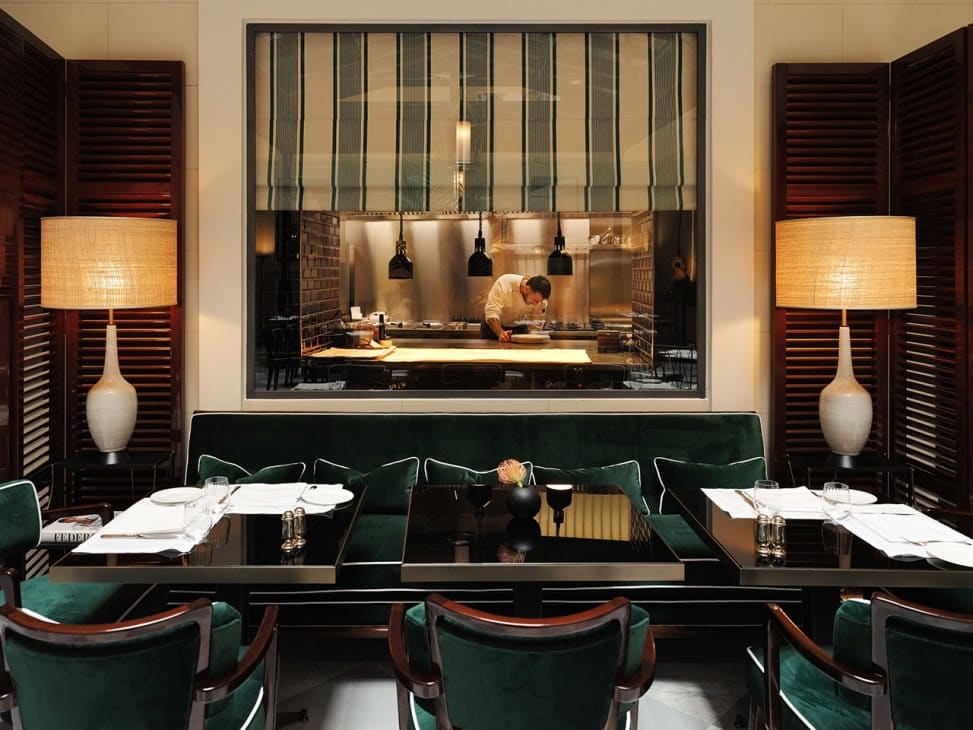
The restaurant, Boca, is led by chef Lauryn Therin, who honed her skills at London's Ottolenghi before returning to the Continent. Her menu leans toward communal Mediterranean dishes: tuna skewers dressed with pistachio, tahini, and sumac; platters meant to be shared rather than portioned. It is cooking that assumes generosity, that expects conversation.
Wisniewski's work at The Companion reflects a broader understanding that historic buildings need not be embalmed. They can be inhabited, adapted, made relevant again. The trick is knowing what to preserve and what to reimagine, when to defer to history and when to write a new chapter.
Fort Lauderdale: A 1950s Motel Reimagined
In Fort Lauderdale, where ever-larger resorts continue to redraw the skyline of what was once called the "Venice of America," Perroquet has chosen a different path. Tucked onto a leafy residential street between the Intracoastal Waterway and the Atlantic Ocean, the 37-key hotel occupies a 1950s motel that Belgian architect Bernard Dubois has transformed into a polished retreat.
The emphasis here is on quiet craftsmanship, a deliberate counterpoint to the spectacle that often defines South Florida hospitality, particularly in neighboring Miami. Dubois did not erase the building's mid-century bones; instead, he embraced them. The original low-rise footprint remains intact. Lush landscaping and carefully choreographed outdoor spaces unfold gradually, revealing themselves in stages from arrival to poolside.
Guest rooms continue this narrative. Custom furniture sits alongside Sferra linens and Byredo amenities. The art collection includes works by Jean Cocteau and Jeff Koons, a pairing that speaks to the hotel's willingness to juxtapose eras and sensibilities without anxiety.
Perroquet has arrived at a moment when Fort Lauderdale is broadening its cultural ambitions. The boutiques of Las Olas Boulevard, the 14-hectare Bonnet House Museum and Gardens, and the NSU Art Museum are all within a ten-minute drive, making the hotel a credible base for travelers who want more than beach and sun.
Rome: Apartments Imagined on a Grand Scale
Walk into a unit at Casa JK Place in Rome and the first impression is one of scale. These are not hotel rooms in any conventional sense; they are apartments imagined with the proportions and amenities of a five-star property. In the living rooms, gold-handled double doors seem to multiply, each one opening onto a new discovery: a black marble bathroom here, a sprawling kitchen topped with Calacatta marble there, bedrooms painted in Venetian red, ivy green, and tobacco tones.
"Everyone dreams of a home that's like a hotel and a hotel that's as cozy as a home," says Michele Bönan, the Florence-based architect behind Casa JK Place and its European siblings. Over 25 years, Bönan and Ori Kafri, owner of the JK Place group, have developed a signature aesthetic: Florentine grandeur rendered in richly saturated hues, chrome and velvet, with antique statuary and vintage pieces that give each property the feel of a collector's residence.
"Our clients are looking for privacy and flexibility," Kafri notes. It is a telling observation. The traditional hotel model, with its fixed meal times and regimented services, no longer satisfies a certain kind of traveler. They want the infrastructure of hospitality without its constraints, the polish of a hotel without its public character.
The JK Place group now has properties in Capri and Paris, with a 41-key hotel opening next year in Milan. Casa JK Place in Rome represents the fullest expression of this vision: a hotel that functions as a series of private residences, each one a small world unto itself.
The New Luxury Playbook
What unites these four properties is not a shared aesthetic or a common location but a philosophy. They have chosen to root themselves in the materials, rhythms, and identities of their places. They have rejected the impulse to announce themselves loudly. They understand that luxury, at its most refined, is not about volume but about coherence, not about spectacle but about belonging.
In an age when so much of travel feels frictionless and interchangeable, when the same hotel brands replicate themselves across continents, these retreats offer something increasingly rare: a sense of specificity. They are hotels that could only exist where they are, built from the stone and traditions and histories of their regions. They are places that whisper rather than shout, that invite you to slow down, to notice, to stay a while longer.
We return to them not because they dazzle but because they endure, not because they impress but because they feel right. And in the end, that may be the truest measure of hospitality: not how loudly a place announces itself, but how deeply it allows you to settle in.