Belitung's New Geopark Status Marks a Turning Point for Indonesia's Quietest Coast
On a boot-shaped island off Sumatra, granite monoliths and nocturnal primates share space with a rare experiment in regenerative hospitality.
A Road Almost Empty
The tarmac cuts through villages where roofs tilt toward the sea and scooters pass every few minutes, stacked improbably high with passengers. Belitung feels like a place held in suspension, its coastline still mostly unscripted, its pace dictated by the rhythm of tide and light rather than tour-bus schedules. The island lies off the coast of Sumatra, shaped like a boot, and for decades it has remained outside the itineraries that funnel travellers through Bali and Lombok and the Gilis. That is changing now, though the change is still measured in whispers rather than arrivals.
In 2025, UNESCO granted the island Global Geopark status, a designation that recognises geological significance while setting expectations for environmental stewardship and community-led development. The designation covers 17 geosites scattered across the island, from Triassic granite formations that rise like sails from turquoise water to a rare black tektite formed when a meteorite struck tin-rich earth more than 700,000 years ago. A new direct flight from Singapore has begun, and two hotels built on regenerative principles now operate within a protected coastal reserve. The question hanging over Belitung is whether it can welcome visitors without eroding the qualities that make it worth visiting in the first place.
Forest, Marriage Rites, and a Creature with Olive Eyes
Bukit Peramun sits half an hour inland from the coast, a community-managed forest of 60 hectares where ironwood and wild fig grow thick. The guide, Jimie Afrian, leads the way along a trail strewn with leaves, pointing out ginseng roots used in herbal medicine and a pair of granite boulders known as Batu Kember, the Twin Rocks. Teenagers from the surrounding villages once hiked here to test their readiness for marriage. They would stand between the rocks, arms stretched wide. If their fingertips touched both surfaces, the community deemed them adults.
The forest is home to pangolins, hornbills, and mousedeer. Until recently, visitors could wander alone; now a guide is mandatory. Afrian is clear about the stakes. From a wooden viewing platform overlooking farmland, palm-oil plantations, and forest, he says, "It may only be 60 hectares, but we will protect it."
The path climbs toward the park's highest point, where a pop-up restaurant serves tea and fresh cassava with local honey. The sky shifts through ochre and lilac as the sun drops behind the hills. But the real draw arrives after dark. Rangers move ahead with infrared lights, searching for the endangered Belitung tarsier. The nocturnal primate is shy, preferring the high canopy. Then one of the rangers signals, and the group moves quickly and quietly. Six feet overhead, a long pink tail dangles from a branch. The tarsier's large olive eyes study the intruders, its toes curling and uncurling around the wood. Afrian allows only a brief encounter. "You are using up their time to get food," he says.
Two Hotels, One Coastal Reserve
The Tanjung Kelayang Reserve stretches across 350 hectares along the coast. Two hotels operate within its boundaries, both designed with environmental constraints in mind. The Sheraton Belitung uses handmade clay bricks and renggadai wood, collects rainwater, and relies in part on solar energy. Where other resorts might install lawns, the Sheraton has built ecoponds lined with kaolin clay, a natural filtration system. Further along the shore, the Billiton Ekobeach Retreat constructs its villas from dolken logs and nipa palm leaf roofs.
The reserve also includes a stingless bee farm where honey is served straight from the hive, and a network of trails through regenerating forest. The arrangement reflects a broader ambition, articulated by hoteliers and guides alike, to demonstrate that tourism can reinforce rather than deplete the landscape.
Island-Hopping Through Granite and Coral
A boat departs from the beach in front of the Sheraton, piloted by Rio, with 18-year-old Alif Faozin as guide. Faozin recently returned to Belitung after time away, drawn by the prospect of work in the emerging tourism sector. His parents, employed by palm oil companies, are pleased he can meet people from other countries and share stories of the island.
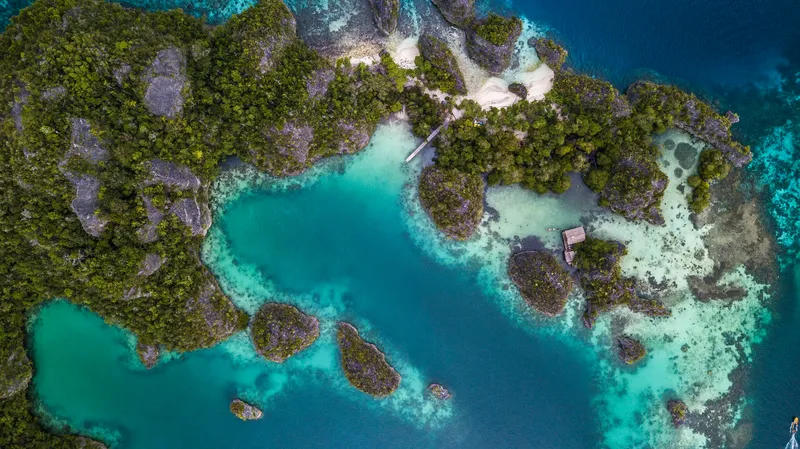
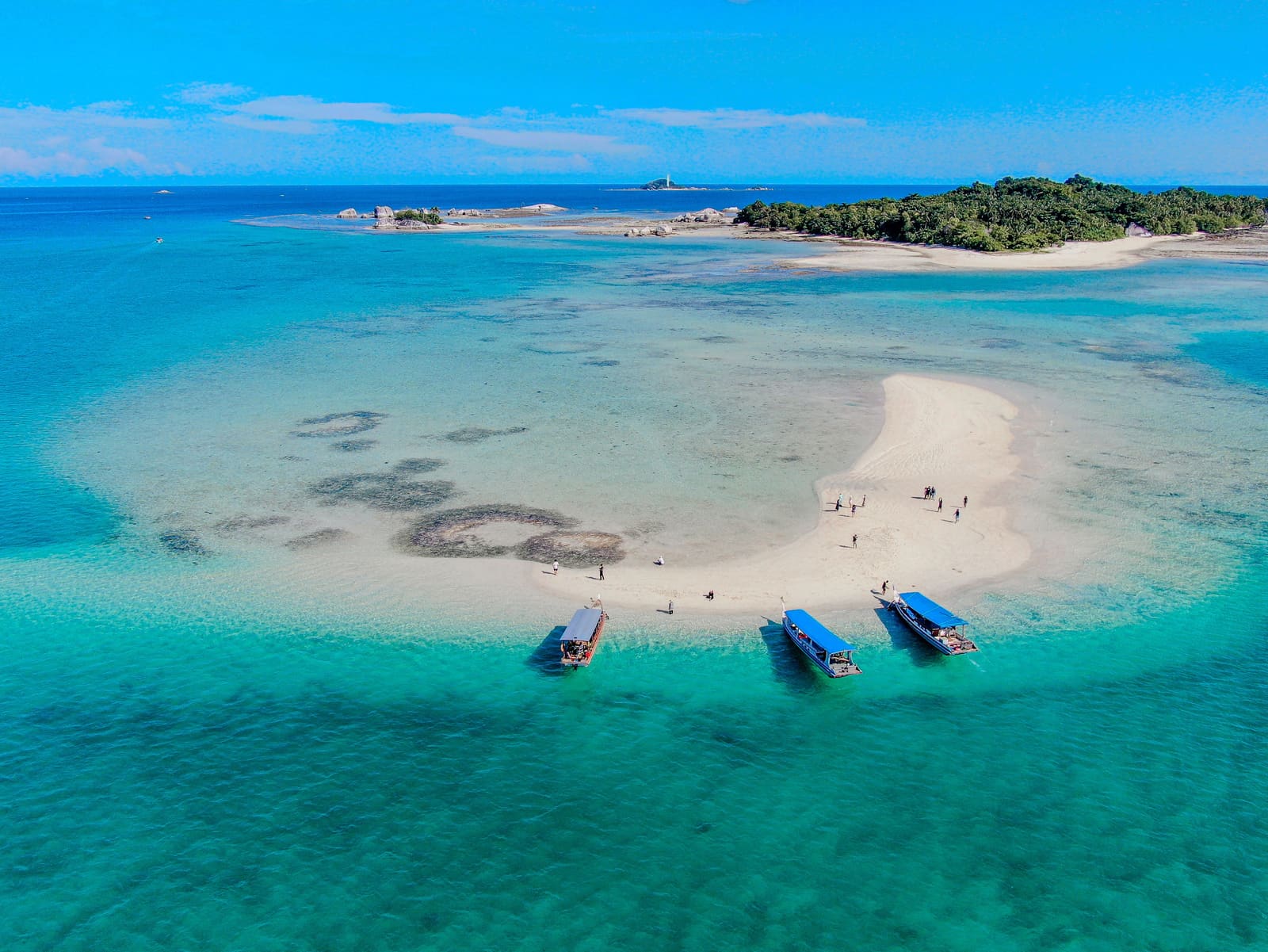
The boat weaves between tropical islands crowned with coconut palms and granite formations stacked in improbable geometries. In the shallows, locals dive for sea cucumbers and, occasionally, remnants of ninth-century Tang dynasty treasure, a trove discovered in 1998. The boat pauses at a sandbank where hot pink starfish cluster, then continues to Kelayang Island. Bamboo huts dot the shore, where locals wait to feed travellers. A leafy trail leads to Kelayang Cave, where bats hang drowsy after a night of feeding.
Lengkuas Island, marked by a 19th-century Dutch lighthouse, draws picnickers. Underwater, the reef is a layered expanse of fan corals in purple and gold. Clownfish move over sea anemones; pastel parrotfish glide through the water. The reefs are part of what the geopark designation is meant to protect, along with the Triassic granite and the Satam stone, the jet-black tektite that islanders once cut and polished for jewellery, believing it brought luck and warded off misfortune. The stone is now protected, and visitors are offered replicas made by BICA Ceramic, a community-led workshop that uses Belitung clay.
Batik, Identity, and the Pace of Encounter
Bella Kartika Aprilia, a former pharmacist, founded the batik brand Sepiak Belitung. Her designs feature motifs specific to the island: white pepper, wooden fishing boats, the tiered candle umbrella. "I wanted to create something that didn't just sell clothing but also carried Belitung's identity," she says. "For me, batik is one way to tell the story of a place: its nature, its culture, its people, and the hopes it holds."
Aprilia collaborates with more than 20 local artisans to produce resortwear sold in her shop and in hotel boutiques. She describes Belitung as suited to travellers who want to slow down, to meet people and understand culture rather than simply photograph landmarks. The sentiment is echoed across the island, by guides and hoteliers and artisans who see the geopark designation not as a marketing tool but as a framework for a different kind of encounter.
Castaway for an Afternoon
The boat pulls into a private bay ringed by large rocks that form a half-moon around a small beach. Onshore, a tent fringed with palm leaves sits beside colourful beanbags, a stack of novels, and a small campfire. The captain jokes that he will return tomorrow. The joke lands because tomorrow, in this particular bay, with a fresh coconut in hand and the only sound the lap of water against granite, feels impossibly distant.
Belitung's geopark status has set something in motion. The direct flight, the hotels, the trained guides, the replicas of sacred stone, all point toward an industry taking shape. Whether the island can scale its tourism without losing the qualities that make it legible as a place rather than a product remains an open question. For now, the answer is written in the details: the brevity of the tarsier encounter, the clay-lined ponds, the batik that carries the pattern of pepper vines. The island is building its blueprint in real time, and the world is beginning to watch.