Yokohama: Where Fuji Silhouettes Meet Ramen Museums and Harbour Promenades
A thirty-minute rail ride from Tokyo, Japan's second-largest city offers waterfront boulevards, steaming bowls in the country's oldest Chinatown, and a curious temple to instant noodles.
A Harbour Shaped by History
Stand at the edge of Yamashita Park on a clear morning and you may catch Mount Fuji suspended above the bay, pale and improbable against the industrial cranes of Japan's busiest container port. Yokohama's waterfront has always been a threshold, the place where Japan first opened its gates to foreign trade in 1859, and the architecture still reflects that collision: brick warehouses from the Meiji era sit alongside glass towers, and the scent of soy and star anise drifts up from alleyways that have fed dockworkers for more than a century.
Thirty minutes south of Tokyo by express train, Yokohama remains in the capital's gravitational field yet maintains a distinct cadence. The streets are wider. The skyline lower, except where it spikes. There is more water, more weather, more room to walk without purpose.
The Largest Chinatown in the Country
Yokohama's Chinatown is not a preserved quarter or a themed district. It is a working neighbourhood, hemmed in by ornate gates and humming with the everyday commerce of grocers, herbalists, and more than two hundred restaurants. Established in the 1860s by Cantonese merchants who arrived with the opening of the port, it has expanded and contracted with the tides of migration and war, but never disappeared.
Walk Chukagai Odori, the main avenue, and you will see queues outside steamed-bun shops at midday, families navigating dim sum trolleys, and elderly women buying dried seafood by the kilo. The temples are small and smoky. Offerings are made in Mandarin, Cantonese, Japanese. The cuisine skews Cantonese but has absorbed influences from Sichuan, Shanghai, and the Japanese palate's preference for lighter broths and less oil.
For a meal that captures the layering, try a table at Heichinrou, one of the oldest establishments, where Peking duck is carved tableside and the dining rooms overlook courtyards planted with bamboo. The restaurant has been operating since 1884, and its longevity is less about nostalgia than about consistency: the same recipes, the same suppliers, the same attention to the temperature of the teapot.
A Museum Devoted to Instant Noodles
In 1958, Momofuku Ando, a Taiwanese-Japanese inventor, fried the first batch of instant ramen in a shed in Osaka. Thirteen years later, he introduced Cup Noodles, a waterproof container that could be filled with boiling water and eaten without a bowl. The product became a global phenomenon, and Yokohama built a museum to honour it.
The Cupnoodles Museum is not ironic. It is earnest, polished, and unexpectedly absorbing. Visitors can trace the evolution of packaging design across five decades, watch factory machinery in action, and design their own cup noodle flavour combinations at an interactive station. There is a theatre that screens a short film about Ando's life, and a play area for children styled as a noodle factory.
What makes the museum compelling is not the subject matter alone but the way it treats invention as a form of problem-solving rooted in observation. Ando noticed that people queued in the cold for fresh ramen. He wondered if noodles could be shelf-stable. He experimented with frying techniques until he found one that created air pockets, allowing rapid rehydration. The museum frames this process as both humble and transformative, a reminder that infrastructure and convenience shape how cities eat.
Waterfront Walks and Repurposed Warehouses
Minato Mirai 21, the city's harbourfont district, was built on reclaimed land and decommissioned dockyards beginning in the 1980s. The result is a planned neighbourhood of shopping malls, corporate headquarters, and public plazas that feels less like Tokyo's dense spontaneity and more like a Pacific Rim cousin to Vancouver or Sydney.
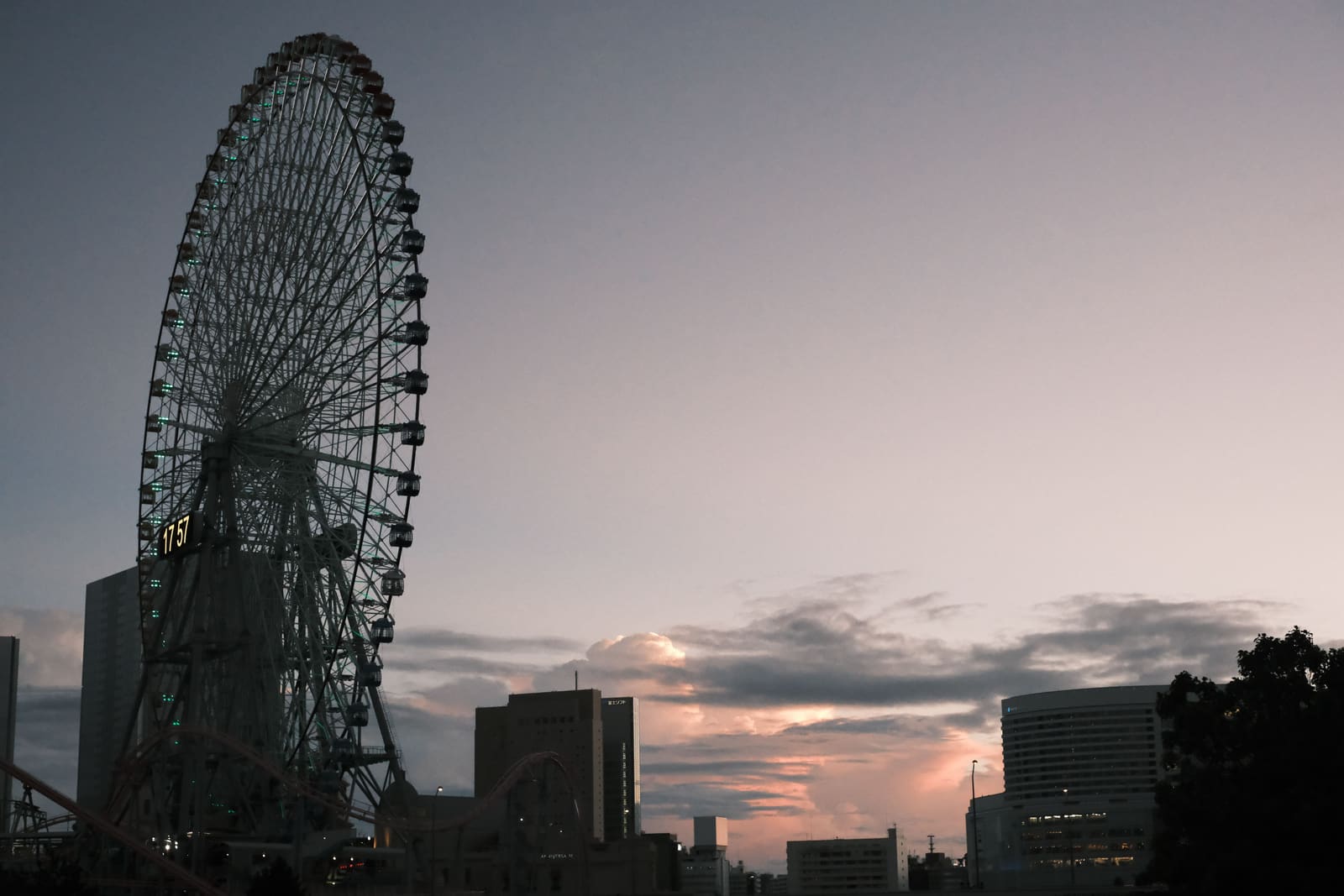
The Landmark Tower, once Japan's tallest building, offers observation-deck views that stretch across the bay to the Boso Peninsula and, on fortunate days, to Fuji's cone. Below, the Cosmo Clock 21 Ferris wheel turns slowly above the water, and couples stroll the boardwalk at dusk.
More atmospheric are the Aka Renga Soko, the Red Brick Warehouses, a pair of Meiji-era structures that now house cafés, craft shops, and event spaces. The exteriors have been preserved, the interiors gutted and reconfigured. On weekends, the plaza between the two buildings hosts markets: organic vegetables, handmade ceramics, small-batch sake. It is a gentle commercialism, more artisan than corporate, and the brick and iron lend it a texture that the glass towers lack.
Sankeien Garden and the Art of Borrowed Landscape
A twenty-minute bus ride from the harbour brings you to Sankeien, a seventeen-hectare garden assembled in the early twentieth century by Tomitaro Hara, a silk merchant and patron of the arts. Hara purchased historic tea houses, villas, and pagodas from Kyoto and Kamakura, dismantled them, and reconstructed them within his estate, creating a curated landscape that telescopes several centuries of Japanese architectural history into a single afternoon's walk.
The garden is designed around the principle of shakkei, or borrowed scenery, where distant mountains and sky are framed by foreground plantings to create the illusion of infinite depth. In spring, cherry blossoms float above the ponds. In autumn, maples turn the hillsides amber and rust. The structures themselves, some dating to the sixteenth century, are open for exploration: you can sit on tatami mats in a tea pavilion and watch light move across shoji screens, or climb the steps of a three-storey pagoda relocated from a temple in Kyoto.
Sankeien is not widely known outside Japan, and that relative obscurity is part of its appeal. It remains a place where locals come to mark the seasons, to practice photography, to simply sit. The quiet is profound, broken only by the rustle of leaves and the occasional clack of a bamboo water feature.
Mount Fuji from the Bay
Yokohama's proximity to Mount Fuji is a matter of sightlines and weather. The mountain is visible from several points along the waterfront, particularly from Osanbashi Pier, a wave-shaped terminal that juts into the harbour and offers unobstructed views west. Early morning and late autumn provide the clearest conditions, when the air is dry and the mountain emerges from the haze.
Fuji is eighty kilometres away, but the scale of it collapses distance. It dominates the horizon without effort, a geometry so perfect it seems less natural than inevitable. For travellers accustomed to seeing the mountain in ukiyo-e prints or tourist brochures, the real thing can be both more and less impressive: more solid, less ethereal, and entirely indifferent to observation.
The Logistics of a Day or a Weekend
Yokohama is accessible from Tokyo via multiple rail lines; the fastest is the Tokyu Toyoko Line, which connects Shibuya to Yokohama Station in under thirty minutes. From there, the Minatomirai Line reaches the waterfront district in five minutes. A day trip is feasible, but an overnight stay allows for a more measured pace and the chance to see the harbour at different hours.
Accommodation ranges from international chains in Minato Mirai to smaller ryokan-style inns near Sankeien. The city's dining scene extends well beyond Chinatown: the harbour area is known for French and Italian restaurants that capitalise on the port's access to fresh seafood, and the backstreets near Kannai Station hide izakaya and yakitori joints frequented by office workers.
Yokohama does not demand to be seen. It simply offers itself: a harbour, a garden, a bowl of noodles in the oldest Chinatown in Japan, and a mountain on the horizon that appears when the sky permits.