Where Light Falls Differently: Twenty-Five Frames of Japan
From vine bridges swaying over gorges to torii gates that appear to float on water, the country's most photogenic landscapes reveal why beauty here has always been measured in moments, not monuments.
The Geography of Fleeting Things
There is a bridge in the Iya Valley made entirely of mountain vines, rebuilt every three years because permanence was never the point. To cross it is to feel the gorge exhale beneath you, the planks spaced just wide enough to glimpse the river threading silver through the rocks below. This is not infrastructure. It is a conversation between craft and impermanence, renewed each time the vines are rewoven, each time a traveller decides to trust them.
Japan's most arresting landscapes share this quality: they are beautiful not in spite of their transience but because of it. The floating torii at Itsukushima appears to hover only at high tide; for the rest of the day it stands in mud, ordinary and patient. Cherry blossoms hold the nation's attention for ten days each spring, then surrender to wind and rain without ceremony. To photograph these places is to admit that the frame can never contain the thing itself, only the moment it allowed you to look.
This is a country where aesthetics are inseparable from philosophy. The concept of mono no aware, the poignancy of things, runs through landscape design, seasonal rituals, even the way a garden stone is positioned. Beauty here is not about grandeur. It is about noticing, about the quality of attention you bring to a hillside temple or a coastal pine clinging to rock. Twenty-five such places offer not a checklist but a lens, a way of seeing that rewards the slow traveller and punishes the hurried.
Bridges That Refuse to Last
The vine bridges of Iya Valley are among the oldest examples of living architecture in the archipelago. Local accounts suggest they date back centuries, originally used by mountain communities and, according to some histories, by warriors fleeing defeat. Today the most famous spans remain open to visitors, though the ritual of replacement continues. The vines, harvested from the surrounding forest, are woven by hand, and the bridge is tested for safety even as its design acknowledges fragility.
Standing on one, you are aware of every gust of wind, every shift in weight. The gorge below is deep and thickly forested, the kind of landscape that swallows sound. The experience is less about crossing than about pausing midway, feeling the structure move, and understanding that this, too, is part of the design. It is beautiful because it asks something of you.
Elsewhere, other bridges punctuate Japan's topography with equal drama. The vermilion span at Saruhashi, a stone's throw from Mount Fuji, arches over a ravine in a single elegant sweep. The bridge at Kintai, with its five wooden arches, was reconstructed after floods destroyed earlier versions, its form refined over generations. Each tells a story not just of place but of return, of rebuilding, of refusing to let a landscape go unnamed.
Water That Holds the Sky
The torii gate at Itsukushima Shrine, off the coast of Hiroshima, is perhaps the most photographed structure in Japan. It appears to float at high tide, its reflection doubling in the still water, and visitors time their arrivals to catch this moment. But the gate is also worth seeing at low tide, when it stands in sand and seaweed, accessible on foot, its vermilion pillars streaked with salt and age. Both states are true. Both are beautiful. The gate does not choose.
This duality extends to other water-bound landmarks. Lake Kawaguchi, one of the Fuji Five Lakes, offers mirror-perfect reflections of the mountain on windless mornings, the kind of image that has been reproduced on woodblock prints for centuries. The reality is often more complex: clouds, ripples, the presence of other travellers. Yet the lake's appeal lies not in guaranteed perfection but in the chance of it, the willingness to arrive early and wait.
In Kyoto, the Kamo River runs through the city like a seam, its banks lined with cherry trees that bloom in late March and early April. During this brief window, the water carries petals downstream, a slow procession that locals and visitors alike stop to watch. The river itself is unremarkable for most of the year, a shallow watercourse crossed by dozens of bridges. But in spring it becomes something else: a stage, a clock, a reminder that beauty here is always scheduled.
Mountains That Anchor the View
Mount Fuji is visible from Tokyo on clear days, a distant cone that appears and disappears depending on weather and pollution. Its symmetry is almost abstract, the kind of shape that seems designed rather than geological. Pilgrims have climbed it for centuries, and the mountain opens to hikers during the summer months, though the ascent is more trudge than adventure, a crowded switchback trail leading to a crater rim where sunrise is the main event.
What makes Fuji compelling is not the climb but the sightlines it commands. From the tea fields of Shizuoka, the mountain rises beyond rows of green, a study in scale. From the Chureito Pagoda, it frames itself behind a five-storey tower, the composition so iconic it borders on cliché. Yet even overexposed, Fuji retains a gravitational pull. It is the reference point, the landmark against which other landscapes are measured.
Other mountains offer different rewards. The Japanese Alps, straddling Nagano and Gifu prefectures, deliver alpine drama without the crowds, their peaks dusted with snow well into spring. The volcanic slopes of Aso in Kyushu cradle one of the world's largest calderas, a vast grassland punctuated by an active crater that still vents steam. These are not passive backdrops. They shape weather, dictate settlement patterns, and hold a kind of visual authority that no amount of photography can diminish.
Forests Where Silence Accumulates
Arashiyama's bamboo grove, on the western edge of Kyoto, is tall and dense, the stalks rising in parallel lines that block out peripheral vision. Early morning is the only time to experience it without crowds, before the tour groups arrive and the path becomes a queue. The sound is what people remember: the creak of bamboo rubbing against itself, the rustle of leaves overhead. It is a corridor, not a forest, carefully maintained and replanted, yet the effect remains potent.
Yakushima, an island off the southern coast of Kyushu, offers a wilder counterpoint. Its ancient cedar forests are home to trees over a thousand years old, their trunks thick and gnarled, draped in moss that glows green even in low light. The island receives heavy rainfall, and the forest is perpetually damp, the air thick with the smell of earth and decay. Hiking here is slow work, the trails muddy and root-strewn, but the reward is a landscape that feels untouched, or at least unbothered.
In Nara, the forest is occupied. Deer roam freely through Nara Park, descendants of animals once considered sacred messengers. They are habituated to humans, willing to bow for crackers sold by vendors, and their presence transforms the park into something between wilderness and theatre. The forest itself is secondary, a backdrop to the deer, the temples, the crowds. Yet it persists, a reminder that even in a city, trees can hold their ground.
Blossoms That Command the Calendar
Cherry blossom season in Japan is not a single event but a wave that moves north from Okinawa to Hokkaido, beginning in late January and concluding in early May. Forecasts are issued weeks in advance, and entire weekends are planned around peak bloom. In Tokyo, Ueno Park becomes a sprawl of picnic blankets and sake bottles, the trees overhead heavy with pale pink flowers. In Kyoto, the Path of Philosophy follows a canal lined with cherry trees, the petals falling into the water like punctuation.
The blossoms themselves last only days at their fullest, a week if conditions are kind. After that, the petals drop, covering pavements and rivers in a pale carpet that is swept away or washed downstream. This brevity is central to their appeal. Hanami, the tradition of flower viewing, is as much about marking time as it is about aesthetics. You go because the blossoms will not wait, and neither will the season.
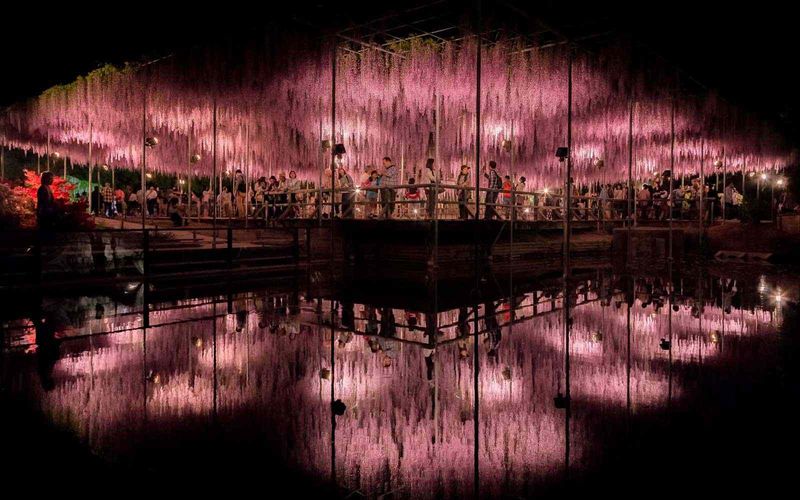
Other flowers claim their own moments. Wisteria blooms in late April and early May, its cascading purple clusters trained over trellises at gardens like Ashikaga Flower Park. Autumn brings the fiery reds and golds of maple leaves, particularly in the temple gardens of Kyoto and the mountainous regions of Nikko. Each season has its visual signature, and each demands presence. To miss it is to wait another year.
Coasts That Refuse Straight Lines
The Tottori Sand Dunes stretch along the Sea of Japan, an unexpected expanse of windswept sand in a country known for its greenery. The dunes shift constantly, reshaped by wind and tide, and visitors can walk or rent camels, though the surreal juxtaposition of desert and ocean is best appreciated on foot. In winter, the dunes are often dusted with snow, adding another layer of incongruity.
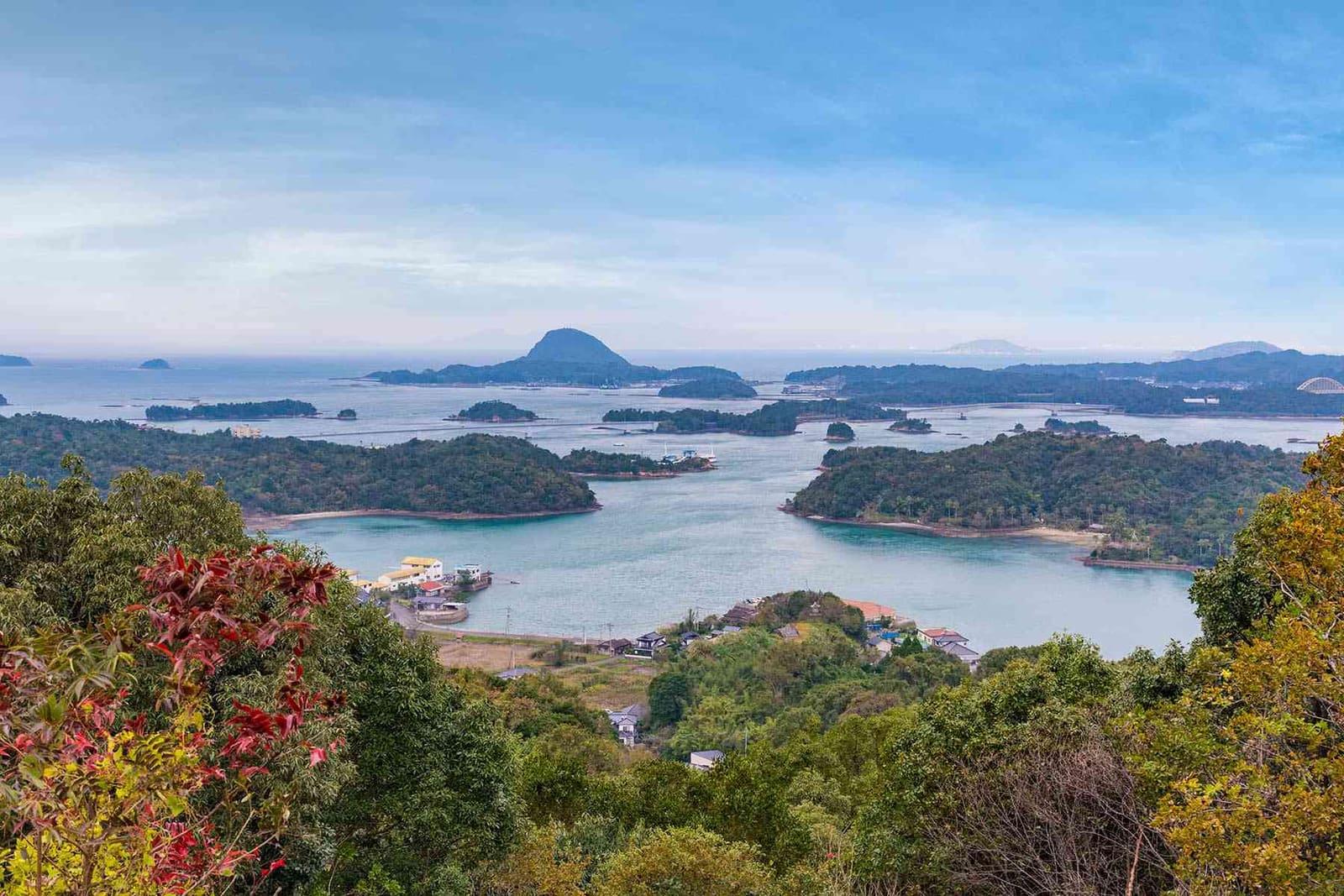
Further south, the Seto Inland Sea is dotted with islands, many small enough to walk around in an hour, some famous for contemporary art installations that draw visitors year-round. Naoshima, the most developed, has become a pilgrimage site for architecture and design enthusiasts, its museums and sculptures integrated into the landscape. The sea itself is calm, sheltered by the surrounding landmasses, its waters a pale blue that shifts with the light.
On the western edge of Honshu, the Oki Islands rise from the Sea of Japan, their cliffs sheer and dramatic, carved by wind and wave into shapes that seem deliberate. These islands see fewer visitors, their remoteness a barrier and an asset. The coastline here is raw, the kind of place where weather dictates the day, and the beauty is not curated. It simply is.
Gardens That Require Years to Read
Japanese gardens are not meant to be walked through quickly. Ryoan-ji in Kyoto, with its fifteen stones arranged in raked gravel, is designed for seated contemplation, the composition revealing different relationships depending on where you sit. The stones are said to represent islands, or mountains, or nothing at all. The garden does not explain itself.
Kenroku-en in Kanazawa, by contrast, is expansive, its ponds and bridges and teahouses unfolding over eleven hectares. It was designed to embody six attributes: spaciousness, seclusion, artifice, antiquity, water, and views. Walking through it is a lesson in controlled perspective, each turn revealing a new frame, each element positioned to guide the eye.
In Okayama, Koraku-en spreads across the Asahi River, its lawns and groves maintained with exacting care. The garden was commissioned in the late seventeenth century and has survived floods, wars, and changing tastes. What remains is not a relic but a living practice, a landscape that is tended, adjusted, and renewed, season by season.
The Discipline of Looking
To travel through Japan's most beautiful places is to confront a particular kind of aesthetic discipline. These are not landscapes that shout. They ask you to slow down, to notice the way light falls on water, the angle of a branch, the spacing of stones. They reward patience and punish distraction.
This is not to romanticise. Many of these sites are crowded, commercialised, difficult to reach. The vine bridge sways with tourists. The torii gate is surrounded by selfie sticks. Cherry blossom season can feel like a scrum. Yet even in the press of crowds, the landscapes hold. They were designed, or have evolved, to withstand attention, to offer something even when overexposed.
What ties these twenty-five places together is not geography or category but a shared understanding of beauty as something fleeting, something that must be met on its own terms. The bridge that will be rebuilt. The blossoms that will fall. The mountain that appears only when the sky allows. To photograph them is not to capture them but to mark the moment you were there, the light as it was, the season as it passed. And that, perhaps, is enough.