Where Thermal Water Meets the Sea: Inside Beppu's 2,500 Springs
On Kyushu's eastern coast, Japan's geothermal capital offers a rare convergence of volcanic abundance and Pacific vistas.
A City Built on Steam
Stand anywhere in central Beppu on a cool morning and the city reveals itself in plumes. Steam rises from grates in the pavement, from the gardens of private homes, from the hillsides above the harbour. This is not atmospheric affectation; it is geology made visible. Beppu, a coastal city on the eastern shore of Kyushu, sits atop one of the most geothermally active zones in Japan, a country already defined by its relationship with volcanic heat.
The numbers are staggering in their own quiet way. Beppu is home to more than 2,500 hot springs, a density unmatched anywhere else in the archipelago. Together, these sources produce roughly 130,000 kilolitres of thermal water each day, a volume that has shaped not only the city's infrastructure but its entire cultural identity. For centuries, residents have bathed in these waters, cooked over their steam, and built their lives around the rhythms of heat rising from below.
The Thermal Landscape
What sets Beppu apart is not merely the quantity of its springs but their variety. The city is divided into eight major hot spring districts, each with its own mineral composition and character. Kannawa, dense with steam vents and public baths, feels almost industrial in its concentration of geothermal energy. Myoban, higher on the hillside, is known for its alum-rich waters and traditional thatched huts where minerals are harvested. Beppu Station district caters to the transient visitor, with modern facilities and convenient access. Hamawaki and Horita offer quieter, more residential bathing experiences.
The thermal waters themselves range widely in character. Some are clear and mild, suitable for extended soaking. Others are cloudy with sulphur or iron, their surfaces slick with minerals. A few are acidic enough to require caution, their pH levels approaching that of lemon juice. This diversity reflects the complex underground hydrology of the region, where water heated by magma chambers deep beneath the surface rises through fissures in fractured volcanic rock, dissolving minerals along the way.
Where the Springs Meet the Horizon
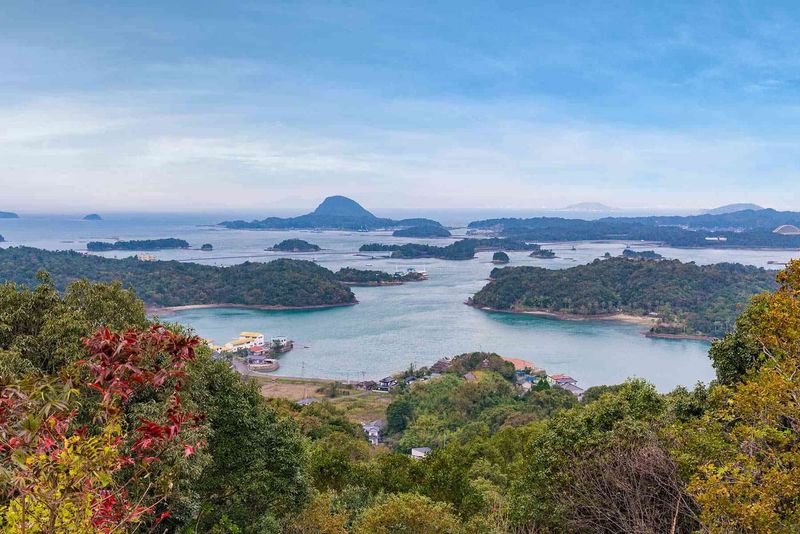
Among Beppu's many bathing experiences, a particular subset stands out for its geographical serendipity. Certain springs are positioned along the coast or on hillsides above the bay, offering unobstructed views of the Pacific whilst bathers soak in water heated by the earth's interior. The juxtaposition is quietly arresting: volcanic warmth against the cool expanse of ocean, the horizontal line of the sea meeting the rising vapour of the bath.
These oceanfront springs are not theme park constructions. They are the result of Beppu's coastal topography, where geothermal activity happens to occur within sight of the water. Some are perched on rocky outcrops just above the tide line. Others occupy terraced positions on the lower slopes of the surrounding hills, their stone-lined pools oriented towards Beppu Bay and the mountains of Shikoku visible in the distance on clear days.
The experience of bathing in such a setting shifts the usual inward focus of the onsen. Instead of contemplating stone lanterns or carefully pruned pines, the eye is drawn outward, across the water, towards weather and light. Fishing boats pass. Ferries trace their routes towards Shikoku. At dusk, the sky colours over the bay, and the boundary between warm water and cool air becomes almost imperceptible.
The Culture of Bathing
In Beppu, hot spring bathing is not tourism; it is infrastructure. The majority of the city's springs are not resort facilities but neighbourhood baths, small operations serving local populations. Many residents do not have private baths at home. They go instead to their district onsen, often daily, sometimes twice a day. This is not leisure in the contemporary sense but a practical and social necessity, woven into the fabric of daily life.
The etiquette is well established. Bathers wash thoroughly at low taps before entering the communal pool. Conversation is muted, unhurried. Towels do not touch the water. The ritual is egalitarian; in the bath, hierarchy dissolves. This democratic quality is part of the appeal, a space where the city's social life unfolds without pretence.
Visitors to Beppu quickly learn that the city's bathing culture is not performance. There is little in the way of luxury branding or wellness rhetoric. The springs are presented as they are: hot water from the ground, mineral-rich and therapeutic, available for a few hundred yen. The lack of embellishment is itself a form of authenticity, a reminder that not all valuable experiences require curation.
The Thermal Economy
Beppu's geothermal resources extend beyond bathing. Steam is piped into homes for heating and cooking. Vegetables are steamed in communal vents. Eggs are boiled in naturally hot water. Mud baths, sand baths, and steam baths diversify the therapeutic offerings. The so-called "hells" of Beppu, hot springs too extreme for bathing, have become visitor attractions in their own right, their vivid colours and violent bubbling a testament to the raw power beneath the surface.
This utilitarian relationship with geothermal energy has given Beppu a pragmatic character. The city does not romanticise its springs so much as it depends on them. They are a resource, exploited efficiently and without excess sentimentality. This attitude may lack the poetic refinement of more famous onsen towns, but it offers something perhaps more enduring: a model of living in direct, functional relationship with the landscape.
The Visitor's Calculus
For travellers accustomed to spa resorts with manicured gardens and prix-fixe kaiseki dinners, Beppu can feel unexpectedly unadorned. The city is working-class in its bones, its aesthetic shaped more by function than by design. This is not Hakone or Yufuin, where the onsen experience is packaged and polished. Beppu is rougher, more immediate, less concerned with presentation.
Yet this lack of polish is precisely what makes the city compelling. The springs are not staged for visitors; they simply exist, used by locals, open to anyone willing to observe the customs. The oceanfront baths are not exclusive retreats but public facilities, accessible for the price of a bus ticket and an entrance fee. The experience is democratic, unglamorous, and oddly liberating.
Beppu rewards those who arrive without fixed expectations, who are content to wander its steaming streets, to try baths in different districts, to eat vegetables steamed in geothermal vents, to watch the city go about its business. It is not a destination that reveals itself immediately, but one that unfolds slowly, in layers, much like the geological strata from which its waters rise.
The Enduring Appeal
In an era when wellness tourism often feels manufactured, Beppu offers something increasingly rare: a bathing culture rooted in necessity rather than leisure, in geology rather than branding. The city's springs are not a product to be consumed but a resource to be shared, a commons maintained by communal use and unspoken agreement.
The presence of the ocean adds a dimension that is both visual and conceptual. To soak in thermal water whilst gazing at the Pacific is to occupy a space between elements, between the heat of the earth and the coolness of the sea, between the intimate scale of the bath and the vastness of the horizon. It is a reminder that luxury, in its truest form, is not about refinement but about access to the elemental, the real, the unmediated.
Beppu does not ask to be admired. It simply continues, day after day, steam rising, water flowing, the city and its springs inseparable.