Wisteria Season Rewrites Japan's Spring Calendar
When the cherry blossoms fade, cascades of purple reclaim the gardens - and the traveler's gaze.
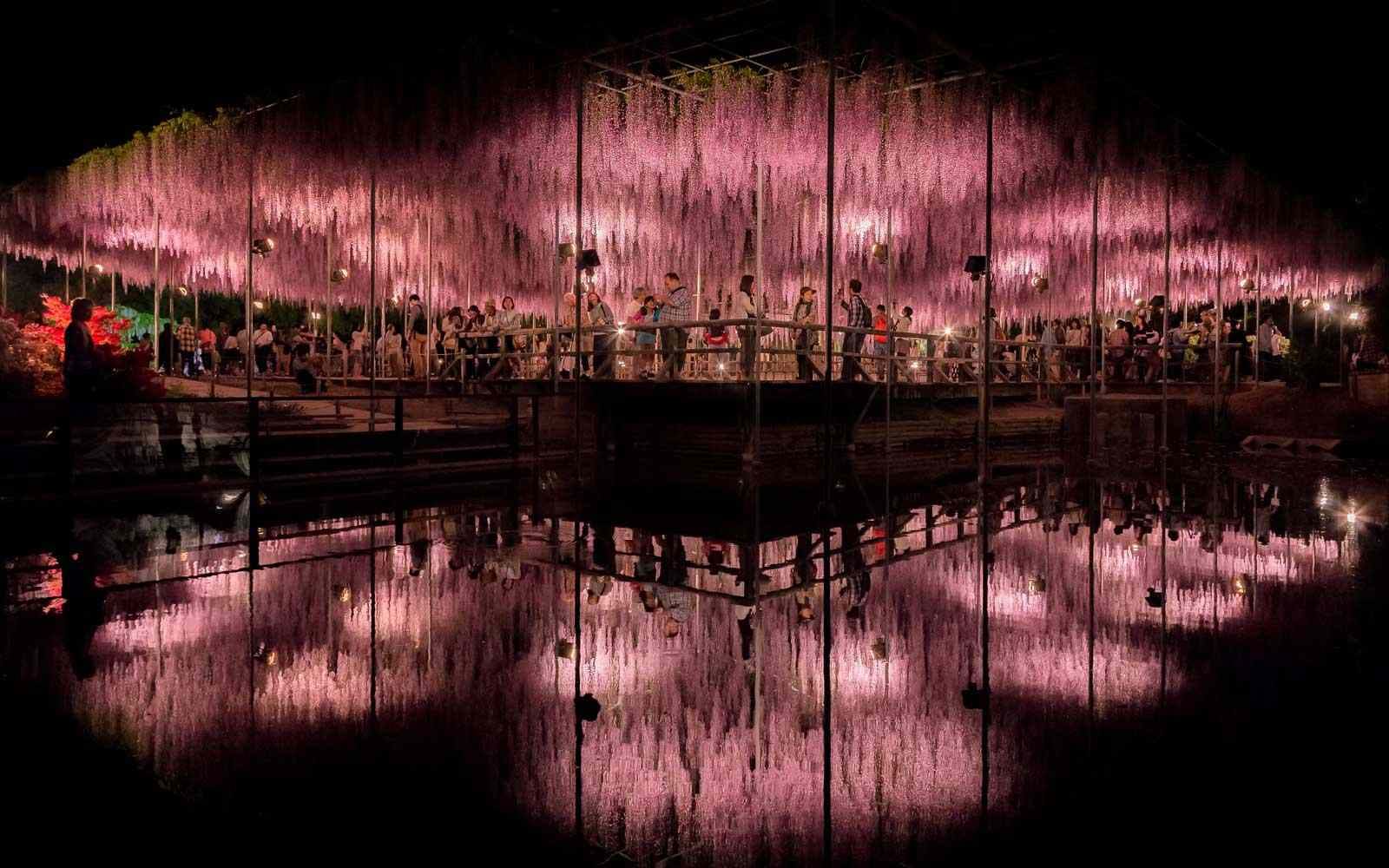
The Flower That Waits
By late April, the cherry trees have already shed their petals. Petals carpet temple steps, float in moats, gather in the corners of subway platforms. Tourists who timed their flights to sakura season have flown home. The gardens grow quiet. And then, almost without announcement, the wisteria begin.
They do not arrive all at once. A single raceme appears first, pale lavender against dark wood, testing the air. Within days, thousands follow. The effect is less like blooming than like curtains being drawn - slow, graceful, transformative. What was an arbor becomes a tunnel. What was a trellis becomes a canopy. The light itself turns violet.
Wisteria - fuji in Japanese - has long occupied a peculiar position in the country's floral calendar. It lacks the cultural mythology of cherry blossoms, the poems and festivals and centuries of imperial patronage. It does not mark the start of the fiscal year or the school term. It simply blooms, heavily and gorgeously, in the interlude between spring's official flower and the humidity of early summer. For travelers willing to linger past sakura's narrow window, it offers something quieter and, in its way, more generous: time.
Where the Arbors Arc
The most famous wisteria in Japan grow not in Kyoto's temple gardens but in less storied places, where horticulture and infrastructure have conspired to spectacular effect. Ashikaga Flower Park, in Tochigi Prefecture north of Tokyo, is home to a wisteria tree estimated to be over 150 years old. Its branches have been trained across a steel framework covering roughly 1,000 square meters - a living ceiling that, at peak bloom in early May, filters daylight into gradients of purple, pink, and white.
Kawachi Fuji Garden, tucked into the hills of Fukuoka Prefecture on Kyushu, takes a different approach. Here, wisteria vines arch over pedestrian walkways in two long tunnels, one planted predominantly in purple varieties, the other in white. The effect is immersive rather than monumental. Visitors walk beneath the blooms, not around them. The air is thick with fragrance - sweet, slightly powdery, unmistakably floral.
Both gardens operate on reservation systems during peak season, a logistical necessity that also serves an aesthetic purpose. Crowds are staggered. The tunnels never feel claustrophobic. Photography, while ubiquitous, does not dominate the experience. There is time to stand still, to look up, to notice the way individual blossoms spiral along the stem.
The Timing, and the Trouble
Wisteria blooms are less predictable than cherry blossoms, and far less tracked. There is no equivalent to the Japan Meteorological Corporation's sakura forecast, no national obsession with the bloom front as it creeps north. Most gardens publish estimated peak dates in March, revise them in early April, and issue final confirmations only a week or two before the flowers open.
The window is narrow. Full bloom typically lasts ten days to two weeks, depending on temperature and rainfall. Early arrivals find green vines and a few tentative clusters. Late arrivals find brown edges, drooping stems, petals on the ground. The margin for error is slim, and the consequences are not trivial for travelers building itineraries around a single spectacle.
Yet this unpredictability also disciplines the gaze. Unlike sakura season, which has become as much about the event as the flower, wisteria season resists packaging. It cannot be easily scheduled around a long weekend or a public holiday. It requires flexibility, a willingness to adjust, a certain comfort with uncertainty. In that sense, it selects for a particular kind of traveler - one who treats the calendar as provisional and the itinerary as a starting point rather than a contract.
Beyond the Tunnels
Wisteria grow elsewhere, too, in contexts less engineered for tourism. Old farmhouses in rural Nagano still train vines over wooden pergolas, as much for shade as for beauty. Urban parks in Osaka and Nagoya plant wisteria along walking paths, where they bloom above joggers and dog walkers with no fanfare. Temple gardens in Nara cultivate varieties with shorter racemes, better suited to the scale of traditional architecture.
These settings lack the visual drama of Ashikaga or Kawachi, but they offer a different kind of encounter - one less mediated by ticketing systems and crowd control, more embedded in the ordinary rhythms of Japanese life. The flowers are the same. The infrastructure around them is not. For travelers interested in how a culture lives with its flora rather than stages it, these quieter sites matter.
The Question of Scale
What wisteria tunnels reveal, more than anything, is the patience required to grow beauty at this scale. A wisteria vine does not bloom heavily in its first decade. It must establish a root system, thicken its trunk, send out lateral branches strong enough to bear the weight of hundreds of flower clusters. Training the vine across an arbor or tunnel framework is a multi-year process, requiring annual pruning, seasonal fertilization, and constant vigilance against pests and disease.
The result is not a garden that can be replicated quickly or cheaply. It is a garden that must be inherited or endured. The 150-year-old wisteria at Ashikaga has outlived its original planters, its first admirers, entire generations of caretakers. It blooms now for people who had no hand in its planting, in a country whose relationship to seasonality and impermanence is both deeply held and constantly renegotiated by tourism.
That tension - between the flower as cultural symbol and the flower as attraction - runs through wisteria season as it does through sakura season, but with less intensity. Wisteria has not yet been fully absorbed into the national brand. It remains, for now, a specialist's bloom, a connoisseur's alternative, a reason to return when the crowds have thinned and the light has softened and the calendar allows for a longer, slower look.
When to Go, and Why
Peak bloom typically falls between late April and mid-May, with northern regions blooming slightly later than southern ones. Ashikaga Flower Park generally reaches full bloom in the first week of May. Kawachi Fuji Garden peaks a few days earlier. Smaller gardens in Kyoto and Nara follow their own schedules, often aligned more closely with local microclimates than regional forecasts.
Reservations are required for most major wisteria sites during peak season and should be made as early as possible - often as soon as booking windows open in March. Gardens release limited daily tickets to manage foot traffic and preserve both the visitor experience and the health of the plants. Walk-up entry is rare.
For travelers building itineraries around wisteria, the strategy is less about pinpointing a single perfect day than about building in flexibility. A three- or four-day window in early May, with accommodations in nearby cities and backup plans for rain or late blooms, offers better odds than a single-day excursion timed to a forecast that may shift.
The reward, when timing aligns, is not just the visual spectacle but the temporal one - the sense of having arrived at a moment that cannot be bought or guaranteed, only waited for. In a travel landscape increasingly defined by on-demand access and algorithmic recommendations, wisteria season insists on its own terms. The flowers bloom when they bloom. The tunnels open when the flowers are ready. The traveler adjusts, or misses it entirely.
That obsolescence, built into the very nature of the bloom, is part of what makes the experience worth pursuing. It is a reminder that some things still require you to show up at the right time, in the right place, with no promise that the spectacle will perform on cue. In Japan, where punctuality is a civic virtue and schedules are honored with near-religious devotion, the wisteria remain gloriously, stubbornly indifferent to all of it. They bloom when they bloom. You come when you can. And if the timing works, the tunnel turns violet, and the light does something no photograph quite captures.