Why Your Business-Class Seat Won't Fix Your Circadian Clock
A new generation of travellers is learning what astronauts already know: conquering time zones has nothing to do with comfort, and everything to do with light.

The Myth of the Lie-Flat Solution
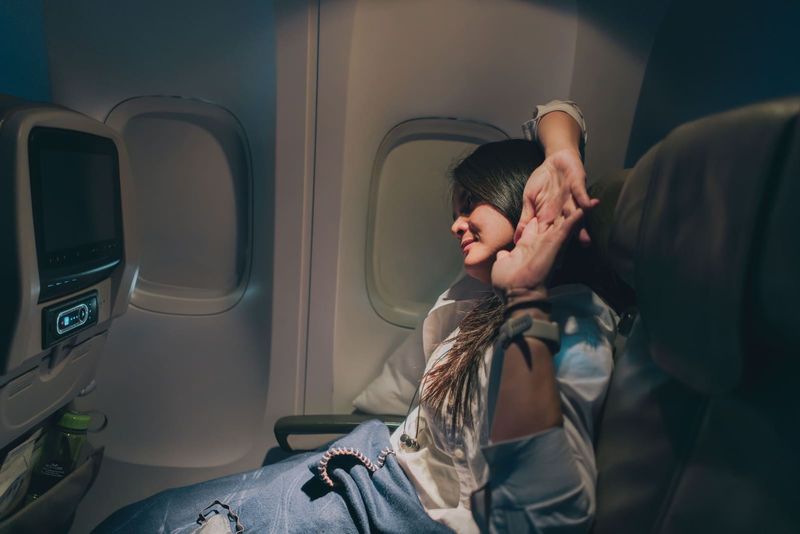
There is a particular fantasy that grips most economy passengers as they edge past the front cabin: that the malaise waiting at journey's end, the fog and fatigue we call jet lag, could be banished if only the seat reclined far enough. Rest deeply enough, the logic goes, and the body will arrive intact.
It will not. The assumption rests on a fundamental misunderstanding. Jet lag is not a deficit of sleep. It is a conflict of clocks, and no amount of cushioning will resolve it.
Circadian science, the study of our internal rhythms, remains poorly grasped outside specialist circles. Yet it holds the key to why crossing time zones leaves us unmoored. Buried within each human brain sits a cluster of neurons called the suprachiasmatic nucleus, no larger than a single grain of rice. This is the body's timekeeper. It dictates when alertness peaks, when drowsiness descends, when hunger strikes. It runs on what chronobiologists call internal time, a rhythm unique to each person and determined by genetics, behaviour, and environment.
Two colleagues might share identical flight itineraries and sleep schedules, yet their internal clocks tick differently. One may be constitutionally inclined to wake at dawn; the other functions best after midnight. These variations, known as chronotypes, mean that identical advice rarely works for everyone. When the plane lands and local time contradicts the traveller's inner rhythm, disorientation follows. That gulf between what your brain expects and what the clock tower shows is the essence of jet lag.
Light, Not Sleep, Resets the Clock
The prevailing wisdom about combating jet lag, stay hydrated, avoid alcohol, sleep on the plane, addresses symptoms but ignores mechanism. Sleep matters, certainly. Without it, exhaustion compounds misery. But sleep's real role is more nuanced. When you close your eyes, you modify your exposure to light. Sleeping at the optimal moment can accelerate the shift your body needs to make. Sleeping at the wrong moment can delay it.
Light is the primary signal that resets circadian rhythm. Martha Merrow, a chronobiologist and visiting professor of circadian medicine at the University of Oxford, describes light exposure as "the main thing" driving adaptation. Darkness matters too, but as the absence of light rather than a force in itself.
This is why dozing through a long-haul flight can backfire. Eight uninterrupted hours in a darkened cabin might feel restorative, yet if those hours occur when your internal clock expects daylight, the neurons governing your rhythm receive the wrong cues. You arrive rested but profoundly out of sync. The solution lies not in sleeping more, but in sleeping, seeking light, and avoiding light at precisely calibrated intervals.
The Algorithm That Travelled to Space
Timeshifter, a circadian technology platform, was built to operationalise this science. Its origins lie not in consumer wellness but in high-stakes professional performance. Steven Lockley, the company's co-founder and chief scientist, previously collaborated with NASA during his tenure at Harvard Medical School. The protocols he developed were designed for astronauts, individuals for whom cognitive sharpness is non-negotiable and whose schedules permit no margin for error.
Michael López-Alegría, a former NASA astronaut, used earlier iterations of the science to prepare for missions. The human body can naturally shift its circadian rhythm by roughly one hour per day. Applying targeted interventions, light at specific times, strategic caffeine use, timed sleep, can triple or quadruple that rate. For astronauts adjusting to launch schedules or orbital cycles, the difference is operational. For travellers, it is transformative.
The Timeshifter application asks users to input age, typical sleep and wake times, caffeine and melatonin habits, and chronotype. Flight details are entered; the algorithm calculates departure and arrival in multiple time zones. The resulting plan begins days before travel. It prescribes when to seek bright light or wear dark glasses, when to consume or avoid caffeine, when to sleep and for how long. Melatonin recommendations appear for those who choose to use it.
The advice can feel counterintuitive. A plan for a London to Tokyo flight might instruct a traveller to stay awake until two in the morning on the eve of departure, skip coffee on the morning of the flight, and sleep immediately after boarding. For a night owl, the late bedtime is manageable. For someone who relies on caffeine to function, the morning restriction is brutal. The difficulty lies not in the science but in compliance.
The Gap Between Precision and Practice
Merrow, who has no commercial ties to Timeshifter, reviewed several personalised plans generated by the application. She confirmed they align with circadian principles. She also noted what other observers have flagged: human behaviour complicates adherence. Airlines serve meals and drinks. Passengers want entertainment. Anxiety keeps some awake. Social obligations intrude. Even the most meticulously crafted plan cannot account for every variable.
The application itself acknowledges this. Guidance notes explain that if sleeping on command proves impossible, wearing dark glasses to block light still nudges the internal clock in the right direction. Partial compliance is better than none.
For professionals whose livelihoods depend on peak performance across time zones, the incentive to follow through is high. Sem Verbeek, who won the Mixed Doubles title at Wimbledon in 2025, credits the platform with allowing him to spend more time with family during the Christmas period rather than travelling early to Australia for the season opener. Formula 1 teams, athletes, and business executives with rigid schedules form a core user base.
Yet even professionals falter. Verbeek's tennis matches do not always align with his circadian plan. Practice sessions and match times are dictated by tournament schedules, not biology. He follows the guidance as closely as circumstances allow, accepting that perfection is unattainable.
Access Beyond the Elite
Timeshifter offers a first plan without charge. Subsequent plans cost nine dollars and ninety-nine cents each, or an annual subscription is available for twenty-four dollars and ninety-nine cents. The pricing targets frequent long-haul travellers who control their schedules and value cognitive clarity on arrival.
Partnerships with major travel brands have expanded access. United Airlines provides complimentary plans to its Premier 1K members. In August, InterContinental Hotels broadened its collaboration with the platform; guests booking stays at the brand's properties receive access with every reservation. Tom Rowntree, vice president of global luxury and lifestyle brands at IHG Hotels & Resorts, notes strong guest response. The ability to mitigate long-haul fatigue before arrival, rather than recovering afterwards, appeals to travellers accustomed to optimising every variable.
The democratisation of circadian science represents a shift. What was once the domain of astronauts and elite athletes is now available to anyone willing to adjust their behaviour in service of their biology. The challenge is not access but discipline.
The Limits of Optimisation
Even the most sophisticated circadian intervention cannot override reality. Court times, client meetings, family obligations, and the occasional desperate need for espresso before navigating airport security will always interfere. The question is whether imperfect adherence still yields meaningful benefit.
The answer, for most users, appears to be yes. A plan need not be followed to the minute to produce results. Blocking light when the algorithm advises darkness, even if sleep does not come, still sends useful signals to the suprachiasmatic nucleus. Seeking daylight at the prescribed hour, even briefly, helps recalibrate the internal clock.
The larger lesson is that jet lag is not an inevitable cost of travel. It is a biological problem with a biological solution. The solution requires no luxury seat, no lounge access, no premium cabin. It requires only an understanding of how light governs the tiny cluster of neurons that dictates when we wake and when we sleep. The rest is a matter of timing, and perhaps a willingness to surrender the morning coffee.