Where Water Meets Sky: The Maldives' Most Enchanting Shorelines
Beyond the postcard clichés, fourteen atolls reveal why this archipelago remains the world's most seductive coastal escape.
The Light Before Dawn
On Vaadhoo Island, the darkness before sunrise holds something the daylight conceals. Walk the beach at 4 a.m. and each footstep ignites a cold blue fire. Bioluminescent phytoplankton gather in such concentrations here that the tide itself becomes a living constellation, as if the Milky Way had folded into the Indian Ocean. The phenomenon is not unique to the Maldives, but nowhere else does it occur with such reliability, such theatrical intensity. The local Dhivehi word for it, "redhan faru," translates roughly as "the sea that burns," though nothing about the glow suggests heat. It is a light that belongs to the realm of deep water and microscopic life, not fire.
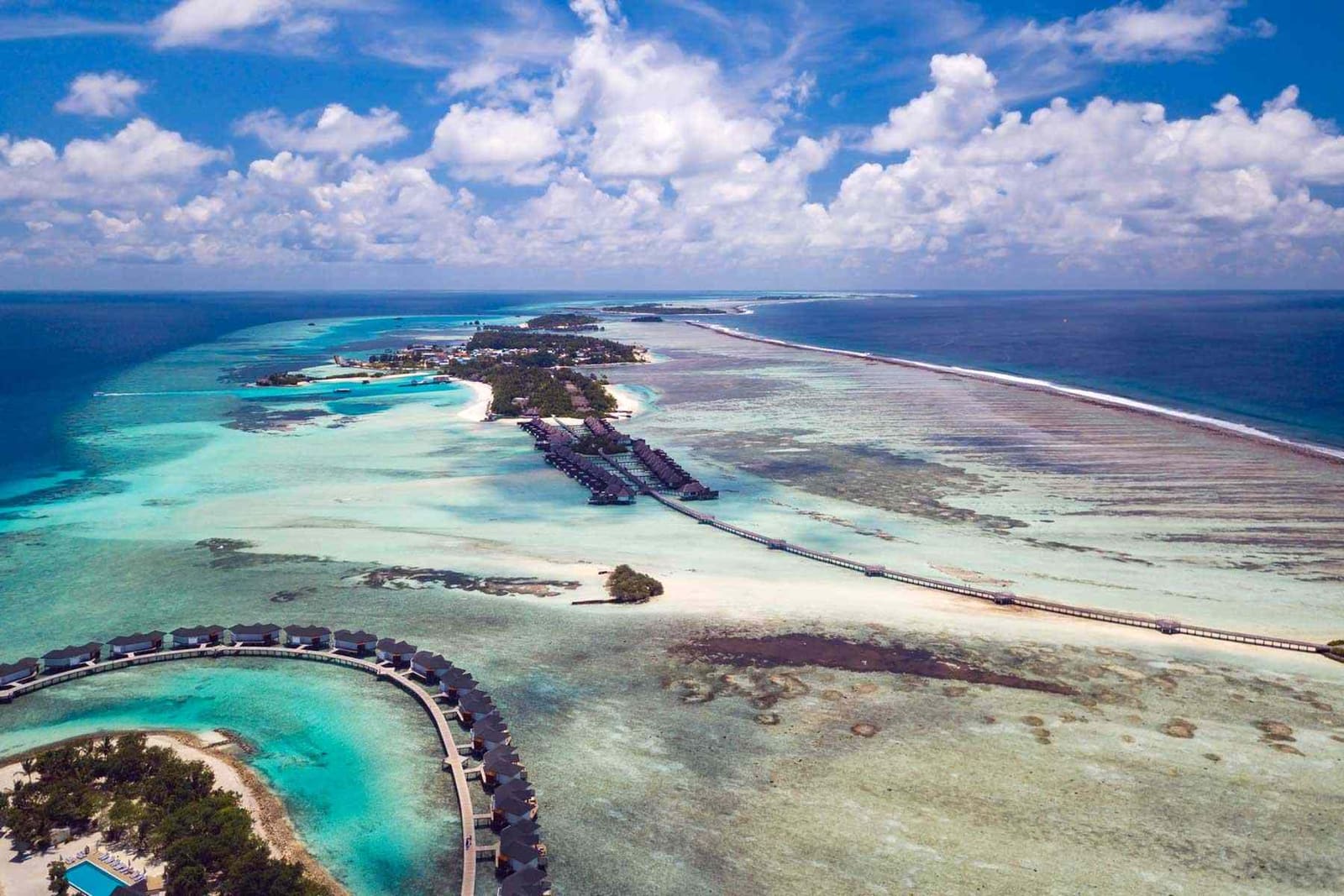
The archipelago comprises 1,192 coral islands arranged in twenty-six natural atolls, stretching across 90,000 square kilometers of ocean. Only 200 islands are inhabited. The rest exist in varying states of wilderness, their beaches shaped by monsoon currents, coral growth, and the slow, relentless work of erosion. What makes certain shorelines unforgettable is not simply their beauty, a word too broad to mean much anymore, but the way they hold contradictions: wildness within luxury, solitude within accessibility, fragility within abundance.
The Geometry of Coral
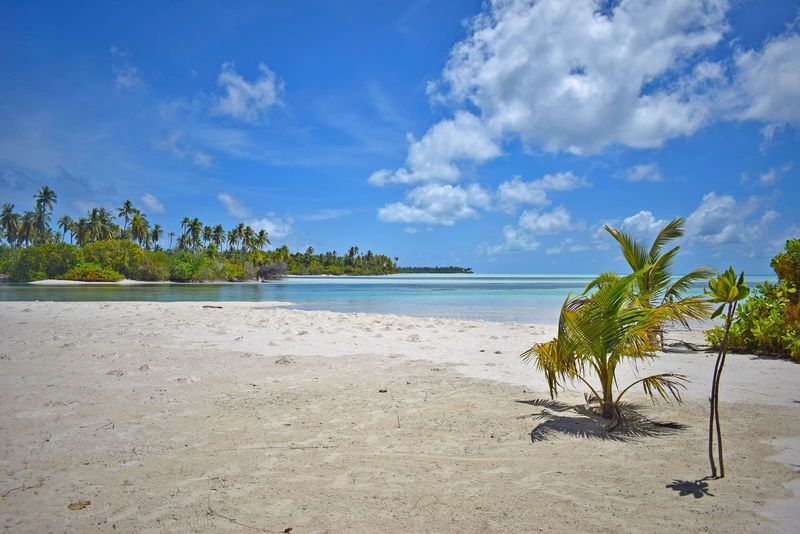
Fulhadhoo, in Baa Atoll, remains one of the few inhabited islands where the local community still outnumbers resort guests. The beach here curves for three uninterrupted kilometers, a crescent of powdered coral sand so fine it squeaks underfoot. The absence of large-scale development means the shoreline retains its original contours, shaped by centuries of wave action rather than landscaping. In the shallows, blacktip reef sharks patrol in small groups, their dorsal fins cutting the surface like dark sails. They are hunting, but they are also part of the visual grammar of the place, as essential to the composition as the coconut palms.
Baa Atoll was designated a UNESCO Biosphere Reserve in 2011, a recognition of the region's exceptional marine biodiversity. Hanifaru Bay, a few nautical miles from Fulhadhoo, becomes a feeding ground for hundreds of manta rays during the southwest monsoon, their wingspans reaching up to five meters. The connection between the bay and the surrounding beaches is not immediately obvious, but it is fundamental. The same nutrient-rich currents that draw the mantas also sustain the coral reefs, which in turn produce the sand, which becomes the beaches. Every grain is a fragment of reef, broken down by parrotfish, waves, and time.
The Architecture of Absence
Some of the most compelling shorelines in the Maldives are not beaches in the conventional sense. They are sandbars, temporary landforms that emerge at low tide and vanish six hours later. The sandbank near Cocoa Island, in South Malé Atoll, appears each morning as a narrow strip of white against cobalt blue, barely a meter above sea level. It has no vegetation, no shade, no infrastructure. It is pure form, a minimalist sculpture that the ocean erases and rewrites twice a day.
Standing on such a place induces a particular kind of vertigo. The water is three meters deep in every direction, the sand beneath your feet no more permanent than a cloud. It is impossible not to think about sea level rise, about the fact that the highest natural point in the entire Maldivian archipelago is 2.4 meters above mean sea level. The sandbars are not metaphors for the nation's vulnerability, they are the vulnerability itself, made visible and beautiful.
Where Coral Becomes Sand
Biyadhoo Island, in South Malé Atoll, offers something increasingly rare: a house reef accessible directly from the beach, with no boat transfer required. Wade thirty meters from shore and the coral wall drops away into a vertical garden of soft corals, sea fans, and barrel sponges. The beach itself is narrow, almost utilitarian, a functional threshold between land and reef rather than a destination in its own right. But that modesty is part of its appeal. It refuses the language of luxury, the rhetoric of pristine sands and infinity pools. It is a working beach, a place where the relationship between ecosystem and visitor remains legible.
The Maldives produces no natural sand in the terrestrial sense. Every beach is a byproduct of reef erosion, a collaboration between coral polyps, herbivorous fish, and wave energy. Parrotfish alone account for roughly 85 percent of the sand on many islands, each fish producing up to 200 kilograms of sand per year by grinding coral rock into powder. The sound of parrotfish feeding, a constant crunching audible even above water, is the sound of beaches being made.
The Inhabited Edge
Maafushi, in Kaafu Atoll, represents a different model entirely. It is not a resort island but a local island, home to roughly 2,700 residents and a growing number of guesthouses catering to budget travelers. The bikini beach, a designated stretch where tourists may wear Western swimwear, occupies the southern tip of the island. It is a compromise, a spatial solution to the tension between Islamic custom and tourism economics. The rest of the island's coastline remains the domain of local life: children playing football on the sand, fishermen mending nets, women collecting shells.
The beach here is not untouched, and that is the point. It is part of a lived landscape, shaped by human use as much as by natural forces. The water is the same turquoise, the sand the same crushed coral, but the context is different. Tourism accounts for more than 60 percent of the Maldives' GDP, according to government figures, yet the majority of visitors experience the archipelago only through the mediated environments of resort islands. Maafushi offers a glimpse of the other Maldives, the one where beaches are not amenities but everyday geography.
Light Through Water
Veligandu Island, in North Ari Atoll, is known for its sandbank extensions, narrow tongues of sand that reach into the lagoon like accusing fingers. At certain tides, you can walk 200 meters from the island into open water, the depth never rising above your ankles. The light in such places behaves strangely. The shallow water filters and refracts it, turning the world into a gradient of blues: cyan, cerulean, ultramarine, Prussian. The gradations are so subtle that naming them feels inadequate, a failure of language.
Photographers favor early morning and late afternoon, the so-called golden hours, but the real magic occurs at midday when the sun is directly overhead. The absence of shadows reveals the texture of the seabed, every ripple and hollow, every patch of seagrass and coral rubble. The water becomes a lens, clarifying rather than obscuring. It is the opposite of mystery, a radical transparency that makes the boundary between surface and depth almost irrelevant.
The Desert Island Myth
Dhigurah, in South Ari Atoll, stretches for three kilometers, making it one of the longest islands in the Maldives. The beach on the eastern side remains largely undeveloped, a corridor of sand backed by dense vegetation. Coconut palms, screw pines, and saltbush form a natural barrier between the interior and the shore. The absence of resorts means the beach accumulates the usual detritus of ocean life: driftwood, coconut husks, bleached coral fragments, the occasional plastic bottle.
This is not the Maldives of the brochures, and that is precisely its value. The impulse to erase all traces of human impact, to present nature as a spotless commodity, produces a kind of ecological amnesia. Real beaches are dynamic systems, constantly receiving and releasing material. They are not museums. Dhigurah's shoreline, with its imperfections intact, offers a corrective to the fantasy of pristine wilderness. It is a beach that acknowledges the ocean as a global commons, connected to currents and coastlines thousands of kilometers away.
The Blue Hour
Hulhumalé Beach, on a reclaimed island adjacent to the capital, Malé, occupies an ambiguous position in any catalog of the Maldives' finest shorelines. It is entirely artificial, built from sand dredged from the lagoon floor and stabilized with seawalls. It is also the most accessible beach in the archipelago, reachable by public ferry and frequented by Maldivian families, expatriate workers, and transit passengers with a few hours to spare.
The artificiality is not a disqualification. Hulhumalé Beach is a frank acknowledgment of the Maldives' demographic and environmental pressures: a growing population, limited land, rising seas. The beach functions as public space, a rare commodity in a nation where most coastline is either privately leased to resorts or part of the domestic sphere of island villages. On Friday afternoons, the beach fills with picnicking families, children building sandcastles, teenagers playing volleyball. It is a beach that belongs to its users, not to an abstraction called paradise.
The Question of Access
Nalaguraidhoo Island, home to a single resort in South Ari Atoll, offers a beach that encircles the entire island in an unbroken band. You can walk the perimeter in forty-five minutes, passing through zones of varying character: a stretch of deep sand perfect for sunbathing, a rocky section where the reef comes almost to the waterline, a shaded cove where the current deposits sea glass and polished coral. The loop structure means you never feel confined, despite the island's modest size.
But access to such places is not neutral. Resort island leases, granted by the Maldivian government, typically run for fifty years and prohibit local Maldivians from visiting except as employees. The beaches are legally public, but in practice they are privatized, fenced not by walls but by water and cost. A week at a mid-range resort can exceed the annual income of a Maldivian fisherman. This economic geography shapes not only who experiences these beaches but how they are imagined and represented.
The Living Reef
Fihalhohi Island, in South Malé Atoll, features a beach that has been partially rebuilt three times in the past two decades, each time using sand pumped from deeper waters. Erosion is a chronic problem, driven by changes in current patterns, coral degradation, and the protective seawalls that disrupt natural sand replenishment. The beach exists in a state of managed precarity, sustained by engineering rather than ecological equilibrium.
This is not an anomaly. Many of the Maldives' most photographed beaches are maintained through active intervention: sand nourishment, groyne construction, coral restoration projects. The line between natural and artificial has become difficult to draw. The beaches are real, the sand is real, but the systems that keep them in place are increasingly technological. The question is not whether this is acceptable but whether it is sustainable, and at what point a beach ceases to be an ecosystem and becomes a theme park.
The Outer Atolls
Fuvammulah, the Maldives' southernmost atoll and the only single-island atoll in the archipelago, offers beaches that feel geologically distinct from the rest of the nation. The island sits on the edge of the oceanic ridge, where deep water comes close to shore. The beaches here are steeper, the waves larger, the currents stronger. Tiger sharks patrol the outer reefs, drawn by the same upwellings that bring nutrients and plankton.
Thoondu Beach, on the island's northern tip, is covered not in coral sand but in smooth white pebbles, rounded by centuries of wave action. The sound of walking on it is different, a soft clatter rather than a whisper. The pebbles are coral fragments, but their size and shape set them apart from the fine sand beaches elsewhere. The distinction is small, a matter of texture and sound, but it breaks the visual monotony that can make one Maldivian beach blur into another.
The Horizon Line
Mirihi Island, in South Ari Atoll, is barely 350 meters long, one of the smallest resort islands in the Maldives. The beach wraps around it like a collar, never more than fifteen meters wide. From the center of the island, you can see water in every direction, a 360-degree horizon that creates the sensation of being adrift. The scale is intimate, almost claustrophobic, the opposite of the expansive emptiness promised by most tropical beach fantasies.
Yet the smallness is liberating. There is no possibility of exploration, no hidden coves to discover, no illusion of wilderness. The island is what it is: a fragment of reef barely holding its head above water, a temporary platform for observing the ocean. The honesty of that condition, the refusal to pretend to be more than it is, makes Mirihi oddly compelling. It is a beach reduced to its essence, sand and water and light, nothing else.
The Photographer's Dilemma
Reethi Beach, on Baa Atoll's Fonimagoodhoo Island, curves in a near-perfect arc, the kind of compositional gift that makes photography feel almost redundant. The water gradates from pale jade to deep sapphire, the sand is uniformly white, the palm trees lean at aesthetically pleasing angles. It is almost too perfect, a beach that photographs itself, that seems to exist primarily as an image.
This is the paradox at the heart of the Maldives' visual culture. The beaches are real, but they have been so thoroughly photographed, so completely assimilated into the global image economy, that encountering them in person feels like meeting a celebrity. You recognize them before you experience them. The challenge is not to see them but to see past the accumulated weight of representation, to find some unmediated encounter with place.
The Returning Tide
The Maldives' beaches are not permanent. Coral reefs, the engines that produce them, are under pressure from warming waters, ocean acidification, and physical damage. The 2016 mass bleaching event affected 60 percent of the nation's reefs, according to the Maldives Marine Research Institute. Some have recovered, others have not. Without living reefs, the supply of new sand ceases. Erosion continues. The islands shrink.
The most beautiful beaches in the Maldives are also the most vulnerable, not despite their beauty but because of the same conditions that create it: shallow water, abundant coral, exposure to open ocean. They exist at the threshold, the place where land and sea negotiate their temporary boundary. To visit them now is to witness something that may not endure, not in this form, not at this scale. That knowledge changes the experience, adds a layer of urgency and melancholy to the turquoise and white.
The beaches do not need superlatives. They need attention, the kind that sees past paradise to the complex, fragile, interconnected systems that make such places possible. They need visitors who understand that a beach is not a backdrop but a process, not a commodity but a commons. The Maldives offers that possibility, if you are willing to look beyond the image to the thing itself.