Menorca's Secret: The Mediterranean Island Where Solitude Still Exists
A stone's throw from Mallorca's crowds, this Balearic neighbor guards its empty coves and silent trails with a geography that rewards the patient.
The Island Geography Forgot to Promote
The ferry from Mallorca cuts through the Balearic Sea in forty-five minutes, a distance so short you can watch one island's limestone cliffs fade as another's appear. Yet that narrow channel of water separates two entirely different philosophies of tourism. Where Mallorca long ago surrendered its coastline to the machinery of mass travel, Menorca remains an anomaly: an island where peak summer still means the possibility of a beach to yourself, where coastal paths wind through pine forests without a souvenir stand in sight, where the infrastructure of overtourism simply never arrived in the same force.
This is not accidental geography. Menorca's designation as a UNESCO Biosphere Reserve in 1993 imposed constraints that its neighbors never faced. Development regulations restricted coastal construction; agricultural land remained agricultural; the interior's patchwork of stone walls and farmsteads stayed largely intact. The result is an island that feels less like a resort destination and more like a place where tourism happens to occur, a subtle but crucial distinction that shapes every hour spent here.
The question is not whether Menorca is beautiful. The Mediterranean offers beauty without effort. The question is whether an island this close to Barcelona, this accessible by air and sea, can still offer what the rest of the region has lost: the experience of discovering a place on your own terms, at your own pace, without the choreography of crowds.
The Arithmetic of Solitude
Dawn on Menorca's northern coast is a study in subtraction. The fewer people awake, the more beach available. The earlier the departure, the longer the stretch of sand that remains unmarked by footprints. This is not poetic observation but practical calculus, the arithmetic that governs any place where beauty is finite and visitors are many.
The island's geography enforces this math. Many of Menorca's finest coves lie at the end of footpaths that require twenty minutes to an hour of walking through scrubland and pine forest. No parking lots abut the sand; no beach clubs rent umbrellas. The effort required is modest by any objective measure, yet it proves sufficient to thin the crowds to a trickle even in August, the month when the rest of the Mediterranean groans under the weight of its own popularity.
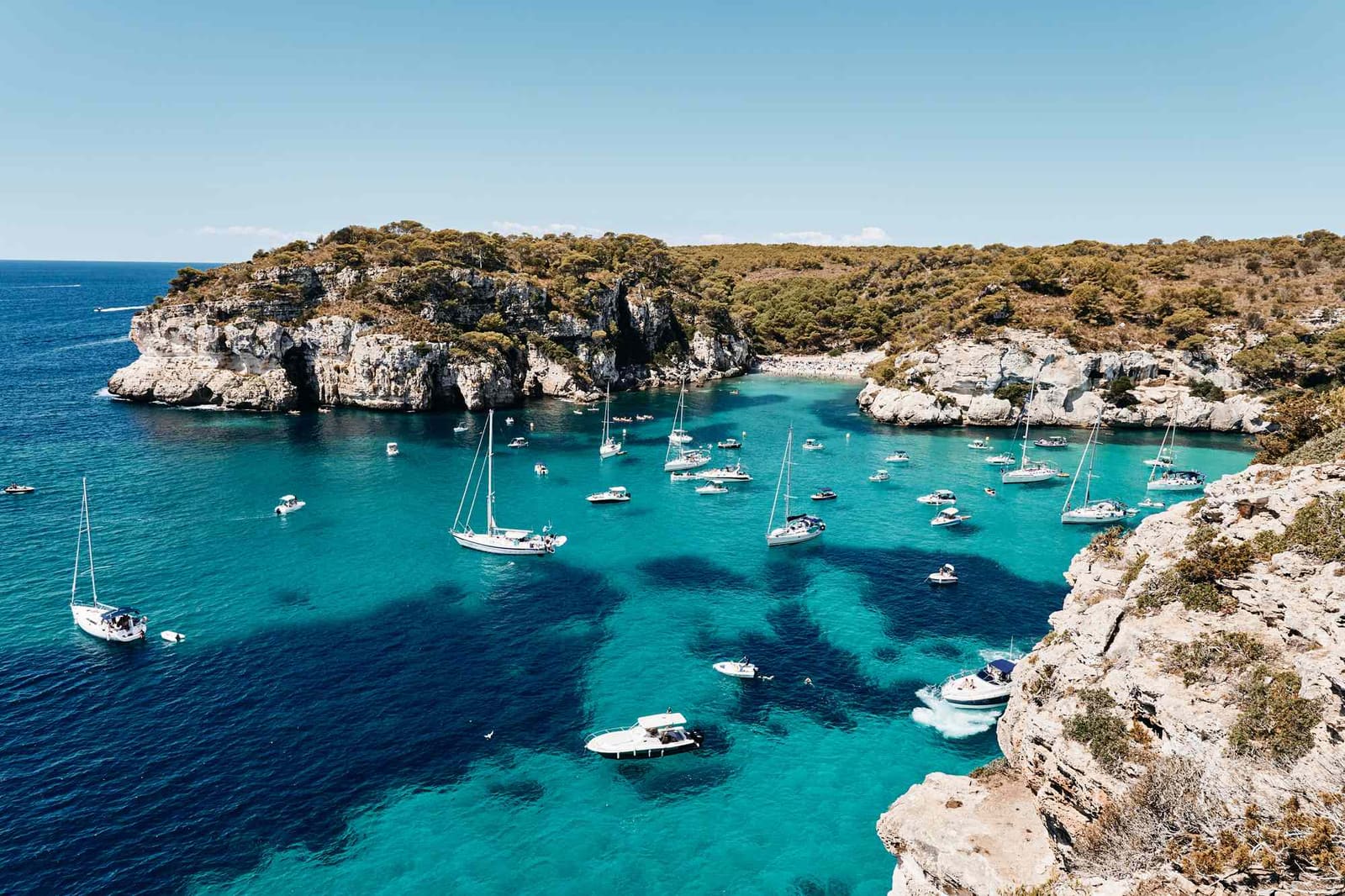
Cala Macarella and its smaller neighbor Macarelleta exemplify this dynamic. The larger beach sees its share of visitors by midday, families spreading towels and inflating rafts. But walk the coastal path another fifteen minutes south, scramble down a rocky slope, and the landscape empties. The water holds the same turquoise clarity, the limestone cliffs the same bone-white glow, but the human density drops to near zero. The secret is not hidden knowledge but simple willingness: to walk a bit farther, to carry your water, to trade convenience for space.
The View From the Water
Menorca's coastline reveals its true architecture only from the sea. What appears from land as an unbroken stretch of cliff face fractures into dozens of inlets and coves when viewed from a kayak or small boat. These calas, carved by millennia of wave action into the soft limestone, create a topology of privacy: each cove its own world, separated from the next by rock walls that might as well be borders.
Renting a kayak from the small outfitters in Fornells or Ciutadella offers access to this hidden shoreline. The paddling is gentle, the Mediterranean in summer more lake than ocean, its surface tension broken only by the occasional passing yacht. Within an hour of leaving shore, the possibility emerges of finding a cove entirely uninhabited, a crescent of white pebbles backed by pines, the water so clear that the sea floor remains visible at depths of twenty feet.
This is not wilderness in any dramatic sense. The island is small, civilization never more than a few kilometers away. But it offers something increasingly rare in the Mediterranean: the illusion of discovery, the feeling of having found rather than been directed. The difference matters. A beach recommended by a guidebook, no matter how beautiful, carries the faint disappointment of the expected. A cove reached by water and effort, with no other boats anchored, no footprints in the sand, becomes something else entirely, a small victory against the homogenization that threatens every popular destination.
The Interior's Quiet Persistence
Away from the coast, Menorca's landscape shifts to a pastoral rhythm that feels lifted from an earlier century. The Camí de Cavalls, a historic bridle path that circles the island's perimeter, passes through farmland divided by those ubiquitous dry-stone walls, past herds of cattle whose genetic line traces back centuries, through forests of holm oak that predate any modern notion of conservation.
Walking sections of this trail in the relative cool of early morning or late afternoon offers a counterpoint to the beach-focused itinerary most visitors follow. The path is well-marked but not overly maintained, its surface varying from smooth dirt to loose rock depending on the season and recent weather. In places it runs within sight of the sea; in others it cuts inland through agricultural zones where the only sounds are insect drone and the distant clank of cowbells.
The island's interior towns, Alaior and Es Mercadal among them, maintain a scale and tempo that resist the tourist economy's usual distortions. Markets still cater primarily to locals; restaurants serve Menorcan cuisine without the performative authenticity that marks so many Mediterranean dining experiences. The cheese here, particularly the Mahón-Menorca variety aged in the island's famous caves, appears on tables as staple rather than specialty, its sharp, salty profile shaped by sea winds and time rather than marketing strategy.
The Architecture of Restraint
Menorca's capital, Mahón, rises from one of the Mediterranean's deepest natural harbors in layers of whitewashed and ocher buildings that climb the hillside without apparent plan. The architecture is vernacular, practical, shaped by wind and sun rather than aesthetic theory. British colonial influence from the 18th century left its mark in the form of sash windows and Georgian doorways, creating a hybrid style that belongs fully to neither tradition but feels entirely comfortable in its own skin.
The harbor itself serves as the island's de facto gathering place, its waterfront lined with restaurants and cafes that fill each evening with a mix of locals and visitors. The scene is convivial without being raucous, the atmosphere shaped by the Spanish tradition of the paseo, that evening stroll that turns public space into social theater. Yachts bob at anchor, their rigging clinking in the breeze; ferries arrive from Barcelona and Mallorca, disgorging passengers who scatter into the narrow streets of the old town.
Ciutadella, the island's second city and former capital, offers a contrasting aesthetic. Its medieval core remains largely intact, a warren of sandstone buildings and hidden plazas that reveal themselves slowly to anyone willing to wander without map or agenda. The cathedral, built on the site of a mosque after the Christian reconquest, anchors the old town with its Gothic severity, a reminder of the island's layered history of conquest and reconquest, of cultures overlapping and displacing one another across centuries.
The Question of Scale
What preserves Menorca is not the absence of tourism but its calibration. The island receives visitors in numbers that would overwhelm a smaller place, yet its 270 square miles of territory and 216 kilometers of coastline absorb them without collapsing into the monoculture that has claimed Ibiza or parts of Mallorca. The balance is delicate, maintained by regulation, geography, and a local economy that never fully committed to tourism as sole industry.
Agriculture persists, particularly cattle farming and cheese production. Fishing remains viable in the island's ports. The shoe industry, particularly the production of traditional Menorcan sandals, employs local workshops that predate the tourist economy by generations. These economic threads create resilience, a diversification that prevents the island from becoming purely a stage set for visitors' leisure.
Yet the pressure increases each season. Social media's democratization of travel knowledge means that formerly obscure coves now appear on Instagram with geotags and hashtags, their coordinates shared globally. The arithmetic of solitude becomes harder to balance when the variables keep changing, when last year's empty beach becomes this year's trending location. Menorca's preservation depends on factors beyond its control: flight capacity, ferry schedules, the fickle currents of travel fashion.
The Morning Advantage
The single most effective strategy for experiencing Menorca as it was rather than as it is becoming requires only an alarm clock. The island's beauty peaks in the hours after dawn, when light strikes the eastern cliffs at an angle that turns limestone gold, when the water holds overnight coolness, when the trails and beaches belong to the early risers and no one else.
This is not a revelation but a reminder, the kind of obvious truth that gets lost in the logistics of vacation planning. Sleep late, take breakfast at leisure, arrive at the beach by eleven, and you will find Menorca pleasant, attractive, worth the trip. Rise at six, reach the coast by seven, and you will find something closer to the island that existed before the flight routes and ferry schedules made it accessible to millions. The difference is not one of kind but of degree, yet degree matters when what you seek is not just beauty but some measure of unmediated encounter with place.
The Inheritance Question
Whether Menorca can maintain its character as pressure from tourism and development intensifies remains the island's central question. The UNESCO designation provides some protection, but regulatory frameworks change with political winds and economic necessity. The generation that remembers Menorca before mass tourism ages; their children face different incentives, different opportunities, different relationships to the land and sea.
What persists for now is an island that rewards patience over itinerary, exploration over agenda. The beaches empty in August are not the famous ones, not the coves that appear in glossy magazines or travel television. They are the ones that require walking, paddling, waking early, accepting inconvenience as the price of solitude. They are the places that remain, for now, on the far side of that forty-five-minute ferry ride, close enough to reach but far enough to remain distinct.
The Mediterranean offers few such places anymore. That Menorca survives as one is partly luck, partly regulation, partly the island's own geographic stubbornness. How long it can maintain this balance is the question every visitor inadvertently poses simply by arriving, by seeking the very solitude that their presence, multiplied across thousands of others, inevitably threatens.