Where the Animals Hold Court: Choosing Your Vessel in the Galápagos
In an archipelago 600 miles from Ecuador's coast, the ship you sail on shapes how you witness one of the planet's last unhurried theatres of evolution.
The Theatre Without a Curtain
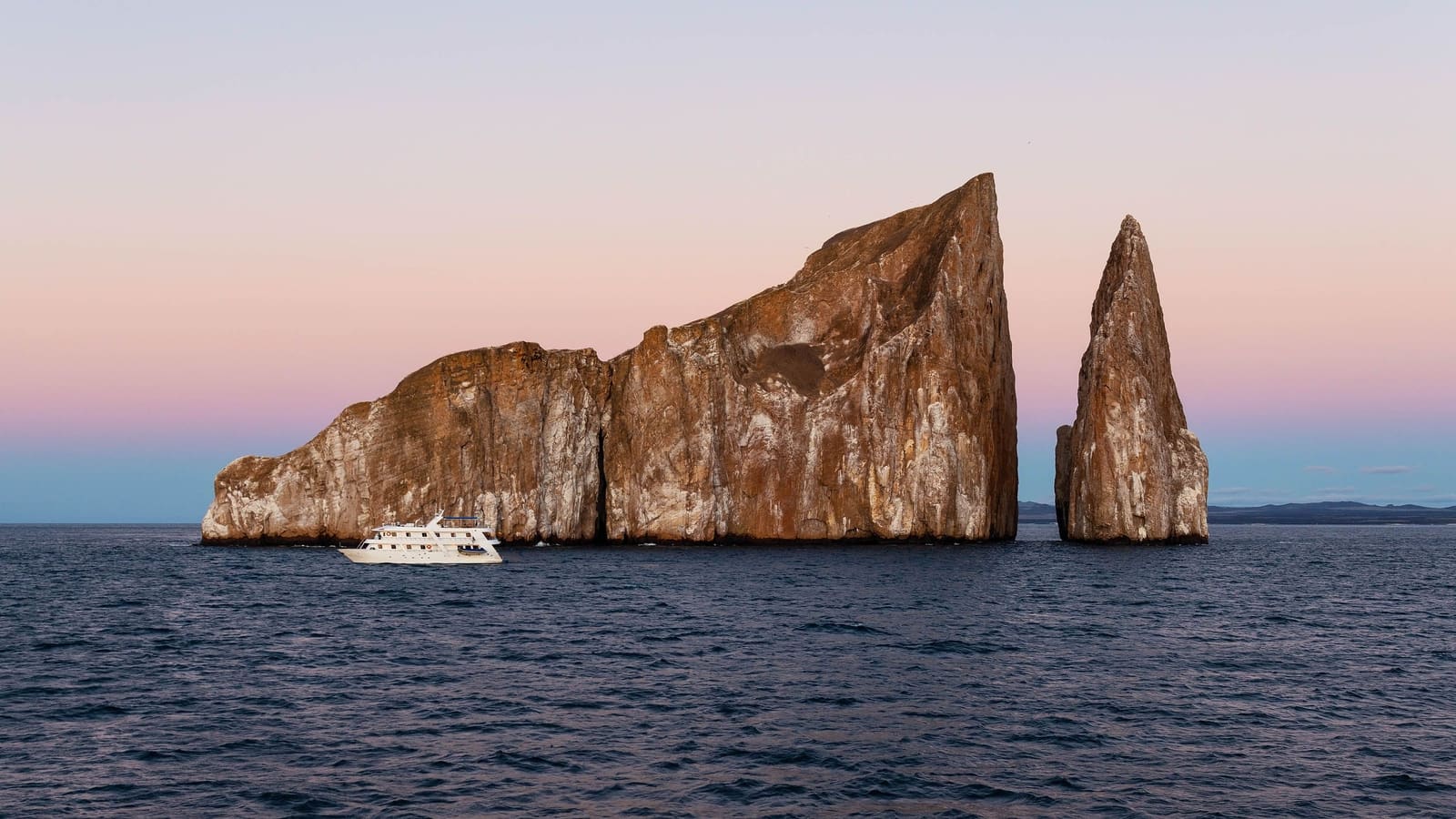
Stand on the deck of a small yacht at dawn, 600 miles off the Ecuadorian mainland, and you'll notice something rare: the absence of ambient noise. No traffic hum, no construction clatter, no engine drone from a distant highway. Instead, the morning air carries the bark of sea lions hauled out on lava rock, the splash of a blue-footed booby diving for breakfast, the hiss of waves breaking over volcanic shelves that cooled centuries before the first human set foot here. The Galápagos Islands do not accommodate mass tourism; they invite a different kind of attention, one measured in small groups, patient observation, and vessels designed to slip through narrow channels without disturbing the creatures who were here first.
Unlike the Caribbean or Mediterranean, where ports buzz with shore excursions and souvenir stalls, the Galápagos archipelago remains largely uninhabited. The islands are a living laboratory, and the ships that ply these waters function less as floating resorts than as mobile base camps. Capacity is strictly limited. Most vessels carry between sixteen and one hundred passengers. There are no casinos, no Broadway-style theatres, no water slides spiralling down multiple decks. The entertainment is provided by giant tortoises lumbering across volcanic highlands, by marine iguanas sunning themselves on black-sand beaches, by stingrays gliding beneath your snorkel mask in water so clear you can count the spots on their backs.
Choosing a ship here is not simply a matter of amenities or itinerary length. It is a question of how you wish to frame your encounter with one of the planet's last unhurried theatres of evolution.
Vessels That Prioritise Space and Silence
For travellers who equate luxury with elbow room, the design of certain ships offers a counterintuitive advantage. The Celebrity Flora, for instance, carries roughly one hundred passengers but was built to the proportions of a vessel twice that size. Suites begin at 224 square feet, with some cabins featuring floor-to-ceiling windows that retract to blur the boundary between interior and ocean. The largest balconies stretch to 321 square feet, generous enough to host a private breakfast while frigate birds wheel overhead. A retractable marina simplifies embarkation and disembarkation for guests with mobility concerns, eliminating the scramble over zodiac gunwales that characterises some expedition sailings.
Space aboard ship translates to space in the experience itself. When fewer bodies jostle for position on the sundeck or queue for the zodiacs, the rhythm of the day slows. You can linger over a second coffee while the naturalist briefs the group, or slip away to a quiet corner with binoculars and a field guide. The ship becomes a retreat between excursions, not merely a conveyance.
The Appeal of Intimate Scale
At the opposite end of the spectrum lie yachts built for sixteen passengers or fewer. Avalon Waterways charters the Treasure of the Galápagos, a catamaran whose largest suite spans 430 square feet and includes two private outdoor spaces. With so few guests aboard, the vessel moves through the islands like a private expedition, the itinerary flexible enough to linger at a snorkelling site if a pod of dolphins appears, or to adjust the landing schedule if weather favours an early hike.
The intimacy of small-ship sailing reshapes social dynamics. Meals are communal by necessity, and within a day or two, fellow passengers cease to be strangers. You learn who spotted the short-eared owl on Genovesa, who swims strongest in the current off Española, whose child has developed an encyclopaedic knowledge of Darwin's finches. The naturalist guides, often holding advanced degrees in marine biology or ecology, become familiar faces, their enthusiasm for the archipelago's minutiae infectious.
Ecoventura operates three expedition yachts - Origin, Theory, and Evolve - each accommodating twenty guests across ten staterooms. Children aged six and older are welcome, and certain cabins can be linked to form family suites. The crew-to-guest ratio is high, enabling a level of personalised service that extends beyond fresh towels and turn-down chocolates. On one sailing, the crew organised a pirate-themed farewell party, complete with improvised costumes and a treasure hunt that delighted both the eight-year-olds and their parents.
Catamarans and the Question of Stability
The twin-hulled design of a catamaran offers advantages that extend beyond aesthetics. Greater beam translates to reduced roll in open water, a consideration for travellers prone to seasickness. The wider deck also allows for more generous communal spaces: sun loungers that don't require strategic positioning, hot tubs large enough to accommodate half a dozen guests, dining areas that feel less like galleys and more like proper restaurants.
G Adventures' Reina Silvia Voyager, custom-built for the Galápagos, features ten cabins, two of which are configured with single beds and reserved for solo travellers. The ten-day itinerary begins and ends in Quito, threading through the central and eastern islands in search of marine iguanas, sea lions, and the archipelago's astonishing avian diversity. The sundeck is spacious enough for solitude even when all berths are occupied, and the bar at sunset becomes a convivial gathering point for those who crave company after a day spent snorkelling and hiking.
Culinary Ambitions on the Open Ocean
Dining aboard a Galápagos vessel need not be an afterthought. The Silversea-operated Silver Origin carries one hundred passengers and offers two restaurants, including The Grill, where premium cuts of meat are cooked tableside on lava stones. The menu leans heavily on local sourcing: Galápagos-caught fish, Andean quinoa, lobster pulled from the surrounding waters. Meals are served alfresco, the natural landscape providing a backdrop no interior designer could rival. Onboard culinary programming includes ceviche-making classes led by the ship's chef and tastings of Ecuadorian cheese aged in lava tubes, a technique that imparts a faint mineral tang.
Even on less opulent vessels, food serves as a bridge between the islands and the wider culture of Ecuador. Ecoventura's yachts offer breakfast buffets featuring Ecuadorian specialties alongside international staples, and multicourse dinners with vegetarian options. The emphasis is on variety and freshness, the galley restocked at each port call with produce from the mainland.
Adventure Rigging and the Gear That Matters
The Galápagos experience is fundamentally active. You will wade ashore through shallow surf, scramble over lava boulders, snorkel in waters patrolled by Galápagos sharks and sea turtles, kayak along coastlines where penguins nest in crevices. The ships that excel here are those equipped with the gear to support these pursuits and the guides to teach novices how to use it.
Uncruise's La Pinta, a forty-eight-passenger yacht, provides kayaks, paddleboards, snorkelling equipment, scuba gear, and a glass-bottom boat, all included in the fare. The vessel is neither the newest nor the most luxurious afloat, but it is comfortable and recently refurbished, with an itinerary that touches seven islands and islets. Excursions include a hike up Dragon Hill on Santa Cruz in search of land iguanas and flamingos, paddleboarding alongside sea lions off Floreana, and strolls along beaches where the only footprints are your own.
For those who view cruising with scepticism - who associate it with regimented schedules and passive consumption - Uncruise's ethos offers a corrective. The days are structured but not rigid, the tone unpretentious, the focus squarely on immersion rather than pampering.
Science as Participatory Theatre
HX Expeditions' MS Santa Cruz II invites guests to step into the role of citizen scientist. The onboard Citizen Science Programme enlists passengers in active research projects: collecting water samples, recording field observations, analysing materials in the ship's laboratory alongside professional researchers. Between visits to the Charles Darwin Research Station and excursions that trace the naturalist's route through the archipelago, the voyage becomes an exercise in applied learning.
For families, this pedagogical bent finds its fullest expression aboard the National Geographic Gemini, operated in partnership between Lindblad Expeditions and National Geographic. The ship accommodates up to forty-eight passengers across twenty-seven suites, more than a dozen of which include private balconies. One suite features a balcony large enough for a private hot tub, though a communal whirlpool on the sundeck is available to all. The National Geographic Explorers-In-Training programme offers children hands-on instruction in geographical exploration and scientific research, transforming the voyage into a floating field school.
The Economics of Access
The Galápagos are not inexpensive to reach or explore. The archipelago's remoteness, its stringent conservation regulations, and the limited number of vessels licensed to operate here all conspire to keep prices elevated. Yet budget-conscious travellers willing to forgo certain luxuries can still access the islands.
Nature Galápagos & Ecuador specialises in small-ship and land-based tours, with budget-class sailings aboard eight- to ten-person yachts such as the New Flamingo and Merak. Accommodations are simple but functional, with snorkelling gear, meals, and inter-island logistics included. A four- to five-night cruise costs roughly half what a week-long sailing on a larger vessel might command. The trade-off is primarily one of comfort rather than experience; you will still walk among marine iguanas, snorkel with sea turtles, and stand beneath the same vast sky that so astonished Darwin.
Timing and the Art of the Booking
The Galápagos operate on a rhythm dictated by migration patterns, breeding seasons, and the shifting interplay of ocean currents. There is no single "best" time to visit, only different seasons that favour different encounters. January through May brings warmer water and calmer seas, ideal for snorkelling. June through December ushers in cooler, nutrient-rich currents that attract larger marine species.
Booking windows follow a predictable pattern. For the widest selection of vessels and departure dates, reservations made four to nine months in advance yield the best results. Spontaneous travellers may find last-minute availability two to eight weeks before departure, though popular itineraries often sell out well ahead of sailing. The nature of small-ship expeditions means that once a vessel is full, there are no additional cabins to release.
What the Islands Demand of You
To sail the Galápagos is to accept a bargain. The islands will show you things you cannot see elsewhere: penguins at the equator, flightless cormorants drying their vestigial wings on volcanic shelves, albatrosses performing their elaborate courtship dance on clifftops battered by Pacific swells. In exchange, you must move at the islands' pace, which is to say slowly. You must rise early for the best light and the coolest hiking temperatures. You must accept that some landings will be wet, that some snorkelling sites will have strong currents, that the wildlife operates on its own schedule and does not perform on cue.
The vessel you choose will shape how you meet these demands. A larger ship offers more space to retreat when you need solitude. A smaller yacht fosters camaraderie and flexibility. A catamaran provides stability and generous decks. A science-focused expedition frames the experience through the lens of research and discovery. There is no single correct choice, only the vessel that aligns with how you wish to witness one of the planet's last great natural amphitheatres.
The sea lions will bark at dawn regardless of which ship you sail. The question is how you will answer.