From Wiltshire Valleys to Maggiore's Shores: The Geography of Power in The Gentlemen
Guy Ritchie's return to aristocratic crime trades the English countryside for Italian lakeside palazzos, where old money meets older vendettas.

An Estate Built on Secrets
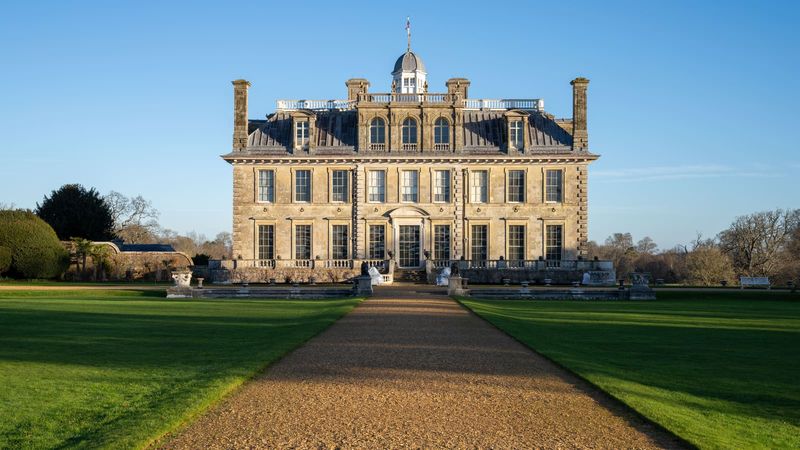
Stand in the entrance hall of Badminton Estate in south Gloucestershire and you might notice the walking sticks leaning by the door, a few spent shotgun cartridges scattered near the boot room. These are the textures of a house actually lived in, not preserved under glass. The estate, ancestral seat of the Duke and Duchess of Beaufort since the early seventeenth century, carries the weight of use alongside its grandeur: oil paintings darkened by centuries, cracks in the plasterwork, the particular fatigue that comes from being a family home rather than a monument.
It is this quality that made Badminton the exterior face of Halstead Manor in the Netflix series that follows Eddie Horniman, a reluctant duke who inherits not just land but a clandestine cannabis operation woven through his family's legacy. The production required a setting that could hold contradictions: tradition and crime, nobility and pragmatism, the veneer of respectability over something far more volatile.
The choice reflects a broader truth about the British aristocracy's contemporary predicament. Grand estates demand revenue streams their original owners never imagined. While the Horniman family's solution is fictional and felonious, the underlying pressure is real. Historic homes across Britain now host weddings, film crews, corporate retreats, anything to keep the roofs from leaking and the grounds maintained.
Ritchie's Own Acres
For a shooting party sequence early in the second season, director Guy Ritchie opened the gates of Ashcombe Estate, his own property in Wiltshire. The decision carried a certain poetic symmetry: a filmmaker staging aristocratic crime drama on land he purchased in 2001 for nine million pounds, a working farm spread across eleven hundred acres of chalk valleys and ash groves.
Ashcombe presented logistical puzzles. No mobile signal. No internet. Everything required for the scene, from frozen partridges to hunting dogs, had to be transported in. The estate had previously belonged to photographer Cecil Beaton, whose eye for composition and theatricality seems apt for a property now serving as a backdrop for stylised violence and class commentary.
The layers accumulate: a medieval photographer's retreat becomes a pop star's country house (Ritchie bought it with his then-wife Madonna), then a working farm, now a film set depicting the very world its owner inhabits and scrutinises. The line between subject and setting blurs.
Where England Keeps Its Secrets
Other English locations provided the series with its textured sense of place. Loseley Park near Guildford offered both exterior and interior shots, its grounds housing the gamekeeper's cottage. Swakeleys House in Ickenham, a Jacobean mansion built in 1638, transformed across episodes: a rehabilitation centre in one scene, a prison interior in another. Such doubling is practical economy, but it also reinforces the show's thematic interest in surfaces and what they conceal.
London's criminal underworld found its geography in Billingsgate Market and the Reform Club in Pall Mall, the latter masquerading as a gangster's private club. The Adelphi Building off the Strand became an auction house for a sequence involving a stolen Botticelli and a chase through the narrow streets around the Savoy Hotel. That chase required three months of negotiation with Westminster Council and surrounding businesses, but the result captures London's particular density: centuries of architecture compressed into blocks where a secret tunnel can still connect one world to another.
The Italian Turn
The second season required a geographic expansion. Horniman's ambitions push beyond Britain into territory controlled by Italy's organised crime families. Ritchie chose Lake Maggiore, a body of water straddling Piedmont and Lombardy, less touristed than Como, less mythologised than Garda.
Villa Rusconi Clerici, a nineteenth-century palazzo on the Piedmont shore, became the home of Contessa Isabella Savanza de Parme. The villa was built for Stefano Türr, a Hungarian colonel who married into Napoleon's family and played a role in Italian unification. Its Art Nouveau interiors, grand staircase with wrought iron balustrade, and light bouncing off the lake provided what the production sought: a visual echo of Halstead Manor, aristocratic lineage meeting aristocratic lineage, old European money recognising itself across borders.
The Grand Hotel Majestic, first opened in 1870, stood in for a wedding venue. Its French interiors, parquet floors, chandeliers, and private beach offered the kind of faded opulence that signals both history and the effort required to maintain it. From its balconies, the view extends across the lake to Borromeo Island, a composition of water and stone that has drawn the international elite for more than a century.
Mafia Geography
Lake Maggiore is not Sicily. It lacks the entrenched mafia mythology of the south. Yet organised crime has found uses for the area, particularly the 'Ndrangheta, the Calabrian network known for moving cocaine and weapons. The lake's proximity to the Swiss border makes it a corridor, a place where things pass through on their way to somewhere else.
This geographic reality adds a layer of plausibility to the series' plot. Horniman and his partner are not naively wading into Sicily's blood feuds; they are navigating a northern landscape where crime is present but less theatrically visible, where the mechanisms of power operate through bank accounts and border crossings rather than public displays of violence.
The choice also reflects a shift in how Italian organised crime is understood. The 'Ndrangheta has become Europe's most powerful mafia group, not through spectacle but through quiet control of drug routes and financial networks. A palazzo on Lake Maggiore, with its veneer of gentility and its access to Swiss banking, is precisely where such an operation might be headquartered.
Chiesa San Leonardo and the Architecture of Ritual
The sixteenth-century church Chiesa San Leonardo appears in the new season, its pink Baveno granite columns and sixty-five-metre bell tower providing a setting that carries both beauty and weight. The church sits in Pallanza, a lakeside village, with a dramatic staircase leading down to the water.
Religious architecture in crime narratives often serves as ironic counterpoint, the sacred space violated by profane deeds. But in this context, the church also speaks to continuity. Institutions endure. Power structures outlast individuals. The families who control territories, whether through titles or through violence, understand themselves as custodians of something larger than a single generation.
The Aesthetics of Inheritance
What binds these locations, from Gloucestershire to Piedmont, is their relationship to inheritance. Every estate, every palazzo, every centuries-old church exists because someone built it and someone else maintained it. The series uses these settings not as neutral backdrops but as active participants in its exploration of how wealth and power transfer across time.
The British aristocracy and the Italian mafia, in this telling, are mirror images: both are family enterprises, both rely on codes and hierarchies, both struggle with succession. The estates and villas are not just where these families live; they are the physical manifestation of their claims to legitimacy. To lose the land is to lose the identity.
Ritchie's decision to move the story from England to Italy in the second season is not merely about exotic locations. It is about testing whether the codes that govern one aristocratic criminal world translate to another. Whether Eddie Horniman's particular blend of nobility and ruthlessness can function in a context where the history is older, the rules more entrenched, the consequences more final.
Filming as Archaeology
The production's use of real historic sites rather than studio recreations lends the series a texture that would be difficult to fabricate. The cracks in Badminton's plaster, the light on Lake Maggiore, the worn stone of Chiesa San Leonardo, these details anchor the story in physical reality even as the plot veers into heightened territory.
There is something almost archaeological about the process: identifying sites that contain the right accumulation of history, negotiating access, then using them to tell a story about how the past shapes the present. The estates and palazzos are not passive; they impose their own logic on the narrative. A scene set in a seventeenth-century mansion cannot help but carry the weight of those three and a half centuries.
This approach also raises questions about what it means to film in these spaces. Is it preservation or exploitation? Do the location fees help maintain buildings that might otherwise decay, or do they reduce complex histories to scenic backdrops? The answer is likely both, simultaneously, uncomfortably.
What the Landscape Tells
In the end, the geography of the series is its argument. The English countryside, with its rolling estates and hidden grow operations, represents a particular kind of decline: the landed gentry adapting to diminished circumstances through increasingly creative means. Lake Maggiore, with its palazzos and proximity to Swiss borders, represents a different model: old money maintained through alliances with structures that operate outside the law but within their own rigid codes.
Both landscapes are beautiful. Both are sites of violence, historical and ongoing. Both are maintained by people who believe their inheritance gives them certain rights, certain permissions. The series does not resolve these tensions so much as inhabit them, using location as a way to think through questions of legitimacy, power, and what we owe to the past.
When Eddie Horniman stands on the balcony of the Grand Hotel Majestic, looking out across Lake Maggiore, he is measuring the distance he has travelled from Gloucestershire. But he is also confronting a continuity: the same structures of power, dressed in different architecture, speaking a different language, but fundamentally unchanged. The view is spectacular. What lies beneath it is another matter entirely.