Where Silence Costs More Than Service
A new generation of wilderness properties is rewriting the rules of luxury, trading marble lobbies for untouched horizons and privacy that money rarely buys.
The Edge of the Map
There are places where the nearest neighbor is a reindeer, where snowmobiles vanish beneath drifts, and where the summer sun refuses to set for months. Riksgransen, a village of sixty souls perched 125 miles south of the Arctic Circle in Sweden, is one such place. No grand hotel chains anchor its landscape. No velvet ropes or valets mark its entrance. What it offers instead is 2,000 square miles of untracked powder, helicopter access to terrain that humbles even seasoned skiers, and a kind of quiet that feels increasingly expensive.
This is not the Alps. There are no aprés-ski scenes designed for Instagram, no Michelin-starred chalets with waiting lists stretching into next season. Yet finance executives, tech founders, and C-suite veterans are making the seventeen-hour sleeper train journey from Stockholm, or chartering helicopters, to reach it. They come not in spite of the isolation, but because of it.
The shift is quiet but unmistakable. Across Scandinavia, New Zealand, Botswana, and Scotland, a new category of property is emerging that privileges remoteness over refinement, authenticity over opulence. These are not hotels in the traditional sense. They are lodges, villas, and converted farmsteads that sit at the intersection of wilderness and hospitality, offering experiences that cannot be replicated in a city or a resort corridor.
What Money Can No Longer Buy in Familiar Places
For years, luxury travel followed a predictable circuit. St. Moritz in winter, the South of France in summer, private islands in the Caribbean when schedules allowed. These destinations offered comfort, status, and a certain kind of visibility. But as social media turned exclusive retreats into public stages, the value proposition began to erode. Privacy became harder to secure. Authenticity became harder to find.
Lindsay Messina, who advises high-net-worth clients on travel through Fioraé Luxury Travel, has watched the calculus change. Clients who once prioritized brand recognition now prioritize immersion. They want tented camps where the only sound is wind through acacia trees, cliffside retreats where the nearest town is an hour away by boat, manor houses in Ireland where the host is also the chef. The common thread is not luxury in the conventional sense, but a sense of place so strong it becomes inseparable from the experience itself.
This is not about rejecting comfort. The lodges drawing this clientele offer Hästens beds, wine cellars stocked with Burgundy grand crus, and sauna masters who understand the precise rhythm of steam and silence. Niehku Mountain Villa, a fourteen-room property near Riksgransen, holds 3,000 bottles in its cellar, some from Domaine de la Romanée-Conti. Guests ski with guides who have competed in freeride championships, then return to meals prepared by chefs trained in Nordic fine dining and pastry work that has won national recognition.
The difference is context. These amenities exist not to impress, but to match the scale of the landscape. The hospitality is an extension of the environment, not a contrast to it.
The Architecture of Disconnection
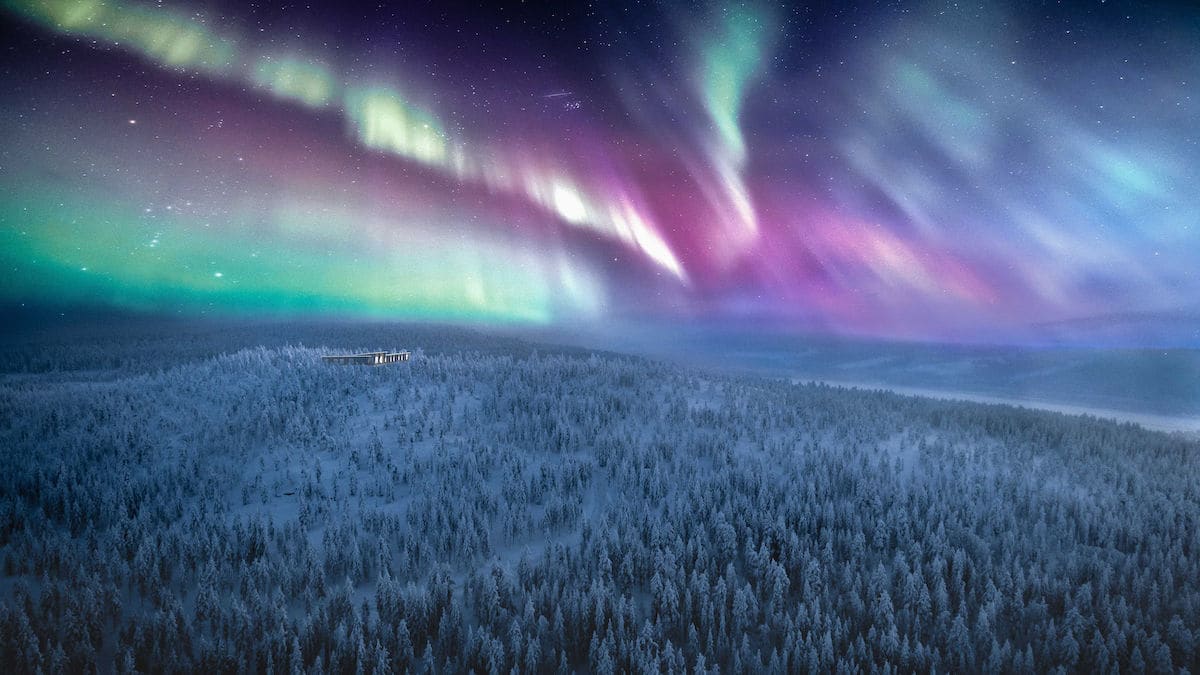
In Finnish Lapland, where winter darkness lasts months and the Northern Lights arc across the sky with regularity, a property called Octola II opened in December 2025. Its exact location is undisclosed. The price is not advertised. Access is arranged privately, by helicopter, husky team, or snowmobile, depending on season and preference. The lodge spans 800 square meters, with five en suite bedrooms, three saunas, a cigar lounge, and a viewing platform designed specifically for the aurora borealis.
Janne Honkanen, who founded Octola, describes the project as a deliberate rejection of standardized luxury. The goal was not to build another property that could exist anywhere, but to create something that could only exist here, in one of the planet's last large stretches of uninhabited land. The remoteness is not an obstacle to overcome. It is the product.
Since the pandemic, Finland has seen more than a dozen such properties open between Lakeland and Lapland. Balder Lodge, Aino Private Island Hotel, and Skyra Retreat all launched within the past two years, many offering full buyouts and already booked through the coming winter. The trend extends beyond Scandinavia. Flockhill in New Zealand, Bainslodge in Botswana, Wildland properties across Scotland, and Amankora in Bhutan all occupy similarly isolated terrain, built around the premise that distance itself has value.
Chad Pike and his wife Blake began renovating a backcountry ski property in Colorado in 2011, which became Scarp Ridge, the first in what is now a portfolio of more than a dozen lodges under the Eleven Experiences brand. One of them, Deplar Farm in northern Iceland, occupies a converted sheep farm in the island's remote north. It has thirteen rooms, access to geothermal waters, and a level of seclusion that has attracted guests seeking privacy for creative work.
Why Conventional Luxury No Longer Holds
Joachim Jocab, who manages Four Seasons Megève in the French Alps, has observed a broader shift in what guests prioritize. Accommodation alone no longer suffices. Travelers expect emotional resonance, a sense of belonging to a place rather than simply occupying it. This applies even in established resort towns, where demand for chalet-style properties and second homes has driven prices in Verbier and Gstaad to levels that rival St. Moritz.
The appetite for nature-led hospitality is not a passing trend, Jocab argues, but a recalibration of what luxury means in an era when almost anything can be bought, but very little feels singular. The question is no longer what a property offers, but what it makes possible. Can it deliver an experience that exists nowhere else? Can it provide not just privacy, but the kind of solitude that allows for reflection, creativity, or simply the absence of performance?
Jason Squatriglia, a travel adviser and Robb Report Travel Master, frames it differently. In a hyperconnected world, disconnection has become the scarcest resource. Time, not money, is the limiting factor for his clients. Privacy is no longer a preference but a requirement. The shift away from overexposed destinations like St. Barts or the Côte d'Azur is not about rejecting those places outright, but about seeking alternatives where discretion is built into the geography.
Deutsche Bank Wealth Investment has noted an uptick in investor interest in what it terms "experience-rich assets," a category that includes independently owned lodges in wilderness settings. There is no centralized database tracking such properties, but hundreds of high-end nature retreats and safari camps have launched since 2023, many backed by private capital rather than hotel conglomerates. The European real estate market reflects similar dynamics, with alpine second homes and remote chalets commanding premiums that reflect demand for seclusion as much as amenity.
The Logistics of Remoteness
Operating a property in a place where infrastructure barely exists requires a different kind of expertise. At Niehku Mountain Villa, co-owner and creative director Thomas Eidefors has built a hospitality model that accounts for extreme weather, limited access, and the logistical complexity of sourcing ingredients and wine in a region where supply chains are fragile. The property employs Sweden's top sommelier, an award-winning pastry chef, and a Nordic chef whose cooking reflects the landscape. Guests are guided by Robert Gustafsson, a veteran of freeride competition and arctic mountaineering who knows the terrain with the precision of someone who has spent decades navigating it.
The effort is not incidental. It is central to the value proposition. The remoteness creates the experience, but the service ensures it remains accessible to those who can afford it. Full buyouts at Niehku run roughly $11,000 per night, a figure that reflects not just the property itself but the orchestration required to make it function.
At Octola, the logistics are even more elaborate. The lodge sits within 800 hectares of Lapland wilderness, accessible only by specialized transport. Guests are assigned a wilderness guide who manages navigation, safety, and activity. The spa includes three distinct saunas, each calibrated to a different tradition. The gym is fully equipped despite the isolation. Every detail is designed to eliminate the friction of remoteness while preserving its benefits.
The Limits of Branding
Large hotel groups have begun to notice the shift. Four Seasons, Aman, and One&Only have all expanded into private homes, villas, and residences, seeking to capture a market that increasingly values exclusivity over brand. But the lodge model resists easy replication. It depends on specificity: a particular landscape, a particular climate, a particular cultural context. A lodge in Lapland cannot be transplanted to the Caribbean and retain its meaning.
Johan 'Jossi' Lindblom, co-owner of Niehku Mountain Villa, describes the property as an answer to a personal question: why travel at all if not to encounter something fundamentally different? The lodge was not conceived as a response to market trends, but as an attempt to make Europe's last wilderness accessible without diluting it. The hospitality is calibrated to the surroundings, not imposed upon them.
Eidefors adds that the model has always been about building curiosity. The guests who return year after year are not seeking comfort alone, but the kind of experience that shifts perspective. The landscape does much of the work. The service ensures the rest.
What Comes After Everywhere
For travelers who have already stayed in the world's most celebrated hotels, who have dined in its most exclusive restaurants and visited its most famous landmarks, the question becomes: what is left? The answer, increasingly, is not another destination but a different relationship to place. Not a resort that could exist anywhere, but a property so rooted in its environment that it becomes inseparable from it.
This is not a rejection of luxury, but a redefinition. It is not about doing without, but about choosing what to do without. The marble lobby, the concierge desk, the other guests. What remains is space, silence, and the kind of immersion that cannot be manufactured or scaled.
The lodges emerging across Scandinavia, New Zealand, and beyond are not replacing traditional luxury hotels. They are offering something those hotels cannot: the feeling of having reached the edge of the world, and finding that the edge is exactly where you wanted to be all along.