Where Stone Becomes Shelter: Inside Matera's Layered Past
Carved into limestone cliffs above a ravine, this southern Italian city preserves millennia of habitation in cave dwellings that now welcome the curious.
The City That Grew from Rock
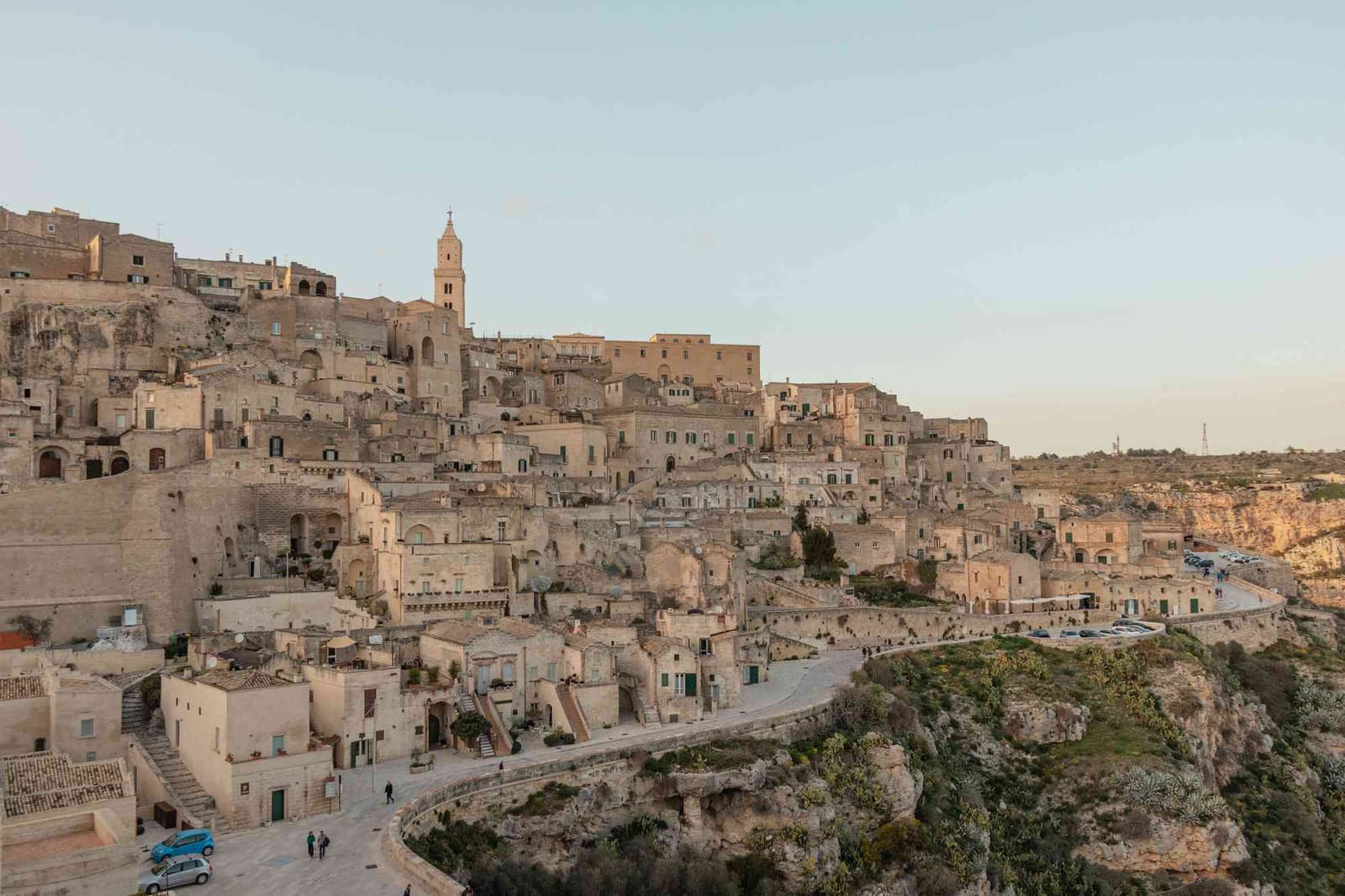
The approach to Matera reveals nothing. Basilicata's plateau stretches flat and wheat-colored under the southern sun, punctuated by olive groves and the occasional farmhouse. Then the road drops, and suddenly there it is: a city that appears to have been carved rather than built, its pale stone facades cascading down the walls of a deep ravine. This is not architecture imposed upon landscape but something closer to collaboration, where human ambition met limestone and decided to work within its terms.
Matera's defining feature is the sassi, districts of cave dwellings excavated directly into the calcareous rock. These are not rustic curiosities or recent tourism ventures. They represent one of the world's longest continuously inhabited settlements, with evidence of occupation stretching back nearly nine thousand years to the Paleolithic era. The caves began as natural shelters, then evolved as successive generations carved deeper, added facades, dug cisterns, and engineered sophisticated water-collection systems that sustained life in an arid climate. What visitors see today is a palimpsest, each layer of habitation leaving its mark on the stone.
The sassi divide into two main quarters: Sasso Barisano to the northwest and Sasso Caveoso to the south. Both tumble down the sides of the Gravina ravine, their rooftops often serving as pathways for the dwellings above. This vertical urban logic created neighborhoods where one family's terrace was another's ceiling, where sunlight and ventilation were precious commodities negotiated through careful excavation. Walking these districts requires adjusting to a three-dimensional maze where staircases tunnel through rock, alleyways dead-end at cliff faces, and what appears to be a blank wall might conceal an entire dwelling behind it.
From Habitation to Abandonment to Revival
For most of its history, Matera existed outside the Italian consciousness, a remote settlement in one of the country's poorest regions. The cave dwellings housed extended families, livestock, and workshops in close quarters, conditions that by the mid-twentieth century had deteriorated into severe overcrowding and unsanitary living. In 1952, the Italian government declared the sassi uninhabitable and relocated residents to modern housing developments on the plateau above. The caves were abandoned, left to decay and collapse.
What followed was one of Europe's more remarkable urban revivals. Beginning in the 1980s, preservation efforts gained momentum, driven by a growing recognition that Matera represented an irreplaceable historical document written in stone. UNESCO designated the sassi and the park of rupestrian churches a World Heritage Site in 1993, citing them as an outstanding example of human settlement adapted to a challenging terrain. That designation brought funding, attention, and eventually, inhabitants.
Today, many of the cave dwellings have been converted into boutique hotels, restaurants, galleries, and private residences. The transformation raises the inevitable tensions of heritage tourism: how to preserve authenticity while accommodating contemporary expectations, how to honor the memory of poverty without romanticizing it. Yet Matera has managed this balance with more grace than many similarly positioned cities. The cave hotels retain the spatial logic of their origins, with vaulted ceilings, stone alcoves, and the particular acoustics of enclosed rock. They offer not luxury imposed on ruins but comfort that respects the architecture's fundamental character.
Rupestrian Churches and Hidden Frescoes
Beyond the residential caves lie Matera's rupestrian churches, more than 150 of them scattered through the ravine and the surrounding Murgia plateau. These sanctuaries were carved between the eighth and thirteenth centuries, primarily by Benedictine and Basilian monks who sought isolation for contemplation. The churches vary dramatically in scale and ambition, from simple single-chamber oratories to complex structures with naves, apses, and columns hewn from living rock.
The interiors of many preserve Byzantine frescoes, their colors muted by centuries but still legible. These paintings depict saints, biblical scenes, and theological narratives in the stylized conventions of Eastern Christianity, evidence of Matera's position at the crossroads of Latin and Byzantine religious traditions. The Chiesa di Santa Maria de Idris, perched on the Monterrone rock overlooking Sasso Caveoso, contains layered frescoes from different periods, each generation of monks adding their devotional imagery to the stone canvas.
Visiting these churches requires effort. Many lie outside the city proper, accessible only by footpaths through the ravine or across the Murgia park. The Cripta del Peccato Originale, often called the Sistine Chapel of rupestrian churches, sits several kilometers from Matera's center and can only be visited by guided tour. Its ninth-century frescoes, depicting scenes from Genesis and the lives of saints, cover the cave's walls and ceiling in a continuous narrative that retains remarkable chromatic intensity. The remoteness feels intentional, a reminder that these spaces were never meant for casual access but for withdrawal from the world.
The Ravine and the Murgia
The Gravina ravine defines Matera's geography and much of its character. This limestone gorge, carved by the Gravina stream, creates a natural fortification and a dramatic backdrop for the city. The ravine's far side, part of the Parco della Murgia Materana, offers the classic panoramic views of the sassi that have become iconic, particularly at sunrise or late afternoon when the stone glows amber.
But the ravine is more than a viewing platform. Its caves and rock faces contain evidence of Neolithic settlements, Bronze Age villages, and the remains of defensive structures from various periods. Trails descend into the gorge, crossing the stream on ancient stone bridges and passing cave dwellings now inhabited only by swifts and jackdaws. The vegetation shifts with elevation and exposure: Mediterranean scrub on the sunny slopes, ferns and moss where water seeps from the rock, wild orchids in spring.
The Murgia park extends beyond the ravine, encompassing a landscape of karst plateaus, sinkholes, and seasonal streams. This is grazing country, dotted with the conical stone shelters called trulli and the occasional masseria, fortified farmhouses that once anchored rural estates. The park's rupestrian churches sit isolated in this landscape, their carved facades barely distinguishable from the surrounding rock until you stand directly before them.
Contemporary Matera and the Weight of Designation
Matera's selection as a European Capital of Culture in 2019 accelerated changes already underway. The designation brought international attention, increased tourism, and significant infrastructure investment. New museums opened, cultural programming expanded, and the city positioned itself as a destination for travelers seeking alternatives to Italy's more saturated heritage sites.
This visibility has consequences. Property values in the sassi have risen sharply, making it increasingly difficult for local residents to afford housing in the historic districts. The conversion of caves to tourist accommodation continues, raising questions about the threshold at which a living city becomes a curated experience. Matera is not yet Venice or Dubrovnik, but the trajectory is familiar.
Yet the city retains elements that resist easy commodification. The sassi remain genuinely disorienting, their spatial complexity defeating the kind of superficial tourism that stays on main thoroughfares. The rupestrian churches, many still requiring guided access or significant hiking, preserve a sense of discovery. And the surrounding landscape, protected within the Murgia park, offers context that grounds Matera's history in its environmental reality: this was always a place where human survival required ingenuity, where architecture meant negotiating with stone and water and sun.
Arrival and Orientation
Matera sits in Basilicata, a region often overlooked in the geography of Italian tourism. The nearest major airport is Bari, roughly sixty kilometers north in Puglia, connected to Matera by bus and private transfer. The train station lies several kilometers from the historic center, requiring a local bus or taxi to reach the sassi. This relative inaccessibility has worked in Matera's favor, filtering out the kind of mass tourism that arrives by cruise ship or coach tour.
The city's layout takes time to internalize. The modern town occupies the plateau, with broad streets, contemporary buildings, and the usual amenities. The sassi districts descend from there, reached by staircases and sloping streets that quickly become pedestrian-only. Maps help but cannot fully capture the three-dimensional reality. Getting lost is inevitable and, within limits, part of the experience. The stone pathways eventually lead either down to the ravine floor or back up to the plateau, providing natural boundaries to wandering.
Accommodations range from converted cave dwellings offering atmospheric if sometimes acoustically challenging stays to conventional hotels on the plateau. The cave hotels vary widely in their approach: some preserve the austere character of the original dwellings, others introduce contemporary design elements that create deliberate contrast with the ancient stone. Choosing depends on how much authenticity, in its various forms, one is prepared to embrace.
What Endures
Matera's appeal lies not in any single monument or view but in the cumulative effect of its layered history made visible. The city offers a legible record of human adaptation: how people carved shelter from rock, managed scarce water, built communities in vertical space, abandoned those communities, and eventually returned to reclaim them under different terms. It is a place where architecture and geology become difficult to separate, where the distinction between natural and built environment blurs.
The current iteration of Matera, with its boutique hotels and cultural programming, represents just the latest layer in this ongoing accumulation. Whether this version proves as enduring as the Byzantine frescoes or the Neolithic settlements remains an open question. What seems certain is that the stone itself will outlast any particular use we assign to it, ready for the next generation to carve their own meanings into its surface.