Where Art Nouveau Meets Modern Craft in Roma Norte
Inside El Cortés, a 15-room hotel where three years of archival research and artisan collaboration have turned a century-old mansion into a study in restraint and romance.
A Building Reclaimed from Its Own Past
There is a particular quality of afternoon light in Roma Norte, the way it filters through urapán branches and catches on wrought iron balconies, that makes you slow your pace without quite knowing why. It was in this same dappled quiet that owner Carlos Zaragoza spent three years restoring a balustraded art nouveau mansion on Calle Colima, combing through archives for century-old photographs, tracking down craftspeople who still practiced traditional plastering techniques, and gradually coaxing the building back toward what he calls its "original soul."
The result is El Cortés, a fifteen-room hotel that opened its doors with the kind of confidence that comes only from deep research and patient execution. This is Zaragoza's first hospitality project, yet the interiors read like the work of someone who has been thinking about texture, proportion, and the relationship between old and new for far longer than three years.
At Global Chic Voyage, we have watched a generation of boutique properties mistake ornament for atmosphere. El Cortés does something more difficult. It layers without crowding, honors without imitating, and creates spaces that feel both historically grounded and entirely livable.
Interiors That Breathe
The lobby sits beneath a low ceiling, dimly lit and wrapped in velvet drapes the color of an approaching storm. Opposite a heavy wooden desk, a fringed loveseat in dandelion yellow holds a collection of needlework cushions, their geometric patterns echoing motifs found in rural Mexican textiles. Behind it, an enormous art deco mirror framed with delicate vine etchings reflects the room back on itself, doubling its intimacy.
Zaragoza describes his approach as one of "delicate balance," a phrase that risks sounding vague until you move through the building and see how carefully each object has been placed. In the first-floor lounge hangs a tiny artwork from 1828, acquired at auction in the city. Its scale is deliberately small, a counterpoint to the grand proportions of the room and a reminder that not everything worth preserving announces itself loudly.
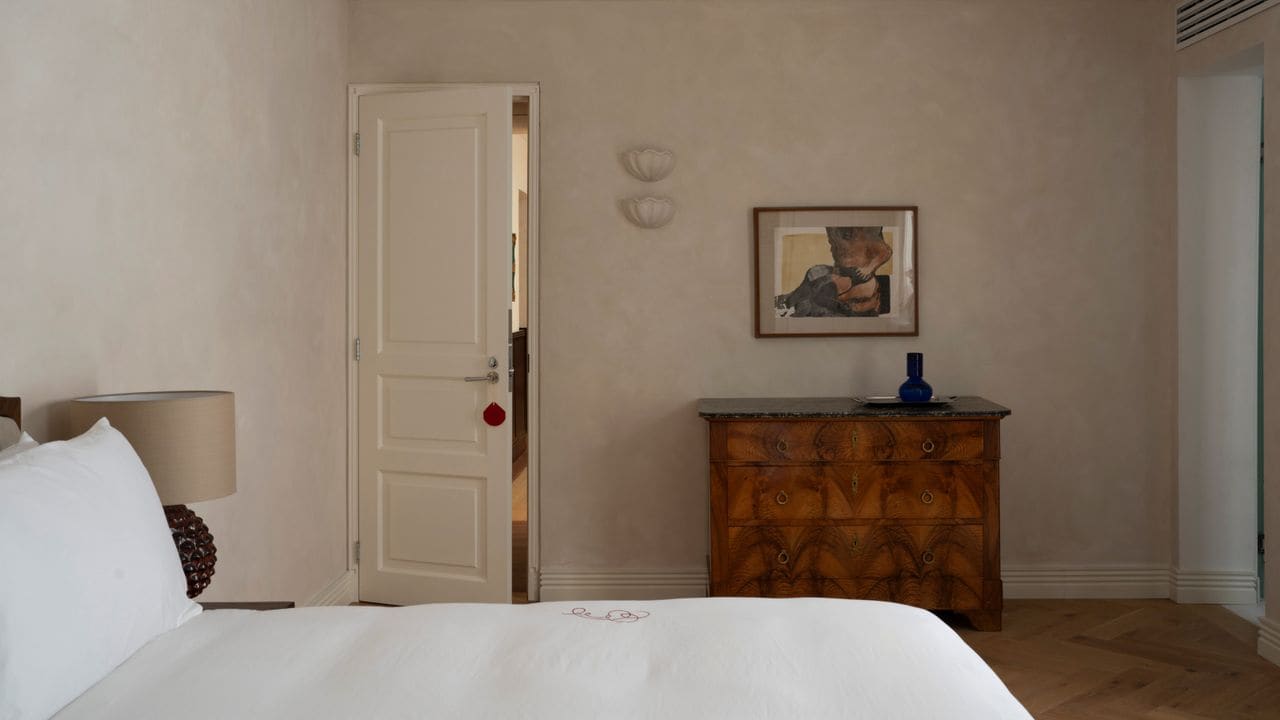
This sensibility carries into the fifteen guest rooms, where pale oak herringbone floors peek out from beneath hand-loomed rugs and oil paintings in time-worn gilded frames hang above beds crowned with oxblood velvet headboards. Plaster sconces shaped like shells draw the eye upward to intricate coving work, while paned windows cast criss-crossed shadows onto lime-washed walls. The effect is one of tremendous romance tempered by restraint, a combination rarely achieved in properties that lean this heavily into period detail.
The Suite with the Tree
Room 103, a Signature Suite on the first floor, may be the most compelling of the collection. Its tall doors open onto a Juliet balcony that abuts an impressive urapán tree, close enough that you can hear the rustle of leaves and catch the scent of bark after rain. Inside, the same attention to craft is evident in details that could easily have been overlooked: a bespoke talavera tissue box on the nightstand, a silken tassel hanging from an enamel handle, the particular weight of the curtain fabric as it pools on the floor.
In the bathrooms, cylindrical glass sconces flank double vanities crafted from slabs of Rosso Levanto marble, their bold veining a deliberate contrast to the softer tones elsewhere. Rainfall showers are tiled in glossy oxblood with checkerboard trim, and niches hold Byredo's Bal d'Afrique products. Several rooms feature claw-foot Kohler bathtubs with polished nickel stoppers, while the two Patio Suites include stained glass panels reworked by Ramon Sierra, the artisan who contributed to the restoration of Castillo de Chapultepec.
Marigolds and dahlias appear in folksy talavera vases, bath salts sit in hand-carved wooden vessels, and the towels carry a barely-there scent developed in collaboration with the hotel's laundry service. Zaragoza opted for something powdery and subtle, reminiscent of talc with a hint of vetiver, meant to evoke purity rather than announce itself as a signature fragrance. It is this kind of thoughtfulness, applied to elements most guests will never consciously register, that distinguishes El Cortés from properties that mistake luxury for spectacle.
A Restaurant Worth Staying In For
In a city as gastronomically rich as Mexico City, it takes a certain confidence to suggest that guests skip the neighborhood's many acclaimed tables and stay put. Lotti, the hotel's ground-floor restaurant, makes that case persuasively. Named after the grandmother of Swiss-born chef Luc Liebster, it offers inventive reinterpretations of European and Mexican classics, all sourced from hyper-local ingredients.
The dining room, designed by Mexico City and Los Angeles-based interiors specialist Rosela Barraza, features exposed brick ceilings crossed by restored original beams, talavera tiles with simplified floral motifs that nod to old hacienda design, and slender bronze-cast lights that resemble primitive fire torches. On one wall hangs a pigment-daubed still-life photograph of corn leaves from Liebster's father's gallery in Zurich, a quiet reminder of the chef's own layered heritage.
Menus are clipped onto grey textured boards with tiny burnished brass fasteners, and waitstaff move through the room in collarless shirts embroidered with the restaurant's name in dark thread. The hasselback potatoes arrive satisfyingly crisp, topped with avocado mousse and trout roe. The shrimp tostada, dressed with pico de gallo, kaffir lime, and hibiscus, balances acid and sweetness with precision. On the drinks front, the mezcal-heavy Sativa cocktail deserves its own following.
Outside, wrought iron chairs topped with yolk-yellow and white cushions cluster beneath square umbrellas on a small pavement patio. Each week, Barraza herself arranges wild, oversized botanical displays using whatever foliage and flowers she finds at the market, an approach that keeps the space feeling alive and seasonally rooted rather than static.
The Neighborhood as Context
Step outside onto tree-studded Calle Colima and you are within walking distance of the galleries, ateliers, cafés, and restaurants that have made Roma Norte one of the city's most sought-after neighborhoods. The Museo del Objeto sits on the same street, and at any given time, vendors sell Tajín-sprinkled mango slices from carts shaded by colorful parasols.
This context matters because El Cortés does not position itself as an escape from the city but as an extension of it. The hotel's design vocabulary, its commitment to local craftsmanship, and its restaurant's sourcing philosophy all reflect an understanding that place is not backdrop but substance. Zaragoza describes his intention as wanting "to reflect the evolution of surrounding Roma Norte," and the building succeeds precisely because it does not try to freeze the neighborhood in amber but instead engages with its ongoing transformation.
What Restraint Looks Like
There is a particular kind of homeliness that emerges when a space has been designed with care but without the need to announce that care at every turn. El Cortés achieves this through layering: contemporary pieces set against restored heritage features, shocking pink dahlias in delicate talavera vessels, the interplay of velvet and plaster and hand-loomed wool. Nothing competes; everything converges.
We have returned to certain hotels over the years not because they dazzle but because they make us feel more like ourselves. El Cortés belongs to that category. It is a property that understands the difference between showing off and showing up, between design as performance and design as hospitality. In a city where new openings arrive with breathless frequency, that distinction is worth celebrating.