Where Craft and Sky Converge: Ten Tokyo Hotels That Redraw Luxury
From ryokan-inspired retreats in the clouds to chocolate boutiques and listening bars, Tokyo's finest properties are less about marble lobbies than the art of considered detail.
The Vertical City and the Art of the Stay
Stand on the fifty-second floor of any Tokyo tower at dusk and you begin to understand why this city's luxury hotels have become laboratories for a new kind of vertical hospitality. Below, neighborhoods unfold like illuminated circuit boards; above, the sky shifts from cerulean to indigo in minutes. The city received more than forty-two million international visitors in 2025, according to the Japan National Tourism Organization, and a great many of them discovered that Tokyo's most compelling stays aren't replicas of what works elsewhere. They're spaces where Italian garden bars share real estate with onsen-inspired soaking tubs, where chefs grow rice for both sushi and sake, where a black Labrador serves as chief greeter.
At Global Chic Voyage, we've watched Tokyo's hotel landscape evolve beyond the predictable parade of international flags. Yes, nearly every major luxury brand has staked a claim here, but the more interesting story unfolds in how these properties adapt, how they absorb and reinterpret Japanese aesthetics rather than simply import a house style. And it's in the newer arrivals, the independent spirits, and the properties that understand luxury as curation rather than accumulation where the city's true character emerges.
Minimalism as Theater
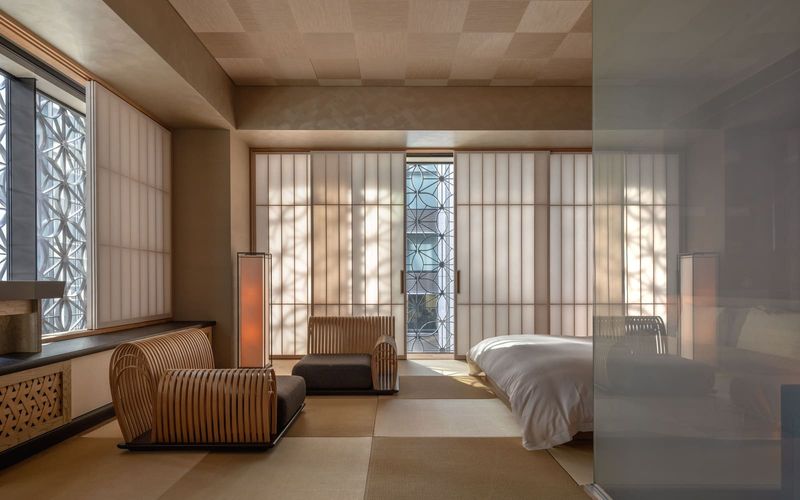
The lobby at Aman Tokyo occupies the thirty-third floor of Otemachi Tower, an eighty-six-foot chamber that reads less as hotel entrance and more as contemplative gallery. Natural wood, stone, and an almost monastic hush: the space doesn't announce itself so much as invite you to slow down. The eighty-four rooms carry that same ryokan-inspired restraint, heated bathroom floors leading to deep stone soaking tubs, matching pajamas and slippers waiting like quiet promises.
But minimalism here isn't about absence. It's about focus. Chef Hiroyuki Musashi grows his own rice, ferments his own sake, throws his own ceramic vessels for the omakase that unfolds at his namesake restaurant. The two-story spa anchors itself around a ninety-eight-foot infinity pool flanked by daybeds, a space that feels less like a gym amenity and more like a private onsen suspended in the sky. Below, the hotel runs its own patisserie and connects directly into the station, a reminder that even the most rarefied experiences in Tokyo remain tethered to the city's relentless, efficient pulse.
The Rooftop as Revelation
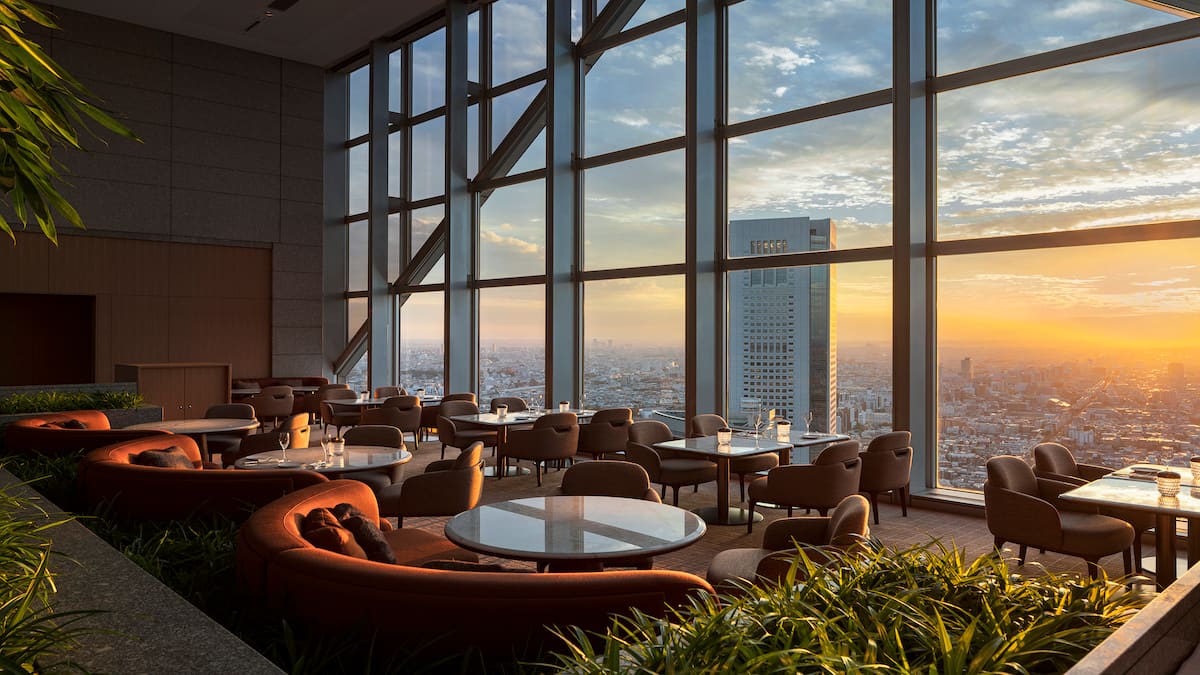
Tokyo demands to be seen from above. The sprawl makes sense only when you can trace the logic of its districts, the way green pockets interrupt concrete, the way towers cluster and recede. At Andaz Tokyo Toranomon Hills, the fifty-second-floor Rooftop Bar offers one of the city's finest vantage points, and hotel guests skip the line and the seating charge. It's a small perk that feels generous at sunset, when Tokyo Tower glows across the skyline and the city's hum softens into something almost gentle.
The hotel's one hundred sixty-four rooms split the difference between traditional and contemporary: walls that evoke shoji screens, sturdy wood furniture, green carpeting, red leather chairs, circular soaking tubs. Floor-to-ceiling windows do the heavy lifting, framing views that shift by the hour. On the same rooftop level, The Sushi remains quietly excellent, an Edomae omakase experience paired with the house-label Andaz 52 sake. The AO Spa and Club spans a large indoor pool, traditional baths, and a modern fitness center, all of it designed for guests who want to retreat without leaving the building.
Italian Warmth Meets Japanese Precision
When Bulgari Hotel Tokyo opened in 2023 within the Tokyo Midtown Yaesu skyscraper, it brought a particular kind of Mediterranean confidence to the city. The ninety-eight rooms are chic in the way only Italian design can manage: warm, tactile, unafraid of color or texture. Yellow accents in the suites, delicate soap dishes arranged like sculpture around the bathroom, soaking tubs that feel more like design statements than amenities.
The forty-fifth-floor Bulgari Bar is modeled as an Italian garden, complete with two rooftop terraces and a whimsical cocktail menu. At Sushi Hōseki, chef Takuro Shimizu works his counter with the kind of precision that makes omakase feel like choreography. The nearly twenty-thousand-square-foot spa includes an eighty-two-foot indoor pool lined with daybeds, a hyperbaric oxygen chamber, and treatments using Augustinus Bader and Mauli products. And then there's the Bulgari Dolci Boutique, an in-house chocolate and pastry shop that feels both indulgent and essential, the kind of detail that separates a luxury hotel from a luxury experience.
The New Guard
Fairmont Tokyo arrived in summer 2025, planting itself in the waterfront Shibaura neighborhood with a thirty-foot lobby filled with oversized art and cascading greenery. The two hundred seventeen rooms come equipped with cocktail tools, tea sets, professional-grade clothing steamers, and multiple bath salts. The slippers, as one might say, are real and they are spectacular. But it's the smaller gestures that linger: Serene, the hotel's black Labrador who serves as Chief Happiness Officer; Off Record, a speakeasy-style listening bar powered by a McIntosh 275 vacuum tube amplifier, its vinyl collection curated for late-night contemplation.
The Fairmont Spa features a sixty-five-foot infinity pool and an outdoor deck with a hot tub, treatments using Mikimoto Cosmetics that include the option to customize a foot scrub with fresh botanicals. Two six-seat counter dining experiences anchor the food program: one for teppanyaki, another for a more intimate culinary format. The indoor-outdoor flow continues throughout, a conscious blurring of boundaries that feels right for a city where space is at such a premium.
What Defines Luxury Now
The best Tokyo hotels in 2026 aren't competing on thread count or marble provenance. They're competing on curation, on the intelligence of their design choices, on whether they understand that luxury travelers no longer want to be insulated from place but immersed in it. A chef who grows his own rice. A listening bar with a vacuum tube amplifier. A chocolate boutique that makes afternoon snacking feel like an event. These are the details that matter now, the ones that signal a property understands hospitality as craft rather than formula.
Tokyo's skyline continues to climb, and new flags continue to plant themselves in the upper floors of its towers. Waldorf Astoria and Dorchester Collection properties are on the horizon, joining recent arrivals like JW Marriott Tokyo. For travelers who prefer something outside the international circuit, options like Hoshinoya Tokyo offer ryokan experiences in the city's heart, while Janu Tokyo represents Aman's new sister brand with a distinct point of view. The funky, twenty-room K5, housed in a converted 1920s bank building, appeals to those who want their luxury a little more offbeat, a little less polished.
The Common Thread
What unites the city's finest properties isn't a shared aesthetic or price point. It's an understanding that Tokyo itself is the main character, and the hotel is simply a very good supporting actor. The best stays don't block out the city; they frame it, interpret it, offer a lens through which to see it more clearly. Whether that's through a rooftop bar at sunset, a spa pool that seems to float above the streets, or a chef who insists on controlling every element of the meal down to the ceramic plate, these hotels recognize that luxury in Tokyo means something different than it does in Paris or New York or Dubai.
It means respecting craft. It means understanding that minimalism isn't emptiness but intentionality. It means knowing when to be quiet and when to dazzle, when to nod to tradition and when to break entirely new ground. And it means, above all, creating spaces where the vertical city and the ancient culture it sits upon can coexist, not in tension but in a kind of elegant, ongoing conversation.