Where an Artist Finds Seoul in Light and Water
Guimi You paints the city she grew up in, and shares the neighbourhoods, markets, and riverside moments that anchor her vision of home.
The River That Divides and Unites
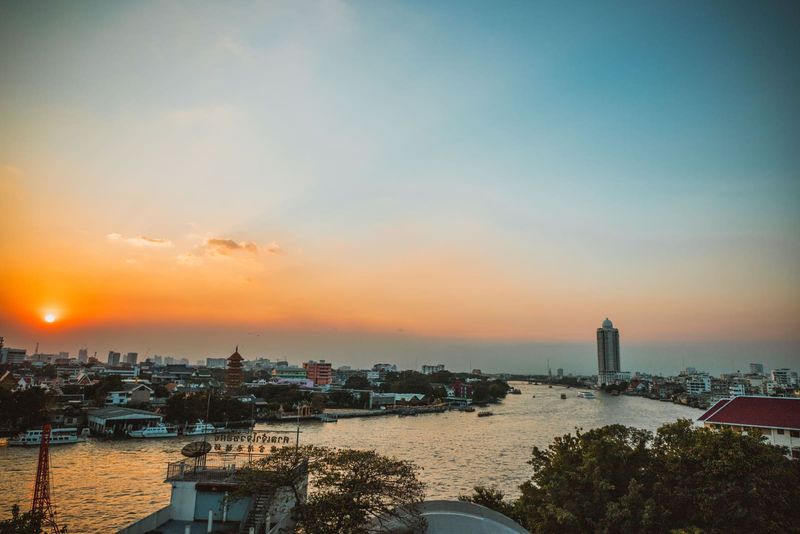
There is a moment just before nightfall when the Han River stops reflecting the sky and begins to hold the city instead. The water darkens, the bridges light up in strands of white and gold, and the sprawl of Seoul arranges itself into something legible. Guimi You knows this hour well. She returns to it often, not only in person but on canvas, where couples drift in swan-shaped pedal boats and the horizon blurs into twilight.
For You, the river is more than geography. It is memory, metaphor, and muse. In her oil paintings, urban energy and natural stillness occupy the same frame without friction. Kinship and isolation coexist. East Asian and Western traditions meet in brushstrokes that neither reconcile nor collide, but simply flow. She spent a decade abroad, first earning a master's degree in painting from the Royal College of Art in London in 2014, then living in California, where distance sharpened her attachment to the place she left behind. Seoul became not just familiar but essential.
"I believe that having such a vast river flowing through the heart of such a large metropolis is one of Seoul's greatest treasures," You says. Her recent work, Us, on the Han River (2026), captures that conviction. The painting, currently on view at Frieze Seoul through 5 September, depicts a couple crossing the water at sunset. The scene is both intimate and expansive, a private moment framed by the city's relentless scale.
You grew up in Seoul, but it was leaving that taught her how to see it. What follows is her map of the city, drawn not in landmarks but in textures, routines, and the kinds of places that reveal themselves slowly.
A Neighbourhood That Still Lives
Bukchon Hanok Village sits between two royal palaces, Gyeongbokgung and Changdeokgung, its lanes lined with traditional hanok homes. The curved tile roofs, the latticed windows, the courtyards hidden behind wooden gates, all of it might read as staged for visitors. But people still live here. Laundry hangs in the courtyards. Bicycles lean against stone walls. The neighbourhood was not built for tourism; it simply persists within it.
You recommends staying in one of the hanok guesthouses, where the architecture shapes the rhythm of the day. Rooms are small, floors are heated from below, and the boundaries between inside and outside feel provisional. One such hanok, Hwuigyumjae, is a 120-year-old structure available for private functions. The experience is less about comfort in the Western sense and more about proximity to a different logic of space, one that prioritises modesty and flow over grandeur.
Walking through Bukchon means moving slowly. The alleys are narrow, the inclines steep, and the best views arrive without warning. You turn a corner and suddenly the city spreads below, or a courtyard gate stands ajar, offering a glimpse of stone jars and potted persimmon trees. Authenticity here is not a selling point. It is simply what remains.
Soup at Any Hour
Jet lag has its own geography. When sleep refuses to come and the city outside is still awake, You heads to Hamgyeongdo Chapssal Sundae, a 24-hour restaurant in Songpa District known for sundaeguk, a hot soup built around slices of Korean blood sausage, rice, and a deep, mineral broth. She has been going since her student days, long before the neighbourhood became a destination.
The ritual is specific. Order the soup. Eat the meat dipped in saeujeot, a condiment of salted and fermented shrimp that cuts through the richness with a sharp, oceanic tang. The restaurant is brightly lit, the tables close together, the turnover constant. It is not romantic. It is sustaining.
Namdaemun Market operates on a different scale. One of Seoul's oldest and largest traditional markets, it sprawls across multiple blocks, selling everything from children's clothing to hardware to medicinal herbs. You can lose an afternoon here without intention. If hunger sets in, the grilled fish alley offers a solution. Restaurants cook fresh mackerel and yellow croaker over charcoal, the smoke visible from several stalls away. The fish arrives whole, crisp-skinned, with banchan and rice.
Afternoons Without Plans
Songnidan-gil Street, near Seokchon Lake and Lotte World Tower, has become a cluster of independent cafés and small restaurants, the kind of neighbourhood that rewards aimlessness. You suggests spending an afternoon here without agenda. Walk until something catches your attention. Sit in a café with good light. Watch the lake if the weather holds.
Nearby, Starfield Coex Mall offers a different rhythm. In the basement food court, You recommends two restaurants. Gangnam Gyoza serves kalguksu, a hand-cut noodle soup with a soft, wheaten bite. Hadongkwan specialises in gomtang, a milky beef broth that has been simmered for hours until the bones release everything they have. Both dishes are elemental, the kind of food that defines a place more than any monument. If you prefer heat, order kimchi on the side.
Art Inside Palace Grounds
The National Museum of Modern and Contemporary Art operates several branches across South Korea, but You returns most often to the Deoksugung location, which sits within the grounds of a Joseon-era palace. The approach matters. You walk through the palace complex first, past stone pathways and wooden pavilions, before reaching the museum entrance. The contrast between old and new is not smoothed over. It is the point.
If the timing aligns, visitors may witness the changing of the royal guard ceremony at the main gate, a choreographed display of historical military protocol that unfolds in silence and colour. Inside the museum, exhibitions rotate frequently, but one show commands attention through early 2027. Do Ho Suh, an artist represented by the same gallery as You, is presenting his first full survey exhibition in South Korea, including early works and new pieces never before shown publicly. The exhibition runs until 9 February 2027.
Suh's practice, like You's, concerns itself with memory, displacement, and the architecture of belonging. His fabric sculptures replicate the homes he has inhabited across the world, rendered in translucent nylon that collapses the boundaries between interior and exterior, presence and absence. The show is a homecoming of sorts, a reckoning with the spaces that shape us.
Markets That Reward Patience
Dongmyo Flea Market is not curated. It is chaotic, crowded, and full of things no one asked for but someone might want. Vintage clothing hangs in dense rows. Secondhand books are stacked in precarious towers. Old vinyl records lean in crates, their covers sun-faded and warped. You recommends browsing without expectation. The pleasure is in the search, and occasionally, in the discovery of something singular at a price that makes no sense.
Insa-dong Culture Street offers a more deliberate experience. The neighbourhood has long been a centre for traditional Korean arts and crafts. Shops sell hanji, the handmade mulberry paper used in Korean painting, along with brushes, ink stones, and pigments. Galleries exhibit contemporary and classical Korean art. Tea houses tucked into side streets serve ceremonial teas in quiet rooms where conversation lowers to a murmur.
For You, Insa-dong is where the materials of her practice live. It is where tradition is not preserved in amber but continues, adapted and reinterpreted by each generation.
An Island That Pulls You Back
Jeju Island lies off the southern coast, a volcanic landscape of black rock, green fields, and a coastline that shifts from dramatic cliffs to gentle beaches. You spent significant time there last year, and the island's quiet atmosphere and spare beauty informed much of her recent work. It is a place, she says, that makes her want to return.
The island is accessible by a short flight from Seoul, and its appeal lies partly in its difference. The pace is slower. The sky feels larger. Hallasan, the shield volcano at the island's centre, dominates the interior, its trails winding through forests and alpine meadows. The Gwaneumsa trail offers one of the more challenging routes to the summit, but the effort is repaid in views that stretch to the sea.
For those seeking accommodation that reflects the island's restrained beauty, architect Byoung Cho has designed a series of elevated cabins that sit lightly on the land, their forms simple and their materials honest. They are places to be still, to watch the light change, to let the island do what it does best: slow you down.
What Remains
Seoul is a city that moves quickly, rebuilds constantly, and rarely pauses to sentimentalise its past. You admires this quality. She speaks of the Korean people's diligence, their energy, their capacity to create and adapt. But her paintings suggest something else, too, a need to hold onto the moments that slip past in the rush. The river at sunset. A couple in a pedal boat. The way the city lights up after dark.
Her work does not resist Seoul's velocity. It simply asks what endures within it. And in her recommendations, the same question surfaces. Not the newest restaurant or the most instagrammable café, but the places that have been there, that continue, that shape the city's memory as much as its skyline. Seoul, in You's telling, is not a spectacle. It is a series of returns, each one deepening the last.