When the Steppe Speaks: Kazakhstan's Artisans Reclaim a Vanished World
In Almaty's studios and workshops, a generation of makers is translating nomadic memory into felt, ceramic, and glass - resurrecting a cosmology nearly erased.
A Geography of Memory
The green metal gate swings open onto a courtyard in Tuzdybastau, a quiet township where Almaty's sprawl finally surrenders to silence. Inside, sheep's wool in rolls the colour of autumn steppe lines the walls of Laila Zharkyn's workshop. She lifts a strand between her fingers, testing its give. Her cat, Simba, weaves between skeins of ivory and rust. This is where wool becomes story - where fibres bond under friction and water into tekemets, the felt carpets that once covered every nomadic floor, every yurt interior, every threshold between earth and sky.
Zharkyn's practice is both preservation and invention. The technique she uses, dry felting with a specialised needle, was passed down through generations of women who understood that a carpet was never merely decoration. Patterns like koshkar muiz - the ram's horn motif - encoded wealth, fertility, the cyclical logic of pastoral life. Yet by the time Zharkyn began her apprenticeship six years ago, few families retained the knowledge. Soviet collectivisation had scattered the herds and the people who tended them. Felt gave way to factory textiles, then to imports, then to luxury brands. The language of the steppe was going silent.
Now, Zharkyn's large-scale panels hang in galleries and private collections. Her 2024 commission for the Central State Museum, a monumental work she calls "time code enciphered in felt," treats each pixel of pattern as both echo and aspiration. She teaches her sister and nieces the craft, a relay of knowledge that feels urgent. "When we know our history," she says, "we're firmly rooted in the ground."
The Cosmology Beneath the City
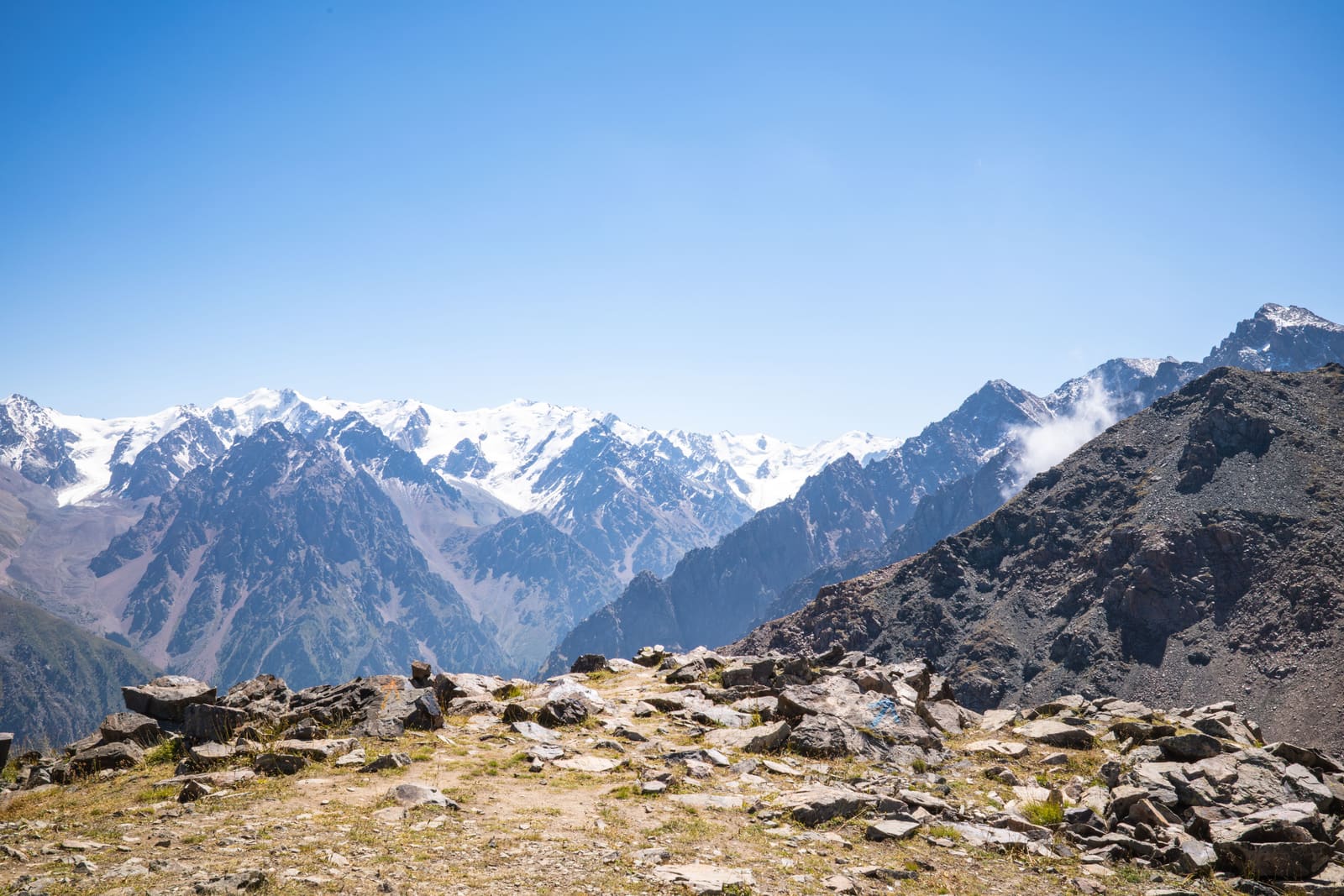
Almaty sits in the shadow of the Tian Shan mountains, a metropolis built atop layers of older geographies. Leafy boulevards carry Soviet-era apartment blocks alongside neo-nomad restaurants where diners eat beshbarmak - slow-boiled meat over flat noodles - under chandeliers. The steppe is not visible from most street corners, but its imprint is everywhere: in the hospitality philosophy of dastarkhan, in the practice of zheti ata (knowing seven generations of one's lineage), in the spring celebration of Nauryz that marks resilience over winter.
For fashion designer Alina Aitzhanova, this invisible presence is the foundation of her work. Her label, Al Basty, takes its name from a Turkic spirit once invoked to protect women in childbirth, later distorted into a scolding term for misbehaving children. Aitzhanova's sculptural garments - dramatic cuts, spiky hemlines, avant-garde silhouettes - reinterpret myths that have been misunderstood or forgotten. A liver bag named Bayur. A white wool coat inspired by Aqqu, the sacred swan. "Modern armour for the soul," she calls them, pieces that allow wearers to inhabit legend without costume.
Aitzhanova comes from a lineage of felt masters and artisans. Her grandfather worked with his hands; she works with myth. "The steppe is a powerful image," she explains. "Harsh yet generous, with unhewn forms and an endless gaze that sees everything." That gaze, in her telling, belongs to Tengri - the supreme deity of the nomadic worldview, representing the boundless sky. In Tengrism, sun and wind and ancestor spirits possess as much agency as the living. The yurt itself was understood as a microcosm of the universe: wooden lattices connecting to earth, circular walls mirroring the sun's arc, the whole structure a sacral geometry.
This cosmology was systematically dismantled. Forced settlements in the 1930s, famine, collectivisation - these policies killed and displaced over a third of the Kazakh population. Nomads lost their animals, their lands, their portable shelters. The yurt became a relic, then a tourist attraction, then a symbol to be cautiously reclaimed.
The Mosaic Revival
Inside Aqqu, a cafe that first opened in the 1960s and was restored last year, the walls are covered in Soviet-era mosaics. Condensed milk tins line the shelves. The room hums with conversation, mostly young people ordering wafers and tea. This is not nostalgia for ideology - few of Aqqu's patrons remember the Soviet Union - but for texture, for the tactile weight of analog objects, for visual codes that feel distinct in an era of algorithmic homogeneity.
Daria Zaitova, founder of Art Oskolok, a mosaic studio a few blocks away, has watched this shift unfold. Her workshop is filled with natural stone, smalt, glass tile, books, plants. She fell into mosaic work through its meditative rhythm, the way small fragments cohere into something monumental. "Part of Soviet Modernism and monumental art, mosaics have become the cultural code of the city," Zaitova explains. "They're highly visible in the streets; it is impossible to overlook them."
During the Soviet period, these panels appeared on metro stations, school facades, residential blocks. In Central Asia, far from Moscow's oversight, local artists sometimes embedded regional motifs into the official iconography. After independence in 1991, many were damaged or destroyed. Now, a new generation is commissioning replicas and original works. Art Oskolok runs daily masterclasses and sells gift sets through the Asif Khan-designed Tsellinny Center of Contemporary Culture, which opened in 2025. Their designs - depicting the late-modernist Kazakhstan Hotel, the mountains, the swallows that once adorned Qarlygash Cafe - appear in restaurants and on street corners across Almaty.
Zaitova attributes the resurgence to visual fatigue. "People have grown tired of uniform styles," she says. "Mosaics possess a powerful character; they're durable, textured, vibrant, making modern materials look less expressive by comparison." The craft's durability mirrors the cultural work being done: a reassertion of local identity through materials that outlast trends.
Inheritance in a Seventh-Floor Studio
On a quiet floor of the Union of Artists building, Altynay Baizhan works in the same room her grandfather, the painter Issatay Issabayev, occupied from the 1970s until the early 2000s. His paintings still hang on the walls. Baizhan's practice, Altyn Ceramics, translates his visual language into three dimensions - mugs, bowls, vessels that carry the weight of lineage without sentimentality.
Ceramic work, like felting and mosaic, is both ancient and newly urgent in Almaty. It offers a way to handle inheritance without simply reproducing it. Baizhan's pieces are functional, meant for daily use, but they carry patterns and glazes that reference older systems of meaning. A mug becomes a way to drink tea and to remember the philosophy of dastarkhan, the ethic of generosity encoded in every shared meal.
This is the thread that connects the city's emerging makers: a refusal to let memory ossify into museum display. Zharkyn's felt panels are sold at boutiques like Korkem and through private appointments. Aitzhanova's garments appear in streetwear contexts, not costume archives. Zaitova's mosaics adorn cafes, not just galleries. The work is alive because it circulates, because it enters daily life rather than remaining sealed behind glass.
The Pull of Open Space
Zharkyn speaks of "urban fatigue," a restlessness she sees in her peers and clients. "Our nomadic soul demands returning to our roots," she says. "People are tired of the cities and are missing the steppe. The need for wide spaces is in our blood." This is not a call to abandon Almaty, but a recognition that the city's identity is incomplete without the landscape that shaped its people.
The Great Steppe, a vast expanse of grasslands and deserts covering much of Kazakhstan, was home to Turkic tribes for millennia. By the 15th century, these groups were known as the Kazakh Khanate. They moved with the seasons, raised livestock, lived in portable yurts. The yurt was shelter and temple, its structure reflecting a belief that the universe itself was yurt-shaped. Felt rugs inside depicted tört tülik mal, the four essential animals of the steppe - horses, sheep, camels, goats - each a pillar of survival and symbol of cosmic order.
That order was disrupted, but not erased. The artisans working in Almaty today are not reconstructing a lost world so much as translating it into forms that can survive modernity. Aitzhanova's garments are not costumes; Zharkyn's felt is not replica. They are acts of interpretation, ways of asking what nomadic cosmology might mean in a city where the steppe is no longer visible but remains, as Zharkyn insists, in the blood.
What Remains
The Golden Square, a five-block pedestrian district in historic Almaty, gathers the city's restaurants, boutiques, and promenades into a compact grid. It is where visitors come to see the city at its most curated, where locals come to encounter a version of themselves made legible to outsiders. Yet even here, the work of reclamation is visible. Mosaics reappear on storefronts. Felt panels hang in shop windows. Ceramic mugs are sold alongside imported espresso machines.
This is not a return to the past, but a negotiation with it. The artisans driving Almaty's craft revival are not nostalgic for a time they never knew. They are building a language that acknowledges rupture - the Soviet erasure, the post-independence tumult, the influx of global capital - while insisting that something essential persists. That persistence is not passive. It requires labour, technique, the willingness to learn what has been nearly lost and to make it speak again.
Aitzhanova, Zharkyn, Zaitova, Baizhan - each in their own medium - are translating the steppe's cosmology into objects that can be worn, hung, used, inhabited. They are asking what it means to carry a nomadic soul into the 21st century, not as burden but as orientation. The yurt's geometry, the felt's warmth, the mosaic's fragments, the ceramic's glaze - all are ways of saying: this is where we come from, this is what we carry forward, this is how we remain rooted while the world shifts beneath us.