When Thunder Wakes You in the Canopy
Inside the newest chapter of Twin Farms, where elevated treehouses and a kitchen salon redefine the Vermont mountain retreat.
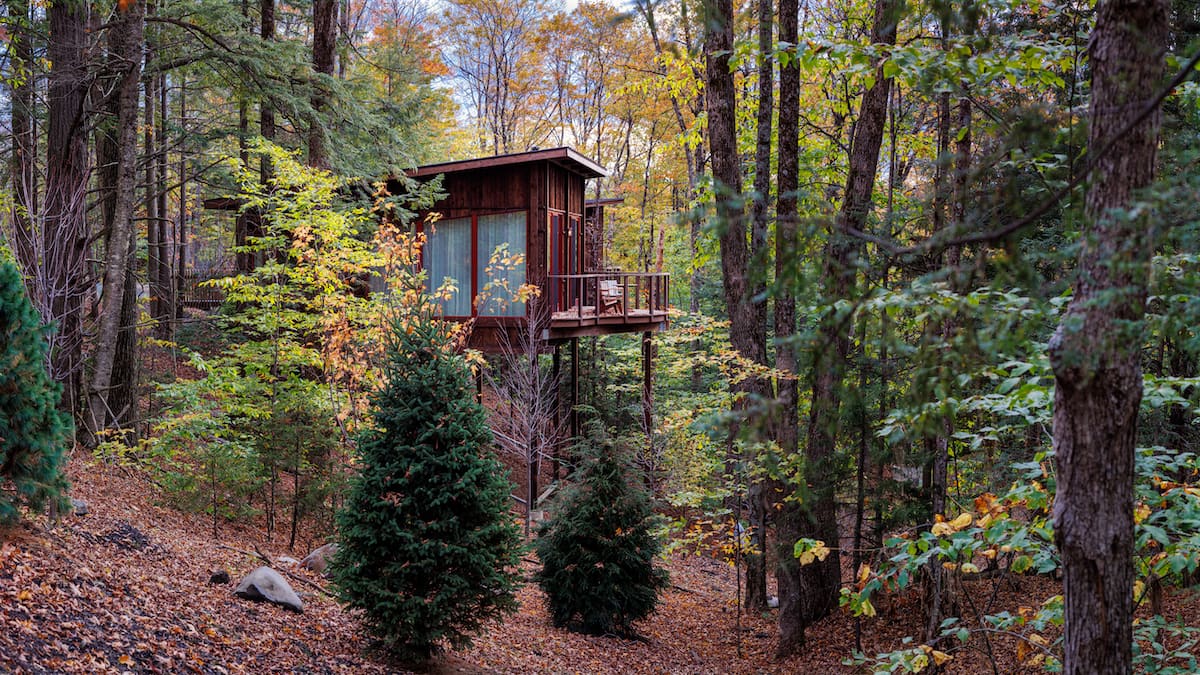
Suspended Between Earth and Sky
At 2:45 in the morning, lightning split the sky above the Green Mountains and thunder rolled through the pines. This was not the gentle Vermont pastoral, but something wilder, more insistent. The kind of storm that makes you question your choice of lodging when that lodging happens to be perched 20 feet above the forest floor, accessible only by footbridge, surrounded by nothing but canopy and wind.
Yet inside the treehouse, wrapped in gauzy curtains and warmed by a hanging gas fireplace, there was only the thrilling awareness of being suspended between earth and sky. Twin Farms, the Relais & Châteaux retreat that has drawn the quietly affluent to Barnard, Vermont, since 1993, recently expanded its collection of accommodations with eight Treehouses, each one an 800-square-foot study in how luxury can sit lightly in the woods. Designed by Michaelis Boyd, the London firm known for its work with members' clubs and thoughtful hospitality projects, these structures embrace a kind of wabi-sabi restraint: burnished wood, open-plan living, oversized decks that put you at eye level with the birds.
At Global Chic Voyage, we have long believed that the best retreats are those that do not insulate you from place, but rather sharpen your awareness of it. Twin Farms has always understood this. Its 300 acres of private forest, meadow, and pond are not backdrop but protagonist. And now, with these new Treehouses, guests are invited not merely to visit the woods but to dwell within them, to sleep and wake and dine in the canopy itself.
A Legacy Written in Wood and Words
The property's origin story reads like something from a mid-century novel. In 1928, Nobel Prize-winning author Sinclair Lewis purchased the land for $10,000 at the behest of his bride, journalist Dorothy Thompson, who had promised to marry him only if he could deliver a Vermont farm with sweeping lawns, orchards, and what she called "delicious air." Lewis obliged. The couple went on to host gatherings of poets, politicians, entertainers, and entrepreneurs, a tradition of cultured conviviality that the resort has quietly maintained ever since.
Today, Twin Farms holds two Michelin keys and operates as an all-inclusive, adults-only sanctuary. The recent addition of the Treehouses brings the total room count to 28, each cottage and suite designed with the same careful balance of comfort and restraint. Books line every surface: volumes of Dickens, coffee-table tomes on nature, mystery novels tucked into reading nooks. The main lodge features a balcony library where guests can settle in with a glass of something local and let the afternoon drift by.
There is a theory, advanced by certain modern-day Thoreaus, that nature and culture exist in opposition, that we crave one in the absence of the other. Twin Farms suggests otherwise. Here, both impulses are honored in equal measure, woven together so seamlessly that it becomes difficult to say where one ends and the other begins.
When the Air Turns Noxious
The week of our visit, Canadian wildfire smoke drifted south, blanketing the Green Mountains in a haze that turned the sky the color of old parchment. A simple one-mile hike around the property, normally a meditative pleasure, became an exercise in shallow breathing and mounting headache. The "delicious air" that Dorothy Thompson once demanded had turned acrid, uncooperative.
Yet this is where Twin Farms reveals its depth. The property offers nine miles of trails, yes, but also yoga sessions, open-play pickleball, pasta-making classes, e-bike tours, watercolor painting workshops, fly-fishing casting lessons, and meditative walks around an on-site labyrinth. There is archery and axe throwing, paddleboard yoga, guided meditation, and access to a traditional Japanese onsen. Copper Pond and Silver Lake are stocked for fishing; canoes and kayaks rest along the shore. A 24-hour fitness center includes steam rooms and tennis courts.
In January 2027, Twin Farms will debut a 10,000-square-foot Garden House Spa featuring a dry Finnish sauna, thermal showers, hot and cold plunge pools, and an indoor-outdoor mineral pool designed for recovery. The addition of a full swimming pool, long overdue, will round out the wellness offerings.
The resort has also introduced "Off Script with Twin Farms," an intimate salon series that brings in authors, chefs, and industry leaders for candid conversations. Past guests have included author Ben Mezrich, financial journalist Andrew Ross Sorkin, Sesame Workshop President Sherrie Westin, and restaurateur Danny Meyer. It is the kind of programming that nods to the property's literary roots while remaining firmly anchored in the present.
Inside the Kitchen Salon
The true revelation, though, is the Chef's Table experience, launched in late 2025 by culinary director Nate Rich and head chef Sylvain Courbet. Available for a handful of guests each evening at an additional cost beyond the all-inclusive rate, the multi-course tasting menu unfolds not in a private dining room but inside the working kitchen itself. You sit, you sip, you watch sous chef Miles Erickson plate a perfect cut of Vermont Wagyu with the precision of a jeweler. You quiz wine director Ryan Bogdan, whose encyclopedic knowledge of beverages, both alcoholic and zero-proof, earns him the unofficial title of "Professor."
After a few rounds of wine pairings, or the equally thoughtful non-alcoholic alternatives, the formality dissolves. You are encouraged to stand, to move closer, to ask questions. What kind of range is that? Has anyone ever been locked in the freezer? Is it strange to have strangers watch you work? The answer to the last question, surprisingly, is no. Chef Sylvain's kitchen operates with an unusual abundance of "pleases" and "thank yous," a far cry from the high-stress drama of television kitchens. None of the chefs watch "The Bear," they confess, because it hits too close to home, and because their own kitchen culture is built on something quieter, more sustainable.
The seasonal tasting menu shifts with what the land offers. In summer, that means heirloom tomatoes and fresh herbs from the property's gardens, trout from the ponds, berries foraged from the edges of the meadows. In winter, root vegetables and game. The experience is immersive not in the theme-park sense, but in the way that all good meals should be: an invitation to pay attention, to taste the work, to understand the choices that bring a dish from field to plate.
The Winnowing Road
Getting to Twin Farms is itself a kind of meditation. The five-hour drive from New York or Boston becomes an exercise in winnowing: the roads narrow, the traffic thins, the houses shrink into practical wooden structures that blend into the hillsides. Hand-chalked signs advertise maple syrup by the quart and duck eggs off the front porch. You pass through Woodstock, not the famous one, then follow State Road through ten miles of farmland punctuated by clusters of solar panels. The journey prepares you, quietly, for arrival.
At night, when the storm rolls through and the thunder shakes the treehouse walls, there is no fear, only exhilaration. The structure is solid, the fireplace glows, and outside, the forest bends and sways in the wind. You are not removed from nature here, but held within it, cradled by it, reminded that comfort and wildness are not opposites but companions.
In the morning, the storm has passed, though the smoke lingers. You step onto the deck, coffee in hand, and watch the mist rise from the meadow below. Somewhere in the distance, a loon calls across Silver Lake. The day stretches ahead, full of possibility: a pasta-making class, perhaps, or an hour in the onsen, or simply more time with a book in the library balcony, letting the hours slip by unmarked.
Twin Farms does not ask you to choose between culture and nature, activity and rest, luxury and simplicity. It offers all of it, layered and interwoven, and trusts you to find your own rhythm within it. That, more than any single amenity or architectural flourish, is what makes it worth the winding drive into the Green Mountains, worth the thunder that wakes you at 2:45 in the morning, worth the smoke that forces you indoors to discover what you might otherwise have missed.
The all-inclusive rate starts at $2,800 per night, a figure that includes meals, beverages, and access to the full slate of activities. The Chef's Table experience carries an additional fee. Reservations are recommended well in advance, particularly for the Treehouses, which have quickly become the most sought-after accommodations on the property.
What Remains
We spent an entire day inside a Treehouse, watching the light shift through the pines, listening to the wind move through the canopy. We spent most of a night in the kitchen, asking too many questions and tasting dishes that will linger in memory long after the smoke clears. This is not the Vermont of postcards, all covered bridges and fall foliage. This is something more textured, more alive, a place where thunder can wake you in the night and you feel only gratitude for the reminder that you are, for a few brief days, suspended between earth and sky, held by both.