When a Tasting Menu Becomes a Journey You Can Sleep Through
Stuart Ralston's Lyla now invites guests to linger past the last course, transforming an Edinburgh Georgian townhouse into a rare marriage of Michelin-starred seafood and overnight sanctuary.
A Georgian Townhouse Opens Its Upper Floors
There is something deeply satisfying about not having to leave. About finishing the last petit four, climbing a single flight of stairs, and surrendering to sleep without negotiating taxi queues or the cold shock of a Scottish night. At Global Chic Voyage, we have long believed that the best meals deserve more than a hurried departure, and Lyla, perched inside a Georgian townhouse on Royal Terrace in Edinburgh, now understands this intimately.
Since April, the restaurant has unveiled four bedrooms on its upper floor. Each bears the name of a coastal plant: Aster, Linen, Samphire, Purslane. The gesture is quiet but deliberate, a nod to the same Scottish shoreline that informs every plate served downstairs. Chef Stuart Ralston, who opened his first Edinburgh restaurant in 2014 after years working kitchens in New York, has built a small empire of four distinct concepts across the city. But Lyla remains the flagship, the one holding a Michelin star and a view that stretches north toward the Firth of Forth.
The addition of rooms transforms what was already an ambitious seafood-focused tasting menu into something closer to a pilgrimage. You arrive for dinner. You stay until morning. The architecture permits it; those tall Georgian windows and soaring ceilings have always suggested permanence, a kind of unhurried elegance that resists the frenetic pace of contemporary dining.
Scarinish's Warm Hand in a Formal Space
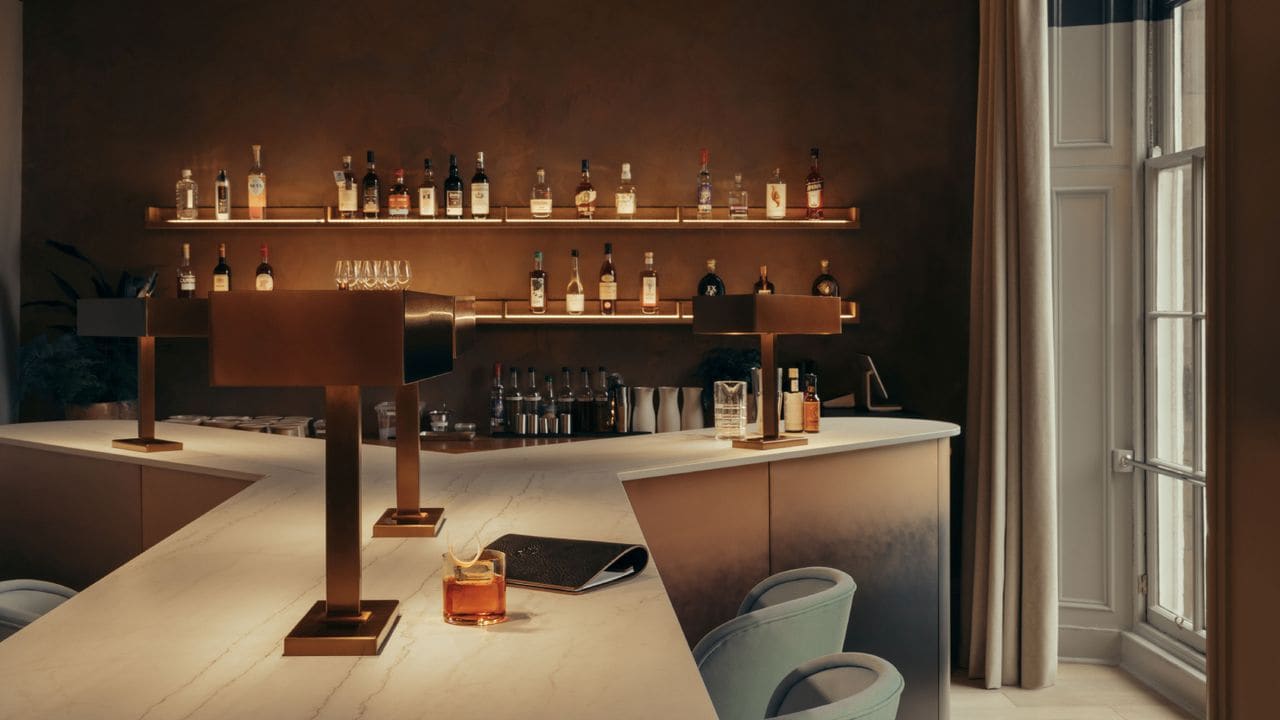
Glasgow-based studio Scarinish, responsible for both the restaurant's 2023 design and the new bedrooms, has approached the interiors with a deft balance of reverence and playfulness. Georgian proportions can intimidate. They can feel museum-like, untouchable. Here, dark wood joinery softens the grandeur, while textiles by Orcadian designer Hilary Grant introduce bold, graphic patterns that refuse to fade into the background.
Brass details on furniture and lighting catch the northern light, that particular quality of illumination Edinburgh wears like a signature. The palette leans into painterly wall colors, muted but not timid, creating rooms that feel hallowed without tipping into formality. The beds are vast, which matters more than one might think after a ten-course tasting menu. Sleep, in this context, becomes part of the experience rather than an afterthought.
What Scarinish has managed, both upstairs and down, is the rare feat of making a grand space feel intimate. The design does not compete with the building's bones; it amplifies them, adding warmth where there might otherwise be austerity.
Seafood as the Guiding Philosophy
The food remains the gravitational center of Lyla. Ralston's tasting menu is unapologetically seafood-driven, a deliberate choice in a fine dining landscape often dominated by red meat and game. Scotland's waters offer extraordinary raw material: langoustine, scallop, halibut, trout, crab, lobster. The menu moves through these with both technical precision and a sense of adventure that keeps the format from feeling rote.
We have grown weary, at times, of the tasting menu as a genre. It can become formulaic, a parade of tiny courses that prioritize novelty over coherence. But Ralston's hand is confident and personal. Each dish arrives with a clear point of view. Squid reimagined as ramen. Sorrel sorbet that shocks the palate awake. Laminated brioche paired with wild garlic butter. A langoustine preparation involving burnt apple that should not work on paper but succeeds completely in practice.
The kitchen team does not hide behind the pass. Chefs deliver many of the courses themselves, explaining provenance and technique, bridging the often awkward distance between kitchen and table. It is a small gesture, but one that fundamentally alters the tone of the evening. Fine dining, in Ralston's vision, does not require aloofness. It can be both rigorous and generous, both precise and joyful.
The Rarest Ingredient in Fine Dining
Joy is the word that lingers. Too often, Michelin-starred dining becomes an exercise in endurance, a test of whether the diner can decode the chef's intentions or appreciate the virtuosity on display. Lyla sidesteps this trap. The food is intricate, yes, and deeply accomplished, but it is also delicious in the most straightforward sense. Each course invites pleasure rather than intellectual labor.
And then there is the luxury of not leaving. Of finishing the final petit four, ascending the staircase, and collapsing into one of those enormous beds without negotiating the outside world. The catatonic satisfaction of a great meal, followed by uninterrupted sleep in a room designed to hold you gently. Morning arrives with breakfast delivered to the door: a picnic-style spread of fresh pastries, banana-chocolate miso muffins, sea trout gravlax, cheese, berries, juice, coffee. It is abundance without excess, a final note that completes the arc of the stay.
We have encountered other restaurant-with-rooms concepts, but few manage this level of integration. Often, the rooms feel like an addendum, a commercial afterthought. Here, they are woven into the philosophy of the experience. Ralston speaks of hospitality as inseparable from the food itself, and the architecture of Lyla's offering bears this out.
Edinburgh's Broadening Appetite
When Ralston opened his first restaurant over a decade ago, Edinburgh's dining scene was already accomplished but narrower in scope. Today, the city holds seven Michelin stars and a growing roster of chefs building restaurants that reflect distinct personal visions rather than chasing trends. Ralston himself embodies this restless energy: four restaurants, each with its own identity, each occupying a different register of ambition and accessibility.
Lyla sits at the apex of this portfolio, the most refined and the most expensive. Dinner begins at £185 per person. An overnight stay for two, including dinner, starts at £715. Room-only rates begin at £345, breakfast included. These are not casual figures, but they reflect both the quality of the experience and the scarcity of what Lyla offers: a rare synthesis of place, craft, and hospitality that allows you to inhabit a single extraordinary space for more than a fleeting evening.
The Logic of Staying
We departed after twelve hours, grateful and slightly reluctant. The outside world reasserted itself, as it always does, but the memory of those muffins and that bed and that view over the Firth lingered. There is a logic to the restaurant-with-rooms model that Lyla executes with uncommon grace. It acknowledges that great meals deserve time, that the body needs rest after indulgence, that the pleasure of a place can extend beyond the table.
Ralston has built something here that feels both ambitious and deeply considered. The Georgian townhouse, the Scarinish interiors, the seafood-driven menu, the four rooms named for coastal plants: each element supports the others, creating an experience that resists easy categorization. It is not simply a restaurant. It is not simply a boutique hotel. It is a place where you arrive for dinner and leave the next morning, having surrendered, for a brief and precious interval, to the rare luxury of not having to leave.