When Stones Become Furniture: The Improbable Rise of Boulders in Restaurant Design
From Greenpoint cafés to Brooklyn pizza parlours, designers are hauling multi-tonne rocks indoors and building their dining rooms around them.
The Bathroom Discovery
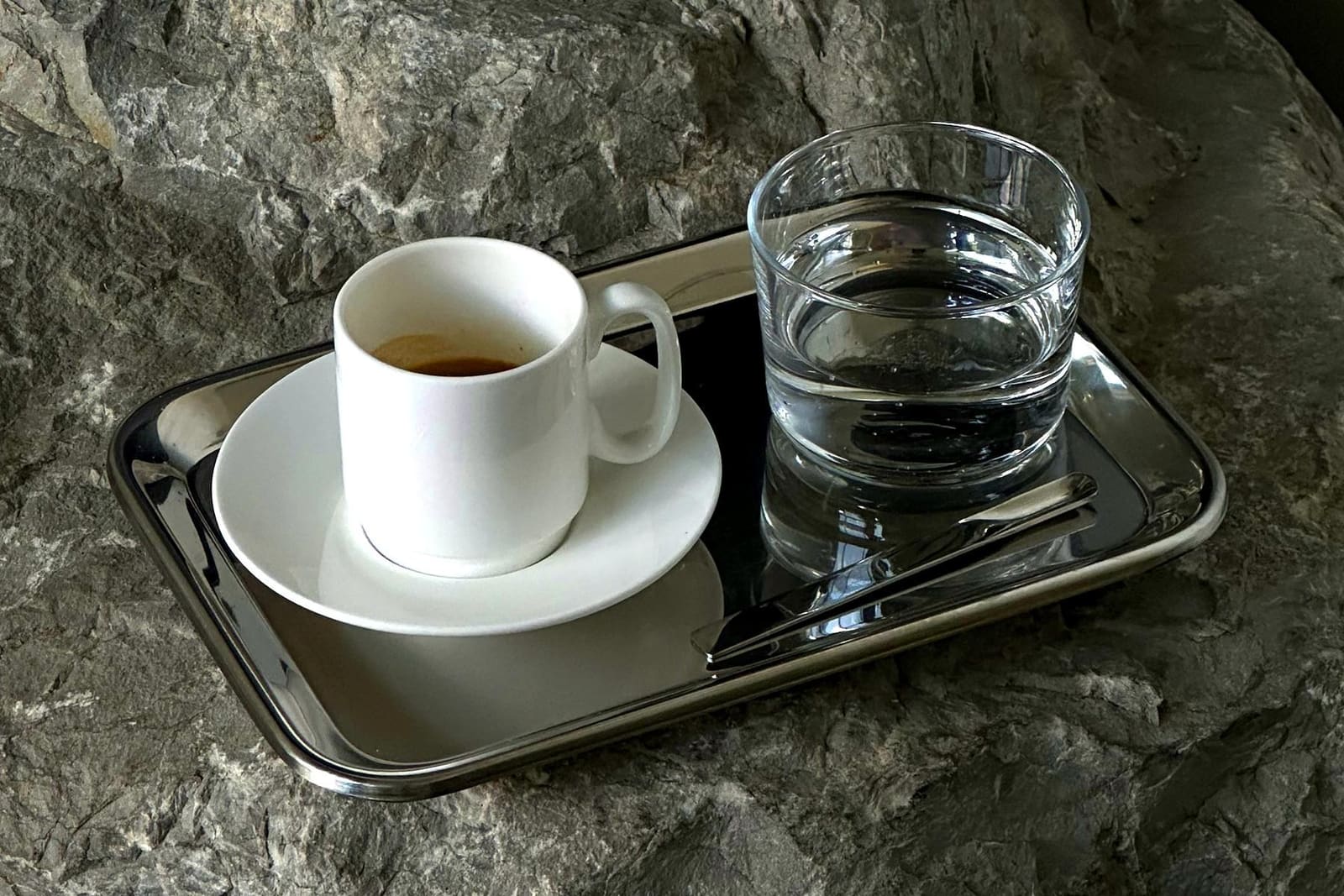
The stone occupied the entire basin, rust-coloured mineral deposits pooling at its centre where water struck and drained away. It sat there, immovable, an object so unexpected in a restaurant lavatory that it demanded a second look. This was not a sculpted ornament or a polished accent piece. It was a rock, plain and unapologetic, wedged into an industrial sink at Gem Home in lower Manhattan.
Months later, another stone appeared, this time at Rhythm Zero in Greenpoint, Brooklyn. A large hunk of it rested beside the counter, positioned in front of a mirror as though it had always belonged there. In the bathroom, yet another stone sat between sink and toilet, a makeshift landing spot for wet hands en route to the dryer. The repetition felt deliberate, a quiet gesture toward something larger than coincidence.
Then came Pizza 4P's, a Vietnamese import that opened in Brooklyn over the summer. Six boulders, each weighing hundreds of kilograms, were transported from a stone wholesaler in New Jersey and forklifted into a high-ceilinged industrial space. The restaurant was designed around them. At that point, the pattern became undeniable.
Building Around the Stone
At Pizza 4P's, the boulders dictate the architecture. The host stand is a waist-high slab chosen for its natural notch, perfect for holding menus. A smaller stone beside it functions as a bench for waiting diners. Four additional boulders punctuate the dining room, forcing the layout into a snaking path that winds around their irregular forms. None have been cut or shaped; the restaurant adapted to their contours rather than the reverse.
According to Pizza 4P's global branding director Kazuya Kubota, the largest stone weighs approximately two tonnes, comparable to the pizza oven itself. Some boulders sprout thick metal support wires, anchoring wooden frames that hold cascading plants along the walls. The effect is a collision of the industrial and the pastoral, Brooklyn urbanism meeting the farms listed on the menu. The stones were sourced after the space was secured, then the floor plan was redrawn to accommodate them.
This approach reflects a broader philosophy within the chain, which operates dozens of locations across multiple countries. Each site is designed with complete originality, guided by a regional theme. In Indonesia, biodiversity shapes the interiors; in the United States, the guiding principle is "what the earth told me." The stones, Kubota explained, are treated like ingredients: something beautiful is found in nature, and the design works around it.
The Japanese Influence
Ivana Somorai, who owns Rhythm Zero, cites Japanese design traditions as her inspiration. The use of raw, unprocessed materials, she noted, introduces an element of surprise into otherwise refined interiors. When the Greenpoint location first opened, it featured minimal seating, a large tangerine tree, and several rocks. A redesign brought in a spacious couch and additional chairs, but the stones remained, largely because moving them would have required equipment and effort that outweighed any aesthetic rationale for their removal.
Over time, the rocks became fixtures in the life of the café. The stone beside the mirror evolved into a favourite perch for regulars. The bathroom rock, meanwhile, served a different purpose: pure astonishment. Somorai wanted visitors to open the door and confront something inexplicable, a large stone in a dark, narrow room. The question "Why is there a rock here?" was the intended response.
Gem Home, Flynn McGarry's Scandi-inflected restaurant in lower Manhattan, also featured a stone in its bathroom sink, as did its sibling establishments Gem Wine and Cove. The rationale behind these placements remains unclear, though the effect is similar: an interruption of expectation, a moment of cognitive dissonance that lingers after the meal is over.
The Impermanence of Trends
Design trends in hospitality tend to announce themselves through repetition. Exposed brick gave way to Edison bulbs, which gave way to millennial pink, which gave way to terrazzo. Each wave feels inevitable in its moment, then fades into the background as tastes shift. Stones, however, resist easy categorisation. They are not ornamental in the conventional sense, nor are they functional in any straightforward way. They simply exist, massive and inert, demanding that the space accommodate them.
At Pizza 4P's, the boulders are permanent fixtures, structural anchors that cannot be removed without significant demolition. At Rhythm Zero, the stones proved less permanent than anticipated. During a recent renovation, the rock outside the bathroom was relocated to nearby Transmitter Park. Somorai described the move with a note of resignation: "where they belong, I guess."
The gesture underscores the paradox at the heart of this trend. Stones are meant to evoke nature, yet their presence indoors is fundamentally artificial. They are too heavy to move casually, yet not heavy enough to be truly immovable. They suggest permanence while remaining subject to the whims of redesign.
The Aesthetic of the Unexpected
What these stones offer, ultimately, is disruption. In dining spaces increasingly defined by Instagram-ready symmetry and carefully curated aesthetics, a boulder introduces an element of chaos. It cannot be styled or softened. It refuses to conform to the grid of the room. Its weight and mass impose themselves on the architecture, forcing diners to navigate around it, lean against it, or simply stare at it in mild bewilderment.
This is not the first time nature has been conscripted into interior design. Living walls, indoor trees, and moss installations have all enjoyed their moment. But those elements can be trimmed, watered, and controlled. A boulder, once installed, dictates its own terms. It is a commitment, both logistical and conceptual, to an aesthetic that privileges the raw over the refined.
Whether this marks the beginning of a broader movement or simply a fleeting curiosity remains to be seen. For now, in a handful of Brooklyn and Manhattan dining rooms, stones sit where tables might have been, silent and immovable, transforming the act of going out to eat into something slightly stranger, slightly more memorable, than it was before.