The Surrey Estate That Proves Intimacy and Grandeur Can Coexist
When privacy matters as much as beauty, country house hotels like Beaverbrook offer something city venues cannot: space to breathe, land that absorbs sound, and the quiet luxury of being unreachable.
When the Landscape Becomes the Guest List
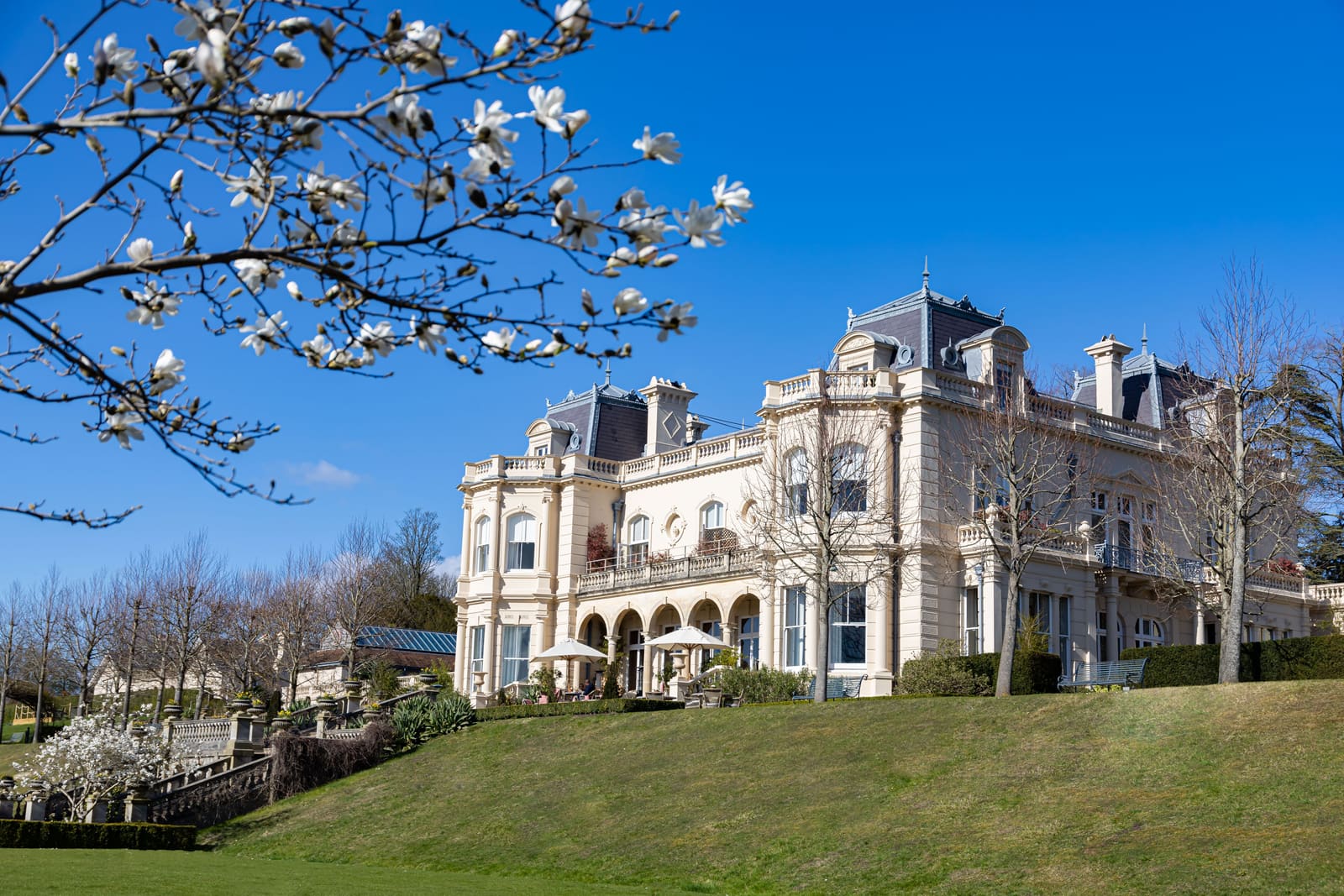
There is a particular kind of silence that belongs only to the English countryside in summer. Not the absence of sound, exactly, but a quality of distance. The world continues elsewhere, behind hedgerows and across meadows, while you stand in a garden watching light move across hills that have looked exactly this way for centuries. This is the appeal of places like Beaverbrook, the Surrey estate that has quietly become one of Britain's most coveted addresses for those who need their celebrations to remain, at least for a while, entirely their own.
When news emerged recently that two of Hollywood's most photographed young stars had chosen this 470-acre property for their wedding celebration, the choice made immediate sense to anyone who understands the particular alchemy of the English country house hotel. It is not merely about luxury, which can be purchased anywhere. It is about the luxury of invisibility, of land that swallows helicopters and grounds that absorb entire parties without echo.
At Global Chic Voyage, we have watched the country estate quietly reclaim its position as the ultimate venue for those who want grandeur without exhibition. The city offers spectacle. The countryside offers something rarer: the possibility of being entirely present, entirely private, and entirely surrounded by beauty that does not need to announce itself.
The Geography of Discretion
Beaverbrook sits in that particular sweet spot of British geography, close enough to London to feel accessible, far enough to feel remote. Forty minutes from Richmond, less than an hour from central London, yet the moment you pass through the gates, the city ceases to exist in any meaningful way. The estate sprawls across rolling Surrey hills, a landscape of manicured lawns giving way to wilder gardens, formal Italian terraces descending toward woodlands, a lake that catches the afternoon light just so.
This is not accidental geography. The best country estates have always understood that proximity and remoteness are not opposites but partners. Guests can arrive from private terminals at Heathrow, London City, or Farnborough without ever encountering public roads for long. The estate maintains its own helipad for those who prefer to avoid roads altogether. Yet once arrived, the acreage creates the illusion of utter isolation.
For a couple rumored to live in southwest London, the location offers something even more valuable than convenience: the ability to visit repeatedly without detection, to taste menus and walk gardens and approve floral arrangements in the weeks leading up to a celebration without alerting a single photographer. In an age when privacy has become the ultimate luxury good, geography is strategy.
Rooms That Remember Their Past Lives
The accommodations at Beaverbrook reflect a particular kind of English confidence, the willingness to layer history and whimsy in equal measure. The main house bedrooms are studies in historic architecture, four-poster beds beneath ceilings that have witnessed a century of house parties, floor-to-ceiling windows framing views that change with the seasons but never lose their essential character.
Then there is the Village, a separate cluster of accommodations a short buggy ride from the main house, where each room takes its theme from a different British writer. It is the kind of detail that could tip into twee but instead feels playful, a reminder that grandeur need not always take itself seriously. For those who require absolute seclusion, the private houses offer something closer to estate living than hotel accommodation. The Dower House, set on 60 private acres, comes with its own swimming pool, spa treatment room, dedicated butler, private chef, and house Aston Martin, because of course it does.
What strikes us about these accommodations is not their luxury, which is considerable, but their variety. A wedding party of 50 or 100 guests need not all sleep in identical rooms. Some will wake in the main house, others in themed cottages, still others in private residences. The effect is less hotel, more sprawling house party, the kind where guests wander into breakfast having slept in entirely different corners of the estate, comparing notes on their bathtubs and views.
The Spa That Understands Aftermath
We have visited wellness facilities across three continents, and the Coach House Spa at Beaverbrook remains one of the most theatrically beautiful we have encountered. Light filters through stained-glass windows, casting kaleidoscopic patterns across treatment rooms where holistic therapies blend deep tissue work with shiatsu and Ayurvedic techniques. The Meadow Hut, hidden away in the gardens, offers the kind of absolute privacy that makes it ideal for post-celebration recovery or pre-event nerves.
There is something particularly thoughtful about a venue that anticipates not just the event itself but the days surrounding it. The morning after a wedding, when guests are fragile and overstimulated and possibly regretting their choices at the bar, a spa of this caliber becomes less amenity than necessity. It is the difference between venues that understand hospitality as a single night and those that understand it as an experience that begins when guests arrive and ends only when they leave, restored.
Interiors That Refuse to Whisper
If there is a signature to Beaverbrook's design, it is a refusal to be boring. The interiors clash and charm in equal measure, bold patterns against richer patterns, colors that should not work together but somehow do. Sir Frank's Bar is all velvet and dim lighting, the kind of space designed for late-night conversations that stretch past reason. The drawing rooms offer cozy corners and grand gestures, spaces that can absorb small groups or entire parties without feeling either empty or crowded.
This is the advantage of a property with multiple distinct spaces. A wedding celebration need not unfold in a single ballroom but can migrate, guests drifting from garden to bar to drawing room as the evening evolves. It creates a sense of discovery, of turning a corner and finding a new pocket of the party, a different conversation, a quieter moment.
The Dining Room, the estate's Japanese-fusion restaurant, offers views that compete with the food for attention. This layering of experiences, this sense that around every corner is another reason to linger, is what separates memorable venues from merely beautiful ones.
The Garden as Co-Conspirator
But perhaps the estate's greatest asset is the land itself. Four hundred seventy acres is not just space, it is possibility. Wedding photographs can unfold against manicured lawns or wildflower meadows, beside the lake or within the Italian garden, beneath ancient trees or against the backdrop of Surrey hills that roll away toward the horizon. For a couple known for guarding their privacy, the acreage offers something invaluable: the ability to create moments that feel entirely unobserved, even surrounded by guests.
At Global Chic Voyage, we have noticed a shift in how our most discerning travelers think about celebration spaces. It is no longer enough for a venue to be beautiful. It must also be protective, a landscape that can absorb a party without broadcasting it, that offers both spectacle and sanctuary. The English country estate, with its combination of historic architecture and sprawling grounds, meets this need in ways that urban venues simply cannot match.
Why This Matters Now
The choice of Beaverbrook for such a high-profile celebration signals something broader about where luxury hospitality is heading. In an era of constant visibility, of every moment documented and shared, there is a growing hunger for experiences that remain private, that unfold without audience or record. The country estate, once considered old-fashioned, has become radically relevant precisely because it offers what the city cannot: distance, discretion, and land enough to disappear.
We expect to see more celebrations migrating from urban hotels to countryside properties, not because cities lack elegance but because they lack isolation. The venues that will thrive in the coming years are those that understand privacy as their primary product, with beauty and service as essential but secondary considerations. Beaverbrook, with its combination of access and remoteness, grandeur and intimacy, has positioned itself perfectly for this moment.
The estate proves that in an age of oversharing, the ultimate luxury is not what you show but what you keep for yourself. And sometimes, that requires 470 acres of Surrey countryside, a helipad, and the good sense to choose beauty that does not need to be broadcast to be believed.