Where Dinner Begins in the Garden
From Catskills cider barns to New Mexico lavender fields, a new breed of American retreat is weaving the kitchen into the landscape.
The Landscape as Larder
There is a moment, just after dawn at Wildflower Farms in New York's Hudson Valley, when the kitchen doors swing open and a guest walks across dewy grass carrying a basket of eggs still warm from the henhouse. The chickens are Icelandic, compact and hardy, and the eggs will be cracked into a pan at Clay restaurant within the hour. No refrigeration. No supply chain. Just a short walk between nest and plate.
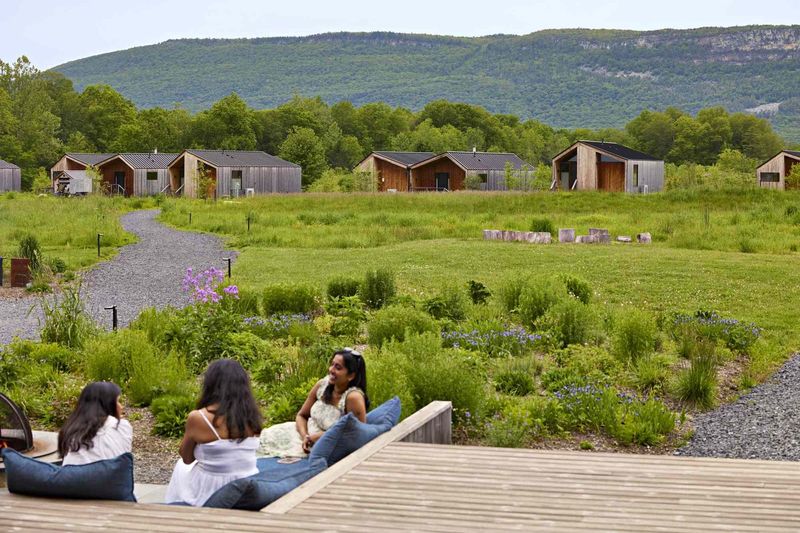
This is not farming in any traditional sense. It is theatre, perhaps, but theatre with stakes: the 65 freestanding cottages scattered across the property exist because someone decided that luxury and agriculture need not occupy separate worlds. The six-acre farm produces nearly 6,400 kilogrammes of fruit, vegetables, and herbs each year. Guests suit up in beekeeping gear to learn honey production, forage for wild edibles on guided walks, and take cocktail classes using ingredients pulled from the soil that morning. Clay's wood-burning fireplace anchors a dining room where lamb and pork are raised within sight of the kitchen, and wine director Vanessa Price has assembled a 7,000-bottle cellar focused on New York's Finger Lakes and North Fork regions, which remain underappreciated despite decades of quiet refinement.
The model is spreading. Across the United States, a handful of properties are embedding culinary programmes so deeply into their operations that the line between accommodation and working farm blurs past recognition. These are not resorts with vegetable gardens as ornamental flourishes. They are places where the rhythm of the season dictates the menu, where guests are invited to participate in the labour that precedes dinner, and where the distance between soil and service is measured in footsteps.
Regenerative Ambitions in Georgia
An hour outside Atlanta, Quercus occupies 1,540 hectares of working ranch in the town of Gay. Four cabins, each with private sauna and cold plunge pool, house guests who have come as much for the biodynamic farming philosophy as for the cooking. Chiara Visconti di Modrone and her husband Angelos Pervanas launched the project as a regenerative agriculture experiment before partnering with Atlanta restaurateurs to expand the vision. Now it functions as an all-inclusive retreat where garden tours are not optional so much as essential: the rare turmeric varieties and uncommon peppers grown here will appear on every plate, and understanding their provenance is part of the experience.
Ryan Smith, whose Atlanta restaurant Staplehouse earned a Michelin star, helms Uberto, a tasting menu that stretches beyond ten courses. Clarified curry made with lemongrass and galangal from the property's tropical greenhouse exemplifies the kitchen's approach. Chefs spend the week in the fermentation lab, but the garden has been preparing for months. Meals can be taken in the restaurant or delivered to cabins in wicker picnic baskets, a version of room service that feels less like hospitality and more like a country ritual. Snacks include house-made beef jerky and gochujang okra chips. Activities range from horse training to kayaking in the Flint River, but the culinary thread runs through everything.
Wellness Without Deprivation
Mii Amo, an adults-only retreat in Sedona's Boynton Canyon, sits within what some consider a vortex of spiritual energy. The 23 casitas overlook red rock formations, and the 3,720-square-metre spa offers the full catalogue of sound baths, meditation, and guided canyon hikes. But the culinary programme at Hummingbird restaurant distinguishes Mii Amo from other wellness properties that treat food as a necessary inconvenience. All-inclusive stays of three to ten nights include three daily meals and unlimited access to a juice bar stocked with protein smoothies, ginger shots, and sleep tonics.
The menu draws from a chef's garden but does not insist on monastic restraint. Sweet treats, alcohol, and caviar are available for those who want them. Weekly nutrition classes and juicing demonstrations teach guests how to replicate the food after they leave. The philosophy is pragmatic: nourishment need not exclude pleasure.
Cider as Architecture
In the Catskills, Susan Manning and Doug Doetsch built Seminary Hill on land that Doetsch's family has farmed for five generations. Eight Shaker-inspired apartments occupy two 19th-century buildings with views of the Delaware River and the 4.9-hectare orchard below. Sixty varieties of apples and pears grow in tidy rows, and cider-maker Joshua Hinchman transforms the fruit into a portfolio that includes traditional cider, fortified apple wines, and cyser, a type of mead.
Tastings take place in a barn constructed from reclaimed wood that once supported the Tappan Zee Bridge. The structure is passive house-certified, the first cidery in the world to meet that energy efficiency standard. Executive chef Edwyn Ferrari weaves apples into the restaurant menu, and the cider posset served at the end of a meal feels like a closing argument: everything here circles back to the orchard.
Sonoma County Immersion
Appellation Healdsburg, co-founded by chef Charlie Palmer and Christopher Hunsberger, a veteran of Four Seasons Hotels and Resorts, bills itself as a culinary hotel. The 108-room property in the heart of Sonoma County backs up the claim with three restaurants, a packed schedule of cooking classes, and proximity to hundreds of wineries. Folia Bar & Kitchen serves a three-course menu sourced from purveyors including Hog Island Oyster Co. and Sonoma Bee Company. Some cooking classes are taught by Palmer himself.
Every Friday, a different winemaker visits the property to host a guided tasting. The concierge can arrange behind-the-scenes tours at Knights Bridge Winery, Bricoleur Vineyards, and Dry Creek Vineyard. The rhythm is clear: the property exists as a gateway to the surrounding landscape, a place to sleep between tastings and vineyard visits.
Lavender and Legacy in New Mexico
Los Poblanos Historic Inn & Organic Farm, dating to 1932, sprawls across 10 hectares of lavender fields, fruit trees, and cottonwood groves in Los Ranchos de Albuquerque. Architect John Gaw Meem designed the property in classic Santa Fe style, with pitched tin roofs that reference its past as a dairy farm. The original hand-painted grain silos from 1934 still stand. Though the dairy is long gone, a 10-hectare organic farm remains the heart of the operation.
Guests can tour greenhouses or wander paths shaded by cottonwoods, irrigated by acequias, community-managed water systems older than New Mexico itself. Campo, the signature restaurant, sources from the farm and from local purveyors including Native American Beef, a programme supporting Indigenous cattle producers. The Farm Shop sells lavender-scented products, hot sauce made from the garden's peppers, and estate gin distilled in downtown Albuquerque.
Abundance on Mackinac Island
The Grand Hotel on Mackinac Island, Michigan, operates on a principle of excess. A 201-metre porch overlooks the car-free island. Three hundred and eighty-eight Victorian guest rooms are decorated in maximalist, candy-coloured schemes. Thirteen bars and restaurants occupy the property. The main dining room serves breakfast, lunch, and dinner, but the evening service is the draw: live music from the Grand Hotel Orchestra accompanies a five-course menu that rotates every three days to highlight a different cuisine.
The Woods Restaurant serves Bavarian dishes in a lodge-like dining room with a roaring fireplace. The Jockey Club offers seafood towers and steakhouse classics in a room outfitted in saddle leather. Casual options include Detroit-style pizza and old-school sundaes made with Guernsey Farms Dairy ice cream at Sadie's Ice Cream Parlor. The abundance is the point.
Ojai's Epicurean Investment
The Ojai Valley Inn has long been known for its 2,880-square-metre spa and location in the bohemian enclave of Ojai, California. But the resort recently invested 20 million US dollars (approximately 20.6 million US dollars) in the Farmhouse, an epicurean centre where culinary ambassador Nancy Silverton curates cookbook talks, cooking classes, and special tasting dinners with visiting chefs and winemakers. The centre also hosts the annual Ojai Food & Wine festival in March, drawing chefs from around the world.
Six restaurants and bars operate on the property, ranging from a casual pub to Olivella, which serves a four-course tasting menu featuring honey from the resort's apiary and wine from a 10,000-bottle cellar. The Farmhouse functions as both education and entertainment, a space where food becomes a subject of study as much as consumption.
Smokies Immersion
Windy Hill Farm and Preserve, in the foothills of the Great Smoky Mountains near Loudon, Tennessee, offers rustic cabins and an all-inclusive experience centred on participation. Beekeeping demonstrations, bourbon tastings, and cooking classes led by executive chef Ben Warwick fill the days. Evenings end with s'mores around a campfire. The retreat functions as an upland preserve, and guests are encouraged to engage with the landscape as both observers and participants.
The New Ritual
What binds these properties is not a shared aesthetic or a common price point but a conviction that food can anchor a stay in ways that spa treatments and infinity pools cannot. The garden tour becomes the arrival ritual. The foraging walk replaces the guided meditation. Dinner is not an amenity but the reason for being there.
This is not a rejection of luxury but a redefinition. The eggs are still warm. The honey is still raw. The distance between the henhouse and the plate is still measured in minutes. And the guest, basket in hand, walks back across the grass as the kitchen prepares to receive what the morning has offered.