When Luxury Becomes Geography: Thailand's Island Resorts and the Tyranny of Perfection
The kingdom's top-scoring properties share a common vocabulary of private pools and cliff-edge villas. What they reveal about escape, and what they conceal, tells a different story.
The Island Question
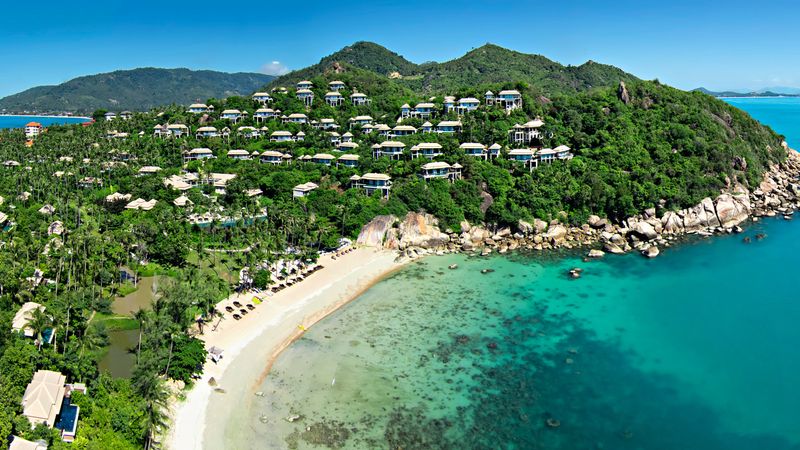
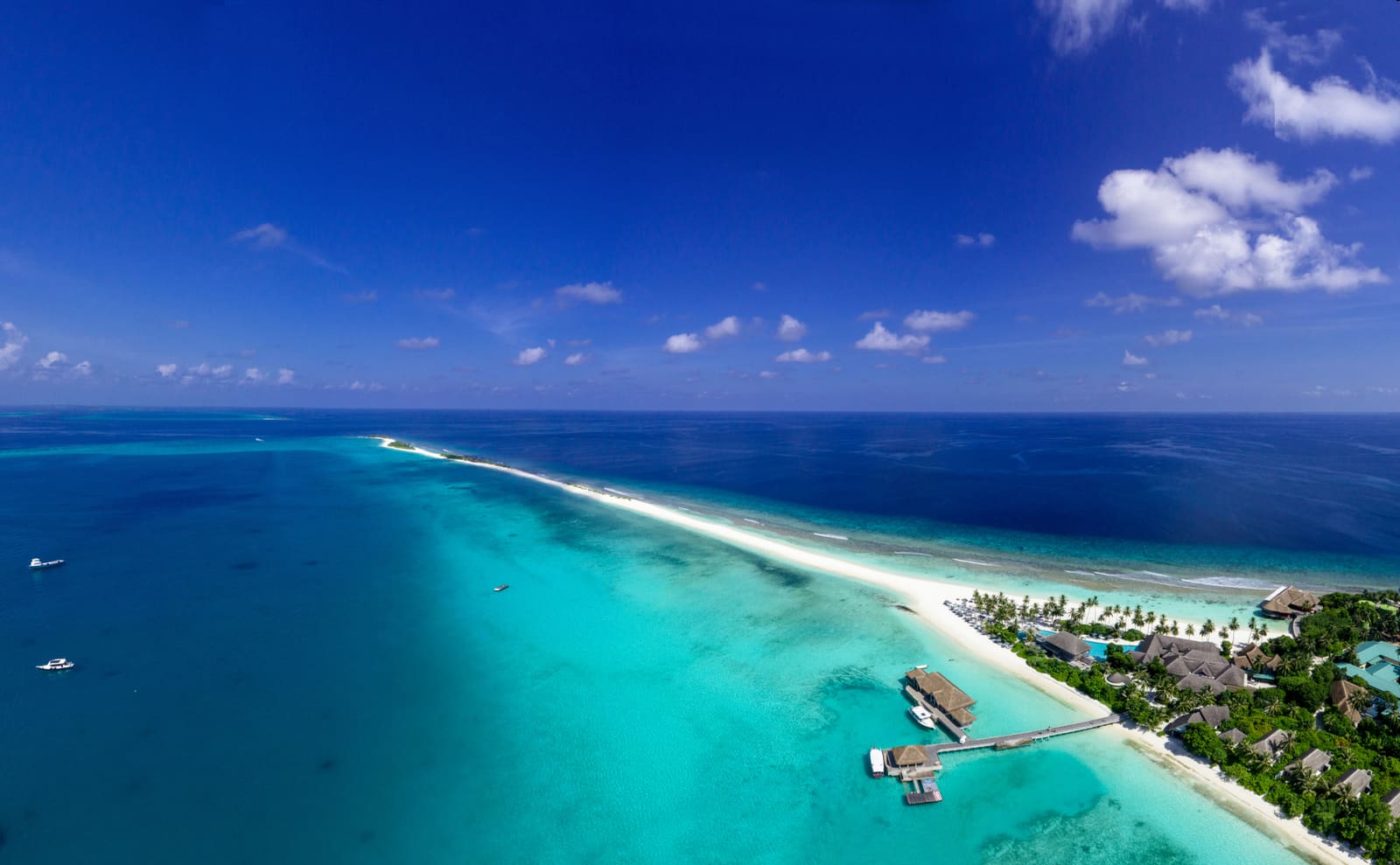
Stand on the western shore of Koh Samui at sunset and you might see the silhouette of another island resort across the bay, its villas terraced into the hillside like amphitheatre seating for a performance that never begins. The view is deliberate. Every sightline has been calculated, every palm tree positioned to frame the Andaman Sea in a way that suggests wildness whilst delivering absolute control. This is the paradox at the heart of Thailand's luxury resort economy: the more remote the property claims to be, the more infrastructure it requires to sustain the illusion.
The 2026 Readers' Choice Awards in Thailand reveal a landscape dominated by this particular formula. Conrad Koh Samui, scoring 99.01 out of 100, anchors the top position in Surat Thani. Four Seasons Resort Koh Samui follows at 99, with Vana Belle taking third at 98.77. The list continues through Phuket, Krabi, and Khao Lak, a constellation of properties that together define what luxury means in the Gulf of Thailand: privacy achieved through architecture, nature accessed through concierge service, authenticity delivered on a tray.
What the rankings do not show is the uniformity of ambition. Nearly every property in the top fifteen offers some variation of the same experience: infinity pools that mirror the sea, open-air pavilions with teak floors, spa treatments that invoke Thai healing traditions whilst adhering to international hospitality standards. The Naka Island, a Luxury Collection property in Phuket, scores 98.71. Phulay Bay, a Ritz-Carlton Reserve in Krabi, earns 98.21. The decimal points suggest precision, but the experiences they measure often blur into one another.
The Samui Consensus
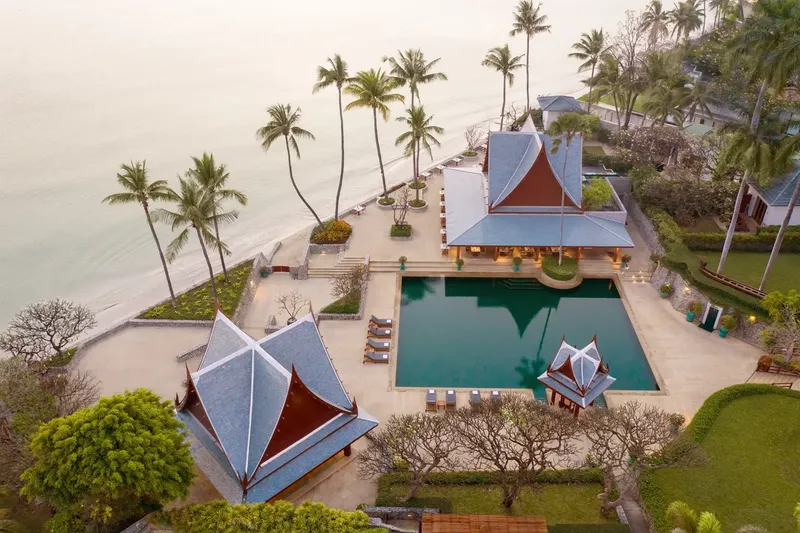
Koh Samui has become the testing ground for this vision. Three of the top four properties occupy the island, each carving out a different stretch of coastline but adhering to a shared aesthetic language. The Conrad sits on a hillside in the island's southwest, its pool villas cascading down towards Aow Thai beach. Four Seasons claims a promontory on the northwest coast, where 60 villas and pavilions occupy forested slopes above Laem Yai Bay. Vana Belle positions itself on Chaweng Noi Beach, the quieter cousin to the island's main tourist strip, offering what it describes as barefoot luxury within walking distance of more commercial terrain.
The concentration is not accidental. Samui's airport, privately owned and architecturally distinct, functions as a kind of gateway drug to high-end island life. The open-air terminal, with its thatched roofs and garden pathways, sets a tone that the resorts then amplify. You arrive already primed for a certain kind of experience, one where nature has been tamed just enough to be comfortable but not so much that it feels suburban.
Yet the island's success has created its own constraints. As more luxury properties open, the definition of remote becomes increasingly elastic. A private beach is only private until the neighbouring resort builds a pier. A secluded villa is only secluded until construction begins on the hillside above. The resorts respond by building higher, digging deeper pools, extending piers further into the water. The pursuit of exclusivity becomes an arms race conducted in teak and limestone.
Phuket's Plurality
Phuket offers a slightly different equation. Larger and more developed than Samui, the island accommodates a wider range of luxury strategies. The Nai Harn, scoring 98.03, occupies the southern tip, a location that allows it to claim both sunrise and sunset views. Banyan Tree Veya, at 97.77, sits inland near Laguna, trading beachfront access for sprawling grounds and a golf course designed by Thai architect Prabhakar Nampiaparampil. JW Marriott Phuket Resort & Spa, at 96.95, straddles Mai Khao Beach on the island's northwest coast, where the Andaman Sea meets undeveloped national parkland.
The variety speaks to Phuket's longer history as a tourist destination. Where Samui cultivated a boutique reputation, Phuket absorbed waves of development over decades, from backpacker bungalows to mega-resorts. The luxury properties that rank highest have learnt to navigate this complexity, carving out enclaves that feel insulated from the island's more chaotic commercial zones whilst remaining accessible to its infrastructure.
The Naka Island complicates the geography further. Technically part of Phuket province but located on a separate island ten minutes by speedboat from the main landmass, it offers the fantasy of inaccessibility without the genuine inconvenience. The boat transfer becomes part of the ritual, a liminal space where the stresses of mainland life fall away. By the time you reach the resort's pier, you have crossed not just water but a psychological threshold.
The Krabi Calculation
Krabi province, stretching along the mainland coast opposite Phuket, presents a third model. Phulay Bay, the Ritz-Carlton Reserve property, occupies a private peninsula south of Ao Nang, the province's main tourist hub. The location allows it to offer both marine and terrestrial landscapes: limestone karsts rising from the Andaman Sea to the west, mangrove forests and rivers to the east. The resort's design, by Thai firm Bunnag Architects, works with this duality, positioning pavilions to frame views in multiple directions.
Sofitel Krabi Phokethra Golf and Spa Resort, scoring 97.97, takes a different approach. Located on Klong Muang Beach north of Ao Nang, it combines beachfront access with an 18-hole golf course, acknowledging that not every luxury traveller wants to spend the entire day contemplating the sea. The property's partnership with L'Occitane for spa treatments signals another calculation: how to balance Thai identity with European luxury codes, a negotiation that plays out across the resort's restaurants, architecture, and service protocols.
What the Numbers Measure
The scoring system behind these rankings remains opaque by design. Readers vote based on criteria that include rooms, facilities, location, service, food, and value, but the weighting of each category is unclear. A property might excel in one dimension and falter in another, yet the final score collapses these nuances into a single decimal. Conrad Koh Samui's 99.01 suggests near-perfection, but perfection at what? Delivering an experience that meets expectations so precisely that nothing surprises? Creating an environment so frictionless that you forget where you are?
The resorts themselves have become expert at managing these metrics. Staff training emphasises anticipation: the drink that arrives before you ask for it, the towel that appears the moment you step out of the pool. Guest feedback loops are tightened, with post-stay surveys feeding directly into operational adjustments. The result is a kind of hyper-responsiveness, where the property moulds itself to aggregate preferences season by season.
But this responsiveness has limits. The more a resort optimises for the median luxury traveller, the less room it has for idiosyncrasy. The architectural details that might alienate some guests get smoothed away. The menu items that divide opinion are replaced with safer options. Over time, the properties begin to converge not because they are copying one another but because they are all solving for the same equation.
The Northern Exception
Anantara Chiang Mai Resort, ranking twelfth with a score of 96.62, offers a counterpoint to the island narrative. Located on the banks of the Mae Ping River in northern Thailand's cultural capital, the property trades beaches for colonial architecture and jungle for urban gardens. The resort occupies the former British consulate, a teak structure dating to the early twentieth century, now surrounded by contemporary additions that defer to the original building's proportions and materials.
Chiang Mai's inclusion in a list dominated by island properties suggests that luxury in Thailand is not monolithic. The northern city attracts a different kind of traveller, one more interested in temple visits and night markets than infinity pools and private beaches. Anantara responds with cooking classes, rice-paddy excursions, and partnerships with local artisans. The experience is no less curated than what the island resorts offer, but it gestures towards a different set of references: Lanna culture, hill-tribe textiles, the rhythms of a city that existed long before tourism.
Yet even here, the formula reasserts itself. The resort's spa offers treatments that could be found at any Anantara property worldwide. The riverside restaurant serves Thai cuisine adapted for international palates. The rooms, whilst referencing local design traditions, adhere to global luxury standards: king beds, rain showers, espresso machines. Chiang Mai's cultural specificity becomes another amenity, packaged and delivered with the same efficiency as turn-down service.
What Remains Unseen
The resorts that dominate Thailand's luxury rankings share a talent for concealment. What you do not see: the staff villages behind the treeline, the supply chains that bring imported cheeses and French wines to remote islands, the environmental cost of maintaining vast lawns and water features in a tropical climate. The experience is designed to feel effortless, which requires enormous effort happening just out of frame.
JW Marriott Khao Lak Resort & Spa, at 96.64, sits in a province still recovering from the 2004 tsunami that devastated the Andaman coast. The resort opened years after the disaster, part of a broader rebuilding effort that transformed Khao Lak from a sleepy beach town into a luxury destination. The property's marketing emphasises tranquillity and natural beauty, a narrative that elides the region's traumatic recent history. This is not deception, exactly, but a selective presentation of place that is common across the industry.
The same could be said of Phuket's luxury properties, many of which occupy coastline once dominated by tin mining and rubber plantations. The environmental remediation required to transform industrial land into resort-ready beach is substantial, yet it rarely features in the guest experience. You arrive to find sand that looks pristine, water that appears untouched, a landscape that suggests it has always been this way.
The Convergence Problem
As Thailand's luxury resort sector matures, the properties at the top face a challenge: how to differentiate when everyone is executing the same playbook at a high level. The scores cluster tightly. Conrad Koh Samui at 99.01, Four Seasons Koh Samui at 99, Vana Belle at 98.77. The gaps are statistically insignificant, yet they drive marketing campaigns and booking decisions. A resort might rise or fall in the rankings based on factors that have little to do with the property itself: currency fluctuations that affect perceived value, airline route changes that make access easier or harder, shifting travel trends that favour one island over another.
The resorts respond by pursuing marginal gains. An extra treatment room at the spa. A new restaurant concept. A partnership with a celebrity chef or designer brand. These additions are announced with fanfare, positioned as transformative, but they rarely change the fundamental experience. You still wake up in a villa with an infinity pool. You still have breakfast delivered to your terrace. You still spend the afternoon alternating between the beach and the spa. The details vary, but the structure holds.
The Question of Value
The rankings include JW Marriott properties in both Phuket and Khao Lak, scoring 96.95 and 96.64 respectively. These are not budget options, but they operate at a different price point than the Four Seasons or Ritz-Carlton. The scores suggest that readers perceive good value: luxury delivered efficiently, without the premium that comes with ultra-luxury branding. Yet value is a moving target. As more properties enter the market, expectations rise. What felt extravagant five years ago becomes standard. The bar for what constitutes luxury shifts upward, and the resorts must shift with it or risk falling behind.
This creates pressure not just on the properties but on the destinations themselves. Islands that were once considered remote become accessible. Beaches that were once empty fill with sun loungers. The very qualities that made a location desirable begin to erode under the weight of success. The resorts build higher walls, plant denser vegetation, extend their boundaries to maintain the illusion of seclusion. But illusion has limits.
Where Luxury Leads
Thailand's luxury resort landscape, as reflected in these rankings, reveals an industry that has perfected a particular vision of escape. The properties deliver it with remarkable consistency: beautiful design, attentive service, settings that balance natural beauty with creature comfort. For many travellers, this is exactly what luxury should be. A place where everything works, where desires are anticipated, where the outside world recedes.
But perfection, pursued too single-mindedly, can become its own constraint. The resorts that rank highest are also the most predictable. They have optimised away surprise, edited out rough edges, created experiences so carefully calibrated that they leave little room for accident or discovery. You know what you will get before you arrive, and the property delivers exactly that. Nothing more, nothing less.
The question is whether this is enough. Whether luxury can sustain itself on consistency alone, or whether it needs friction, idiosyncrasy, the occasional failure that makes success feel earned. The rankings suggest that most travellers prefer reliability. But rankings measure what has already happened, not what might come next. As Thailand's luxury market continues to evolve, the properties that endure may not be the ones that scored highest in 2026, but the ones that figured out how to surprise.