The French Creole Village an Hour From St. Louis That Feels a World Away
Ste. Genevieve unfolds like a quiet revelation - colonial architecture, Missouri wine country, and a rhythm that refuses to hurry.
A Town Built by Memory
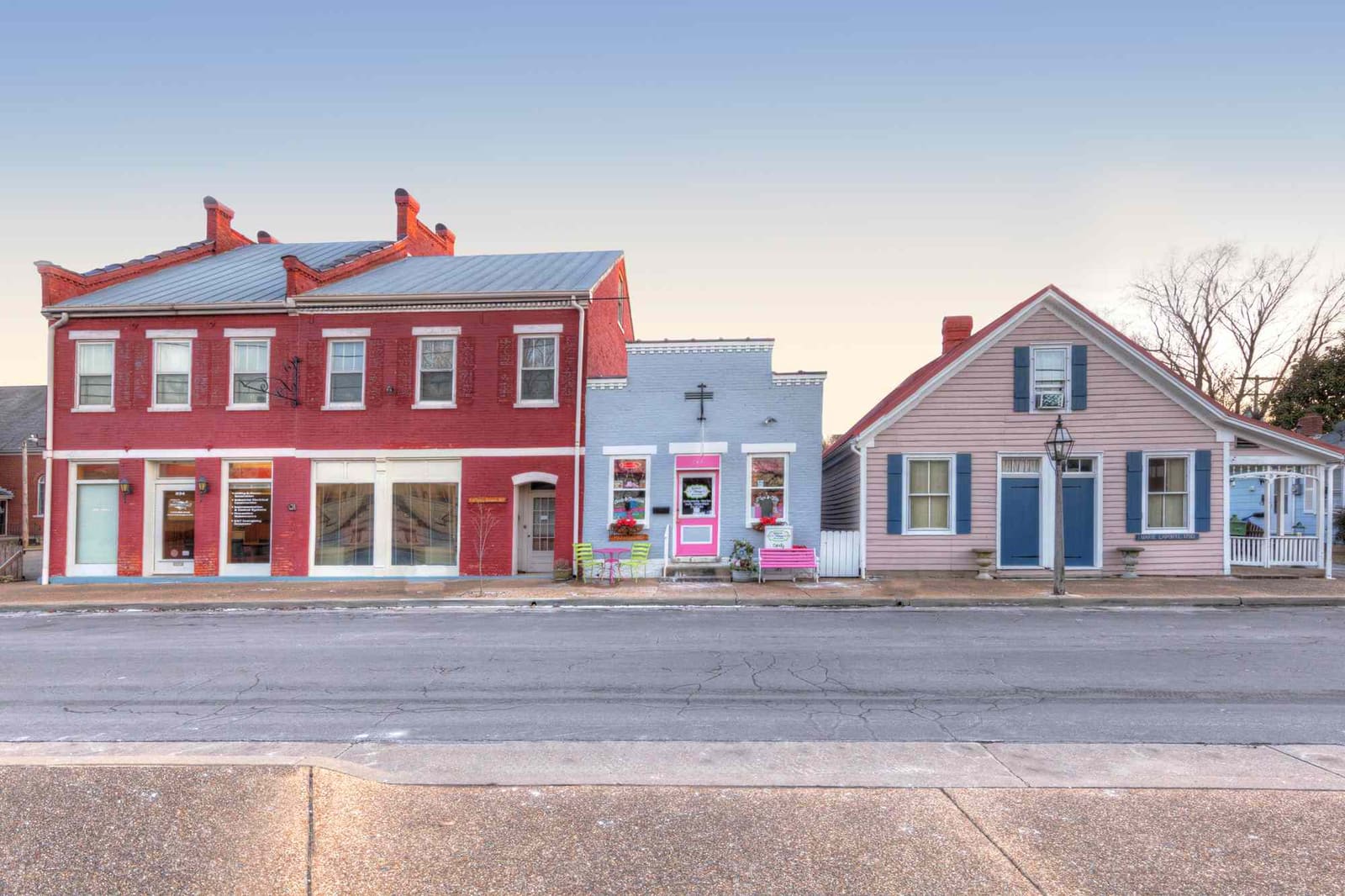
The Mississippi River has a way of holding onto things. In Ste. Genevieve, Missouri, what it held was a fragment of colonial France, transplanted to the American heartland and stubbornly preserved through floods, territorial transfers, and the homogenizing pressures of westward expansion. Walk the compact historic district today and the street grid still follows eighteenth-century logic, the houses still speak French in their vertical-log construction, their broad galleries and steep roofs designed for a climate that swings between deluge and drought.
This is not the Midwest of grain elevators and interstate rest stops. Ste. Genevieve, founded around 1735, predates the American Revolution by decades. It remains the oldest permanent European settlement in Missouri, and unlike so many places that merely gesture toward heritage, this town wears its history in load-bearing walls. The Maison Bolduc-LeMeilleur, the Maison Guibord-Valle, the Amoureux House - these are not reconstructions. They are originals, built by French Creole settlers who arrived when the region was still part of New France, then Spanish Louisiana, and only later, almost incidentally, American.
The architecture tells a story of adaptation. Vertical-log construction, known as poteaux-sur-sol, uses upright timbers set directly on stone sills, a technique rare in the United States but common in the Illinois Country of the eighteenth century. The galleries wrap around the structures, offering shade and social space, while the steep roofs shed rain and snow with equal efficiency. These houses were not designed to impress; they were designed to endure. And they have.
Wine Country in the Shadow of the Bluffs
Beyond the town's colonial core, the landscape opens into gentle hills and limestone bluffs, terrain that has, in recent decades, revealed an unexpected affinity for viticulture. Missouri wine country does not announce itself with the polished tourism infrastructure of Napa or the Willamette Valley. It unfolds quietly, in family-run vineyards and tasting rooms that feel more like living rooms, where the winemaker might also be the one pouring your glass.
The region's wine history is deeper than most realize. German immigrants planted the first commercial vineyards here in the mid-nineteenth century, and before Prohibition, Missouri was the second-largest wine-producing state in the nation. That industry was nearly erased, but it has been slowly, patiently rebuilt. Today, the area around Ste. Genevieve claims several wineries, each with its own interpretation of what Missouri terroir can yield.
The soils here are a mix of loess and limestone, well-drained and mineral-rich. Norton, a native American grape, thrives in this environment, producing wines with a dark, almost brooding character - blackberry, earth, a hint of spice. Vignoles, another cold-hardy variety, offers something lighter, more aromatic. The winemaking is pragmatic, shaped by a climate that can be unforgiving. Late spring frosts, humid summers, unpredictable autumns - these are not conditions that allow for complacency.
What makes the experience compelling is the absence of pretense. Tastings are conversational, unhurried. The vineyards are small enough that a single person's vision still shapes the wine. And the landscape itself, rolling and forested, offers a kind of pastoral beauty that feels earned rather than curated.
The Texture of Daily Life
Ste. Genevieve is not a place that performs for visitors. It has a functioning downtown, local businesses that serve residents first and tourists second, a rhythm dictated by school schedules and harvest seasons rather than peak travel months. The cafes and restaurants draw on the town's French heritage without turning it into caricature. You will find tourtière and pain perdu on menus, but also barbecue and catfish, because this is Missouri, and culinary identity here has always been layered.
The town's calendar is punctuated by festivals - Jour de Fête in August, a celebration of French colonial culture; the Christmas Walk in December, when historic homes open their doors and the streets fill with luminarias. These events are genuine, rooted in community rather than commerce, though they do draw visitors. The balance is delicate, and the town seems aware of it.
What strikes you, walking through Ste. Genevieve, is the sense of continuity. The past is not roped off behind museum glass. It is embedded in the built environment, in the names on the street signs, in the way people speak about their ancestors as though they were just a generation or two removed, even when the timeline stretches back centuries.
Proximity and Distance
An hour from St. Louis is not far, not by Midwestern standards. But the distance between the city's sprawl and Ste. Genevieve's quiet streets feels greater than the odometer suggests. This is a function of scale, of pace, of the way a place orients itself in time. St. Louis looks forward, rebuilds, demolishes, reinvents. Ste. Genevieve looks inward, conserves, repairs, remembers.
There is a certain kind of traveler for whom this appeals - the one who finds satisfaction in the specific rather than the spectacular, who would rather spend an afternoon tracing the joinery in an eighteenth-century timber frame than ticking off landmarks. Ste. Genevieve rewards that inclination. It does not overwhelm. It accumulates.
The town is walkable, easily covered in a few hours if you are merely passing through, but capable of holding your attention for days if you allow it. The pace is your own. The wineries are close enough for a leisurely afternoon circuit. The river is always nearby, a constant presence even when you cannot see it, shaping the land and the lives lived on it.
What Endures
In a region often defined by its transience - by rivers that flood and industries that collapse, by populations that migrate and economies that shift - Ste. Genevieve stands as a counterpoint. It is a place that has held on, not through stubbornness alone, but through a kind of practical reverence for what came before. The preservation is not nostalgic. It is structural, embedded in the way the community understands itself.
The French Creole heritage is not a marketing angle. It is the bedrock, the reason the town exists in the form it does. The wine country is not an overlay. It is a return to something older, a reclamation of an agricultural identity that was interrupted but never entirely lost. And the proximity to St. Louis is not a selling point so much as a geographic accident, one that makes the contrast all the sharper.
Travel, at its best, offers not escape but perspective - a chance to see how differently a place can organize itself, how varied the answers to the same questions can be. Ste. Genevieve offers that. It is not dramatic. It does not compete for your attention with spectacle. But it lingers, the way a good conversation does, the way a place does when it is fully itself.