Munich's Quiet Elegance: Beyond the Beer Halls
Bavaria's capital offers Michelin-starred dining, architectural grandeur, and a sophistication that rivals any European metropolis.
A City That Doesn't Shout
The light in Munich changes as autumn settles over the Isar. By mid-afternoon, it slants through the chestnut trees along Maximilianstrasse, catching the limestone facades of buildings that have stood since the city rebuilt itself after the war. This is not the frenetic energy of Berlin, nor the postcard-perfect quaintness tourists expect from Bavaria. Munich moves at its own deliberate pace, a city confident enough not to announce itself.
For decades, international travellers have flown into Munich only to board trains bound for Alpine villages or continue north to the capital. The assumption has been that Munich offers little beyond October's beer-tent revelry and the occasional day spent wandering the Marienplatz. That assumption deserves reconsideration. What has emerged in recent years is a city that has quietly cultivated a culinary and design scene sophisticated enough to stand alongside Lyon or Copenhagen, yet rooted in a regional identity that feels neither manufactured nor apologetic.
Dining Beyond Tradition
The Michelin guide has taken notice. Munich now counts multiple starred establishments, and the tenor of these kitchens reflects a broader shift in Bavarian gastronomy. Chefs here are no longer content to serve schnitzel and dumplings to tourists seeking authenticity. Instead, they are interrogating what Bavarian ingredients can become when treated with the precision and creativity typically reserved for coastal or Mediterranean cuisines.
At restaurants like Tantris and Atelier, the approach is ingredient-driven and often understated. Root vegetables sourced from farms outside Freising, fish from the Bodensee, game from the Bavarian Forest. The presentations avoid theatricality; the focus remains on clarity of flavour and respect for seasonality. It is a culinary philosophy that mirrors the city itself: serious, grounded, uninterested in spectacle.
Even beyond the starred venues, Munich's dining culture has matured. The Glockenbachviertel and Gärtnerplatzviertel neighbourhoods now shelter wine bars and bistros where natural wines from the Pfalz and Franken regions appear alongside small plates that borrow as much from the Levant as from Upper Bavaria. These are not fusion experiments for the sake of novelty; they reflect the reality of a city whose population has become more international, more curious, and less tethered to the idea that Bavarian identity must be preserved in amber.
Hotels That Understand Restraint
Munich's hotel landscape has undergone a similar evolution. The grand dames remain: the Bayerischer Hof, the Vier Jahreszeiten, institutions that have hosted visiting dignitaries and opera-goers for generations. But newer properties have introduced a different aesthetic, one that prizes understatement and craft over opulence.
The Flushing Meadows, for instance, occupies a converted townhouse near the Isar and feels more like a private residence than a hotel. Rooms feature custom-built furniture, locally sourced textiles, and an absence of unnecessary ornament. The effect is calming rather than austere. Similarly, properties like the Louis Hotel and Cortiina have embraced a mid-century modernist sensibility that feels native to Munich's postwar architectural heritage.
What these hotels share is an understanding that luxury, in the contemporary sense, is as much about what is removed as what is added. There are no lobby fountains, no gilded mirrors, no performative gestures of wealth. Instead, there is space, light, and an attention to detail that becomes apparent only over time.
A City of Walkers
Munich is best understood on foot. The Altstadt, though reconstructed, retains its medieval street plan, and the act of navigating its narrow passages and sudden squares reveals a layered history that no guided tour can adequately convey. From the Residenz, the sprawling palace complex that once housed Bavarian royalty, to the twin domed towers of the Frauenkirche, the city's architectural landmarks sit in close proximity, connected by streets that invite wandering rather than rushing.
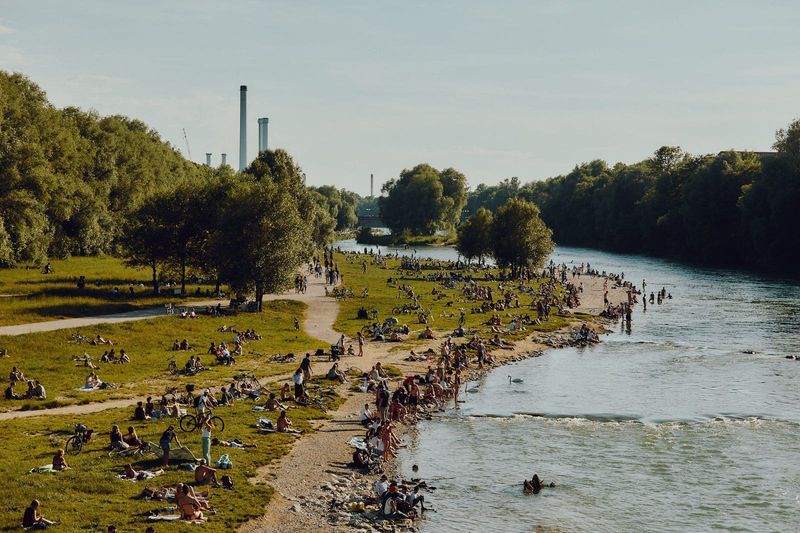
Beyond the historic centre, the Englischer Garten offers one of the largest urban parks in Europe. Unlike the formal gardens of Paris or Vienna, the Englischer Garten feels deliberately unmanicured. Paths wind through dense woodlands, open meadows, and past beer gardens where office workers drink from litre steins on weekday afternoons. The Isar River, which cuts through the eastern edge of the park, has become a gathering point for swimmers and sunbathers in summer, a reminder that Munich's relationship with nature is neither nostalgic nor recreational but woven into daily life.
Cultural Institutions That Take Themselves Seriously
Munich's museums are not minor. The Alte Pinakothek houses one of the finest collections of Old Master paintings in the world, with works by Dürer, Rubens, and Rembrandt displayed in galleries that feel appropriately weighty. Nearby, the Pinakothek der Moderne presents contemporary art, design, and architecture under one roof, its collection spanning the 20th and 21st centuries with a focus on German and Central European voices.
The city's opera house, the Bayerische Staatsoper, maintains a season that rivals Vienna or Milan. Productions here tend toward the traditional, though recent years have seen a willingness to engage with more experimental stagings. For a city often characterised as conservative, Munich's cultural institutions reveal a more complex reality: a place that values heritage but does not mistake preservation for stasis.
The Question of Identity
What Munich lacks, perhaps, is the kind of self-mythologising that makes cities like Paris or New York immediately legible to outsiders. There is no single narrative that defines Munich, no easily extracted essence. It is a city that resists reduction, and that quality can feel frustrating to visitors accustomed to destinations that offer clear, marketable identities.
But this ambiguity is also Munich's strength. It allows the city to evolve without the burden of constantly performing its own past. The beer halls remain, and they are full during Oktoberfest, but they coexist with natural wine bars and Michelin-starred restaurants. The traditional costume shops on Viktualienmarkt share the neighbourhood with concept stores selling Japanese ceramics and Scandinavian knitwear. Munich contains multitudes, and it does so without apparent anxiety.
Arrival and Departure
The city centre lies less than 40 kilometres from Munich Airport, connected by a train line that runs every 10 minutes. Most international visitors arrive this way, glancing out the window as the train passes through suburbs that could belong to any prosperous European city. The architecture is functional, postwar, occasionally bland. It is only upon reaching the centre that Munich's particular character begins to assert itself.
Leaving is equally straightforward, though perhaps less desirable. Munich does not seduce through grand gestures or immediate enchantment. It reveals itself slowly, over repeated visits, to those willing to look beyond the obvious. For travellers who prefer their cities legible and uncomplicated, Berlin will always hold more appeal. But for those who appreciate restraint, craft, and a certain Bavarian stubbornness in the face of easy categorisation, Munich offers something rarer: a city that refuses to simplify itself for anyone's convenience.