Where to Find Singapore's Most Stirring Exhibitions This Season
From Dunhuang cave replicas to AI-driven futures, the city-state's galleries are staging some of the most ambitious shows in years.
A City Turning Inward and Outward at Once
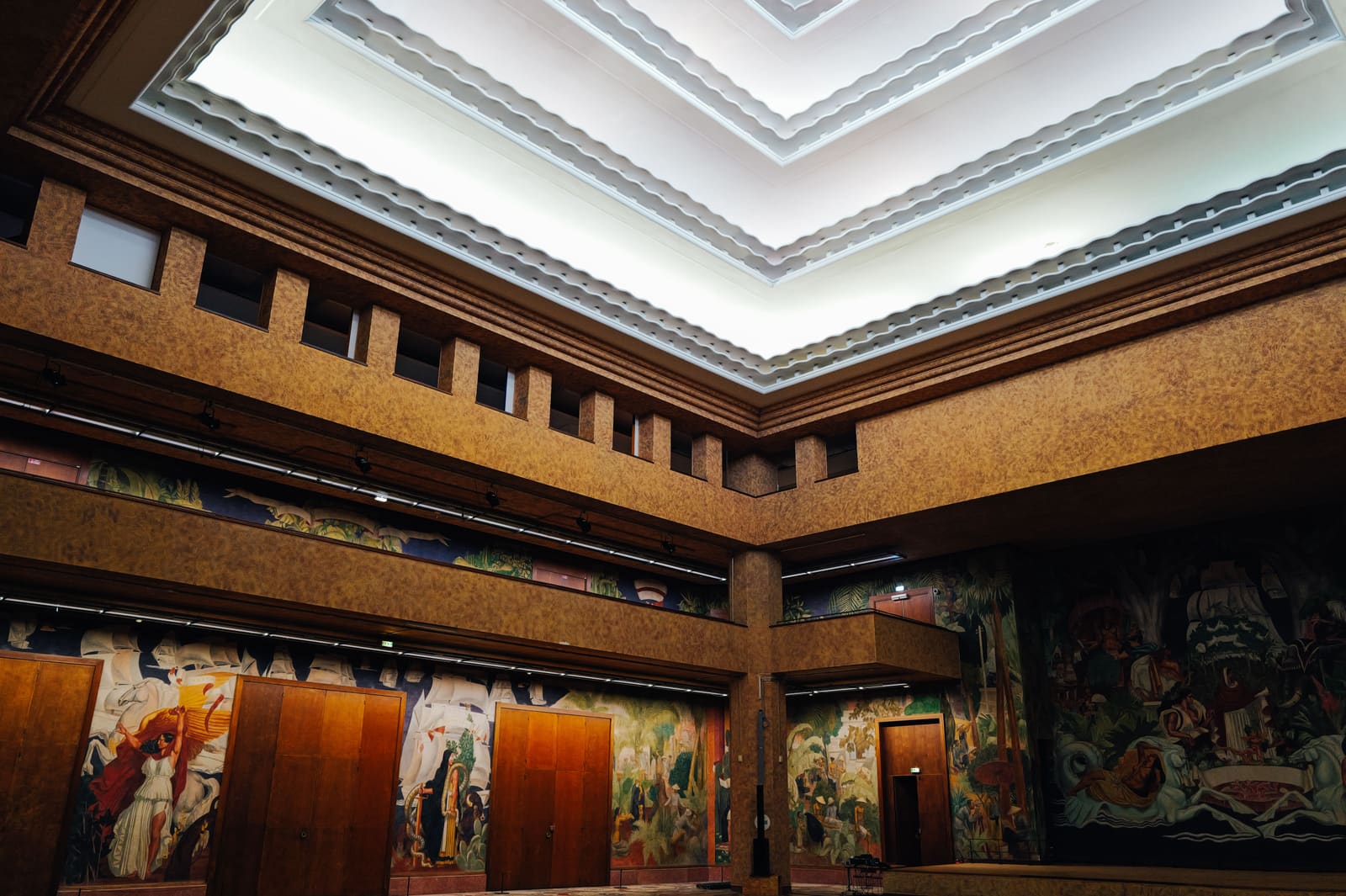
Stand in the foyer of the Asian Civilisations Museum on a weekday morning and the quiet hum of climate control becomes almost meditative. Above, the white coffered ceiling frames a rectangle of tropical light; below, a queue of visitors waits to step inside a replica of Cave 45 from Dunhuang, a grotto that has been closed to the public in Gansu Province for decades. The exhibition, Sacred Caves: Dunhuang, Buddhism, and the Silk Road, presents four life-size reproductions of the Mogao Caves, three of which remain restricted or entirely inaccessible at the original site. It is the first time Southeast Asia has seen these particular chambers rendered in such detail, complete with original paintings, sculptures, manuscripts, textiles and devotional objects on loan from the Dunhuang Academy. The ceiling of Cave 407 alone justifies the visit, though to say more would be to spoil the encounter.
Singapore in 2026 is staging a conversation between epochs and geographies. The National Gallery Singapore, marking a decade since its opening and coinciding with the nation's sixtieth anniversary, has rehung its permanent collection under the title Singapore Stories: Pathways and Detours in Art. More than 400 works span two centuries and multiple media, tracing how artists have negotiated the personal, the political and the poetic within a rapidly evolving island state. The show includes iconic pieces alongside works that have spent years in storage, offering a deliberately non-linear reading of the city's art history.
Lai Foong Moi and the Nanyang Legacy Reconsidered
On the second level of the DBS Singapore Gallery, Lai Foong Moi: Crossings occupies a suite of rooms dedicated to an artist whose name has largely eluded the canon. This is her first solo presentation, drawing together paintings and archival materials that examine identity, gender, labour and the texture of urban life during the 1960s and 1970s. Lai's canvases depict shophouses, street vendors and construction sites with a specificity that resists both nostalgia and romanticism. Her brushwork is direct, her palette earthy, her subjects often women engaged in work that official histories have overlooked. The exhibition, which runs until 3 October 2027, is free for Singaporeans and permanent residents; others pay twenty dollars.
The Nanyang School, long dominated by a handful of celebrated male painters, is being quietly reappraised. Lai's work complicates the narrative of that pivotal moment when Chinese ink traditions met Southeast Asian light and subject matter. Her urban scenes, in particular, offer a counterpoint to the more pastoral visions that have come to define the movement. She painted the city as it was being built, not as it was remembered.
Islamic Art Across Three Empires
A floor above Lai's retrospective, the Asian Civilisations Museum is also hosting Crosscurrents: Masterpieces of Mughal, Safavid, and Ottoman Art, a loan exhibition from the Musée du Louvre. Works from the sixteenth to eighteenth centuries trace the visual languages of three empires whose influence extended across continents. The exhibition explores how expanding trade routes facilitated the exchange of techniques, motifs and materials, making Islamic art a truly transnational phenomenon. Most of the pieces are on view in Singapore for the first time. Admission is free for Singaporeans and permanent residents; others pay from ten dollars. The show closes on 24 January 2027.
The juxtaposition of Dunhuang and the Islamic galleries within the same institution underscores a broader curatorial ambition: to position Singapore not as a peripheral node but as a place where Asian art histories converge and can be examined in depth. The city's museums have long relied on international partnerships, but the scale and scholarly rigour of these recent collaborations suggest a maturing confidence.
Technology, Agency and the Pandemic's Shadow
At the Tanjong Pagar Distripark, the group exhibition Islands in the Net: Southeast Asian Futures in the Age of AI takes a markedly different approach. Open until 16 November 2026 at Padimai Art & Tech Studio, the show gathers artists and technologists to examine what it means to live within systems that predict, organise and monetise behaviour. Several works reference the pandemic years, a period when digital infrastructure became both lifeline and surveillance apparatus. The exhibition asks how art might redefine its agency when algorithms increasingly shape perception and choice. Admission is free.
The title, borrowed from a 1988 cyberpunk novel by Bruce Sterling, signals a fascination with networked futures that has intensified across Southeast Asia in recent years. But the tone here is interrogative rather than celebratory. One installation uses machine-learning models trained on archival photographs of the region, generating speculative images that feel both familiar and estranged. Another invites visitors to input personal data and watch as it is sorted, tagged and resold in a simulated attention economy. The works are uneven, but the urgency is palpable.
Immersive Encounters and Evolving Ecosystems
A few kilometres south, the ArtScience Museum continues its long-running collaboration with the international art collective teamLab. Future World: Where Art Meets Science has been a fixture since the museum opened, but three new installations under the banner Exploring New Frontiers have recently been added. The works are interactive, responding to movement and touch, and the space retains its appeal for visitors who favour the photogenic. Tickets start at twenty-five dollars for adults and twenty for children.
Nearby, Into the Ocean: Journey Beneath occupies the basement galleries through 11 November 2026. The multi-sensory exhibition unfolds across six zones, each exploring different facets of marine life. One highlight is Flock of by bit.studio, a Thailand-based creative technology studio. The installation suspends kinetic helium-filled balloons above visitors, creating the sensation of moving within a school of fish. Tickets begin at 16.50 dollars for Singapore residents and eighteen for tourists.
At the opposite end of the island, Brandon Tay: Sangkalan has been circulating through neighbourhood libraries since April, a collaboration between the Singapore Art Museum and the National Library Board. The installation imagines a fictional island ecosystem shaped by a fruit, an insect and a bird, rendered in vibrant textiles, sculptural pieces and archival-style elements. The exhibition shifts as it travels from Woodlands to Tampines, Jurong and Punggol, with each iteration introducing new components. The final stop, at Punggol Regional Library, runs until 25 October 2026. Admission is free.
Beyond the White Cube
The decision to stage an art exhibition in public libraries rather than a traditional gallery reflects a broader push to decentralise cultural programming. Libraries in Singapore function as community hubs, and placing contemporary art within them invites encounters that might not occur in a museum setting. Tay's work, which draws on natural history and speculative ecology, lends itself to such spaces. The evolving nature of the installation also challenges the notion of the fixed exhibition, suggesting that art can be provisional, responsive and site-specific in ways that conventional displays often resist.
Elsewhere in Dempsey, the Museum of Ice Cream continues to draw crowds with its fourteen interactive installations. Originating in New York City, the museum is known for its pastel aesthetics and social-media-friendly environments. The Singapore outpost includes a sprinkle pool and a jungle filled with 10,000 bananas, alongside complimentary ice cream treats. Tickets start at thirty-five dollars. It is a different register of experience, one that prioritises play and spectacle over contemplation, but it has found an audience.
What These Shows Reveal
Taken together, Singapore's exhibition calendar in 2026 reflects a city negotiating multiple identities. There is the Singapore that looks to its own history, excavating overlooked figures like Lai Foong Moi and reframing the Nanyang School. There is the Singapore that positions itself as a custodian of Asian art, hosting Dunhuang cave replicas and Mughal masterpieces with equal seriousness. And there is the Singapore that engages with contemporary anxieties around technology, ecology and agency, using art as a space to ask uncomfortable questions.
The range is ambitious, perhaps even restless. But it also suggests a cultural infrastructure that has moved beyond simply importing blockbuster shows or promoting local talent in isolation. The city's museums and galleries are beginning to curate conversations that span centuries and continents, using their collections and partnerships to propose new ways of thinking about art, history and place. Whether these exhibitions will shape how the city sees itself, or how the region sees Singapore, remains an open question. For now, they offer a series of encounters worth making.