The Places That Quietly Become Home
Five voices from Singapore's creative community on the corners of the city where memory, routine, and belonging take root.
A Museum That Marks Time
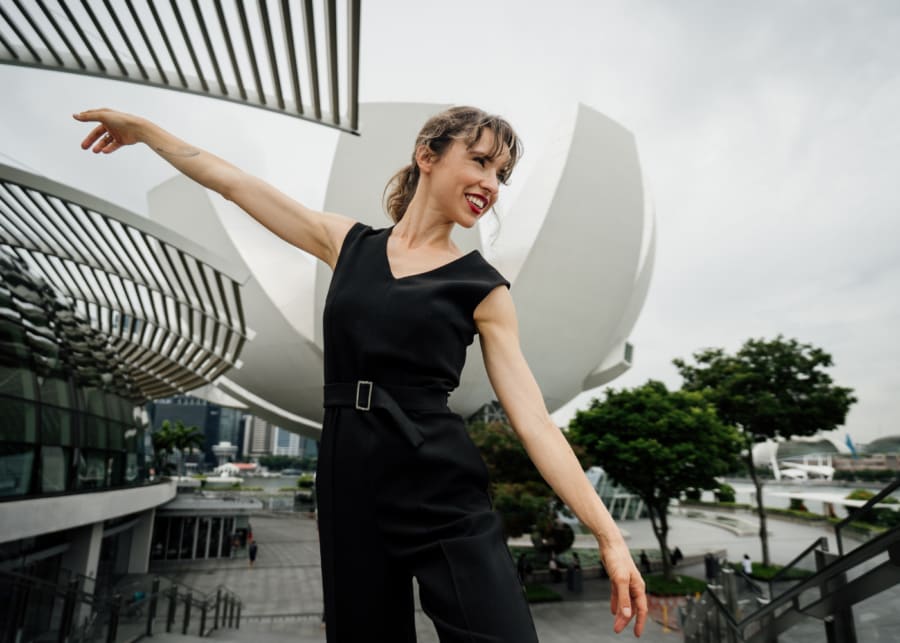
Natalia Moskaleva remembers the first visit clearly. She sat among the waterlilies at the ArtScience Museum, alone, asking herself whether Singapore might actually feel like somewhere she could stay. The answer came slowly, not in that single afternoon but across the years that followed. In 2017, she returned with her partner. Five years later, their son discovered the same lotus-filled hall for the first time. By 2025, they were four.
The museum itself has not changed dramatically. Marina Bay still curves along the waterfront, the iconic petals of the building still catch light in the same way. Yet each visit layers new meaning over the old. For Moskaleva, who now runs Attitude Design Consulting, the space has become something more than architecture or exhibition. It is a family album written in footsteps, a place that has quietly absorbed the shape of her life in Singapore.
At Global Chic Voyage, we have watched certain places take on this quality: landmarks that become personal through repetition, through the small rituals of return. The museums we visit with children, the parks we walk through in different seasons of grief or joy. They do not announce themselves as home. They simply wait, and over time, they become inseparable from the story we tell about where we belong.
A Neighbourhood That Blends Eras
Telok Ayer sits tucked within the Central Business District, a neighbourhood where heritage shophouses lean into modern cafes and temples share walls with murals. Kriti Saj, founder of the fashion label Nimbu, first encountered the area during her working years nearby. It became her terrain for coffee runs and evening walks, a pocket of the city that felt both vibrant and oddly intimate.
The colours stayed with her. The bold facades, the interplay of old and new, the sense that history and contemporary life were not in opposition but in conversation. Those impressions eventually found their way into her design work: jumpsuits in saturated hues, garments meant to move between contexts as fluidly as the neighbourhood itself shifts between eras.
What makes a place feel uniquely Singaporean is often this layering, the refusal to choose between preservation and reinvention. Telok Ayer does not perform its heritage for visitors. It simply continues, absorbing new uses while the bones of the past remain visible. For those who spend time there regularly, the neighbourhood offers a kind of grounding, a reminder that change and continuity can coexist without friction.
The Sea as a Reset
Sophie Leung has lived in multiple countries. For her, home is not a structure but a rhythm, a sense of alignment with a place and its daily cadences. In Singapore, that feeling arrives most reliably at East Coast Park. Whenever life accelerates beyond comfort, the sea becomes her reset.
The park is democratic in its appeal. Cyclists pass families. Aunties exercise in groups. Friends gather around barbecue pits. People sit and watch the waves without agenda. Leung, who founded The Core Humanity Co, values this quality: the way the space accommodates different needs without imposing a single mood or purpose. It is not curated for leisure. It simply offers room to breathe.
For Tan Ying Hui, founder of Yings Creative Lab, East Coast Park carries an additional weight of memory. She grew up in the East, and the park has threaded through her life for as long as she can recall. Now running her web design agency remotely, she spends less time in Singapore than she once did. But each return pulls her back to the same stretch of coastline.
The ritual is consistent: a run along the sea, followed by hawker food at East Coast Lagoon Food Village. Satay, grilled stingray, barbecued chicken wings eaten by the waterfront. The tastes are not available elsewhere, and that specificity matters. Home, in this sense, is not abstract. It is the precise combination of salt air and charred spice, the texture of a place that cannot be replicated.
A Cafe That Remembers Your Name
Adelphia Lim first visited The Social Space at Potong Pasir for work. She did not expect to keep returning, but the place drew her back. The coffee is good. The space is pet-friendly. The team is warm. More than any single feature, though, it is the sense of recognition that lingers. The staff remember names. They make people feel seen.
In a city defined by efficiency and constant motion, this kind of attentiveness stands out. Lim, who founded For The Love of Socials, describes the cafe as a reminder of what community can look like. She has held meetings there, worked from a corner table, caught up with friends, and simply sat in the slowness of an afternoon. The space does not demand productivity. It offers presence.
What she values most is the ethos beneath the surface: connection, kindness, the quiet practice of looking out for one another. These are not grand gestures. They are small acts repeated until they become the character of a place. For Lim, The Social Space embodies something she believes is deeply Singaporean, even as the city's rapid pace sometimes obscures it.
The Geometry of Belonging
Home is not always a door you unlock or an address you write on forms. Sometimes it is a museum hall where your family grows older. Sometimes it is a neighbourhood that taught you to see colour differently. Sometimes it is the sea at dusk, or a cafe where the barista knows your order before you speak.
The people who shared these places are not romanticising Singapore. They are naming the coordinates of their own belonging, the spots where the city stopped feeling foreign and started feeling like theirs. These are not the landmarks that appear in guidebooks or tourism campaigns. They are the places that absorb routine, that witness change, that hold space for the small, repeated acts that make a life.
At Global Chic Voyage, we have learned that luxury is not always about the extraordinary. Sometimes it is about the ordinary made meaningful through repetition. The walk you take every week. The table you always choose. The view that never quite loses its capacity to steady you.
Singapore is a city that reinvents itself relentlessly. Skylines shift. Neighbourhoods transform. What was new last year is already being replaced. Yet within that churn, there are still places that stay with us, that mark time without announcing it, that become part of the architecture of memory.
These are the places that quietly become home. Not because they are perfect, but because they are ours. Because we have returned to them enough times that they now return to us, unbidden, whenever we think about what it means to belong somewhere.