A Lifetime of Markets and Souks, Collected in One Manhattan Home
Costume designer Patricia Field has turned six decades of global shopping into a Lower East Side apartment that reads like a map of her travels.
The Architecture of Discovery
There are apartments that feel like galleries, and apartments that feel like homes. Patricia Field's Lower East Side residence manages to be neither and both, a space where the logic of accumulation follows not trend cycles but flight paths. The costume designer responsible for some of television and film's most fashion-forward moments has spent sixty years moving through cities with an eye trained not on landmarks but on the smaller economies of beauty: the independent shop, the neighborhood souk, the vintage store tucked down an alley most tourists miss.
The apartment itself borrows from Tokyo. Decades ago, work took Field to Japan, where she stayed at the Grand Hyatt and absorbed its spatial philosophy. Her bathroom foregoes a shower in favor of a deep soaking tub. Televisions appear in multiple rooms. The living room unfolds as open space, unbroken by unnecessary walls, with windows that look east across the river toward Brooklyn and Queens. Mirror curtains, a gift from Fendi's New York showroom, multiply the light. It is a home built around the idea that luxury is not about excess but about considered choice, the edit that comes after the hunt.
Objects as Evidence
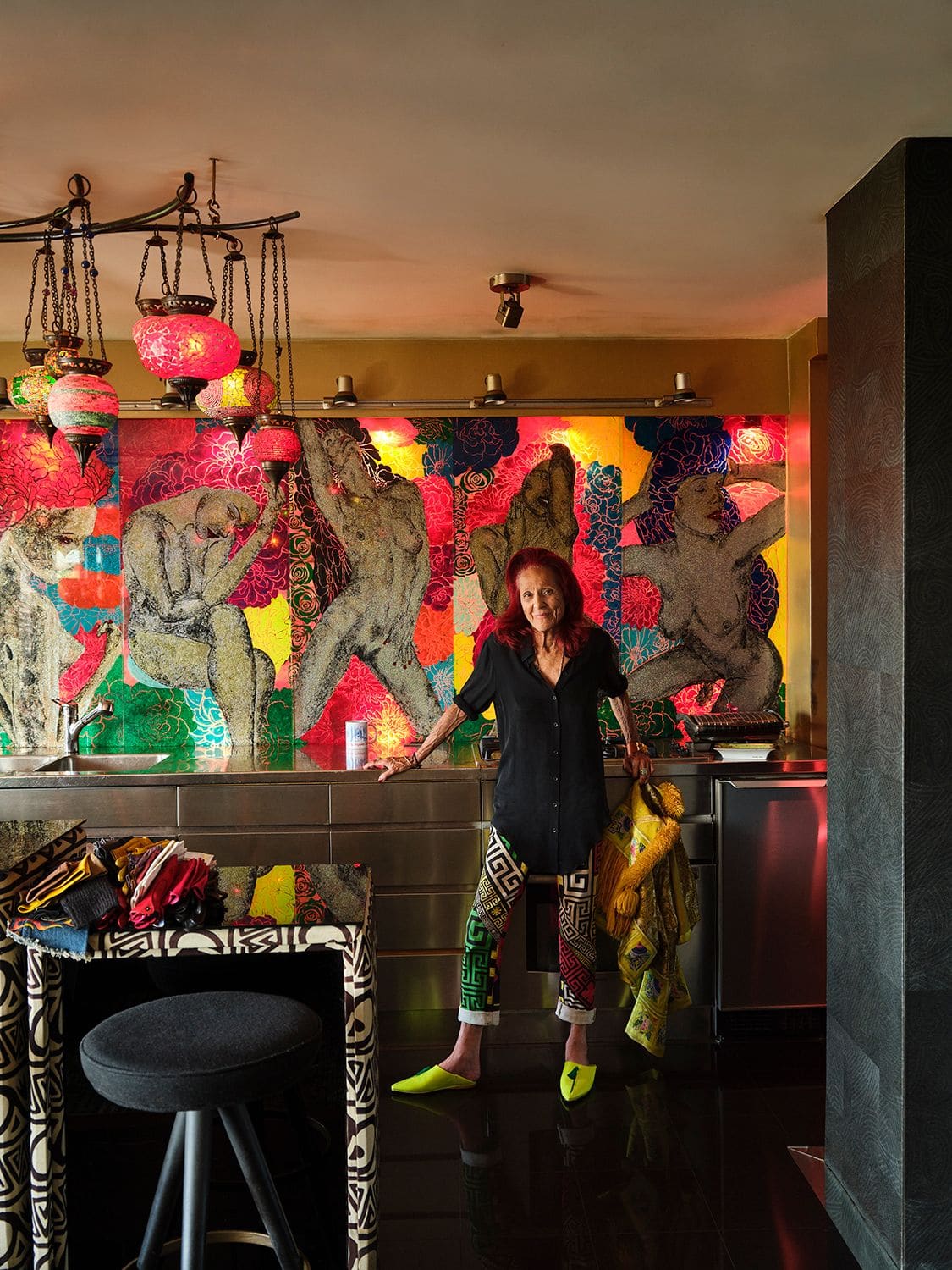
Walk through the rooms and you are walking through her work. The Moroccan slippers scattered near the entryway were purchased in the grand souks of Marrakech while she was dressing the cast of Sex and the City II. Weeks spent traveling between Morocco, Türkiye, and Abu Dhabi left her with more than call sheets and costume lists. The slippers, embroidered and jewel-toned, are what she wears at home now, soft reminders of haggling in narrow market corridors.
Above her kitchen counter hang glass lamps from Istanbul's Grand Bazaar, their colors saturated and jewel-like, the kind of object that announces its origins. Field has visited the city numerous times, drawn to its layered cosmopolitanism, the way East and West fold into each other in architecture and habit. The lamps were shipped back to New York, a logistical feat that speaks to her commitment. These are not impulse buys. They are deliberate acquisitions, things she knew would matter once they were home.
In her bedroom sits a golden palm tree sculpture, vintage, from Las Tías, a consignment store in Miami that has since closed. Field has worked extensively in South Florida and keeps a second home on Miami Beach. The palm, picked up a decade ago, is both kitschy and elegant, a piece that refuses to take itself too seriously while still commanding attention in the room.
The Rituals of Return
Greece occupies a particular place in her geography. Her mother's family emigrated from there to Manhattan, and Field has returned repeatedly, splitting time between Athens and the islands, Paros and Mykonos among them. On Mykonos, along the bustling Matogianni Street, she purchased an ordinary coffee mug in 2017. The translation printed on its side reads "a pound and a half of sardines." It is the kind of souvenir that makes no sense and perfect sense, a piece of local humor carried across an ocean, now sitting in a Manhattan kitchen.
Her devotion to Japanese cosmetics began thirty years ago, another byproduct of work that required her presence in Tokyo. She became attached to a specific Shiseido product, the Beni Kabuki lipstick, a brush-on formula sold only in Japan and available in a single shade of rouge. She stocks up on every visit. When she cannot go herself, friends become couriers, bringing back the small lacquered tubes. It is a loyalty that transcends convenience, a refusal to settle for the available when the perfect thing exists elsewhere.
The Wardrobe as Archive
Her closet reads like a roster of houses that understand fashion as theater. Pucci, Libertine, Hermès, Chanel, all represented. But the piece she returns to most often is a jacket by John Galliano for Christian Dior, purchased in Paris in 2002. The tailoring is exact, the silhouette unmistakable. She wears it at home, often with those Moroccan slippers, a pairing that collapses geography into personal style.
Paris has been a constant. Five seasons of Emily in Paris meant regular trips, and Field made time between fittings and shoots to visit the city's vintage stores, which she considers among the finest in the world. Her work has always required this: the ability to move through a city not as a tourist but as someone hunting for the thing no one else has found yet. It is a skill honed over decades, a kind of professional instinct that has bled into how she lives.
The Discipline of the Eye
What separates Field's collecting from mere shopping is the rigor behind it. She is not interested in the generic or the easily replicated. Markets and independent shops appeal to her because they offer specificity, the handmade and the local, the object that carries the mark of its maker and its place. Her apartment does not feel cluttered despite the abundance of objects. Each piece has earned its spot, survived the journey home, and proven itself worthy of daily proximity.
There is no room here for the careless or the trendy. The items she brings back are chosen with the same eye she brings to a film set, where every garment must work within a larger narrative. At home, that narrative is her own, a six-decade story told through lipstick tubes and coffee mugs, lamps and slippers, a vintage palm tree that catches the light just so. The apartment is not a museum. It is a working collection, things she uses and wears and looks at, reminders of the places she has been and the work that took her there.
A Life Measured in Objects
Field has described herself as someone whose nature is to discover, and discovery requires movement. Her career has provided that in abundance, sending her to cities and countries where fashion and culture intersect in ways that demand attention. She has dressed characters who define their eras, whose wardrobes become cultural reference points. But the process of doing that work has also allowed her to build a private archive, one that exists not in a studio or a storage unit but in the space where she lives.
The view from her living room stretches east, over water and toward boroughs she has known her entire life. The mirror curtains double it, creating the illusion of even more space, more light, more city. It is a view that anchors her, even as the objects around her point outward, toward markets in Marrakech and streets in Mykonos, toward the Grand Bazaar and the boutiques of Paris. Home, in this case, is not the opposite of travel. It is where travel accumulates, where the scattered pieces of a life spent moving finally come to rest.