There Is a Reason People Get Close: Justin Mott on Photographing the Guardians of the Last Animals
The elephant keeper in Nairobi, the woman hand-feeding orphaned gibbons in Malaysia, the ranger lying in the straw beside one of the last two northern white rhinos on earth. Justin Mott, the American photographer behind Kindred Guardians, explains why his camera is pointed at them, what he checks before he agrees to photograph anything, and why he made the film he is proudest of hard to watch.
An armed guard and two animals
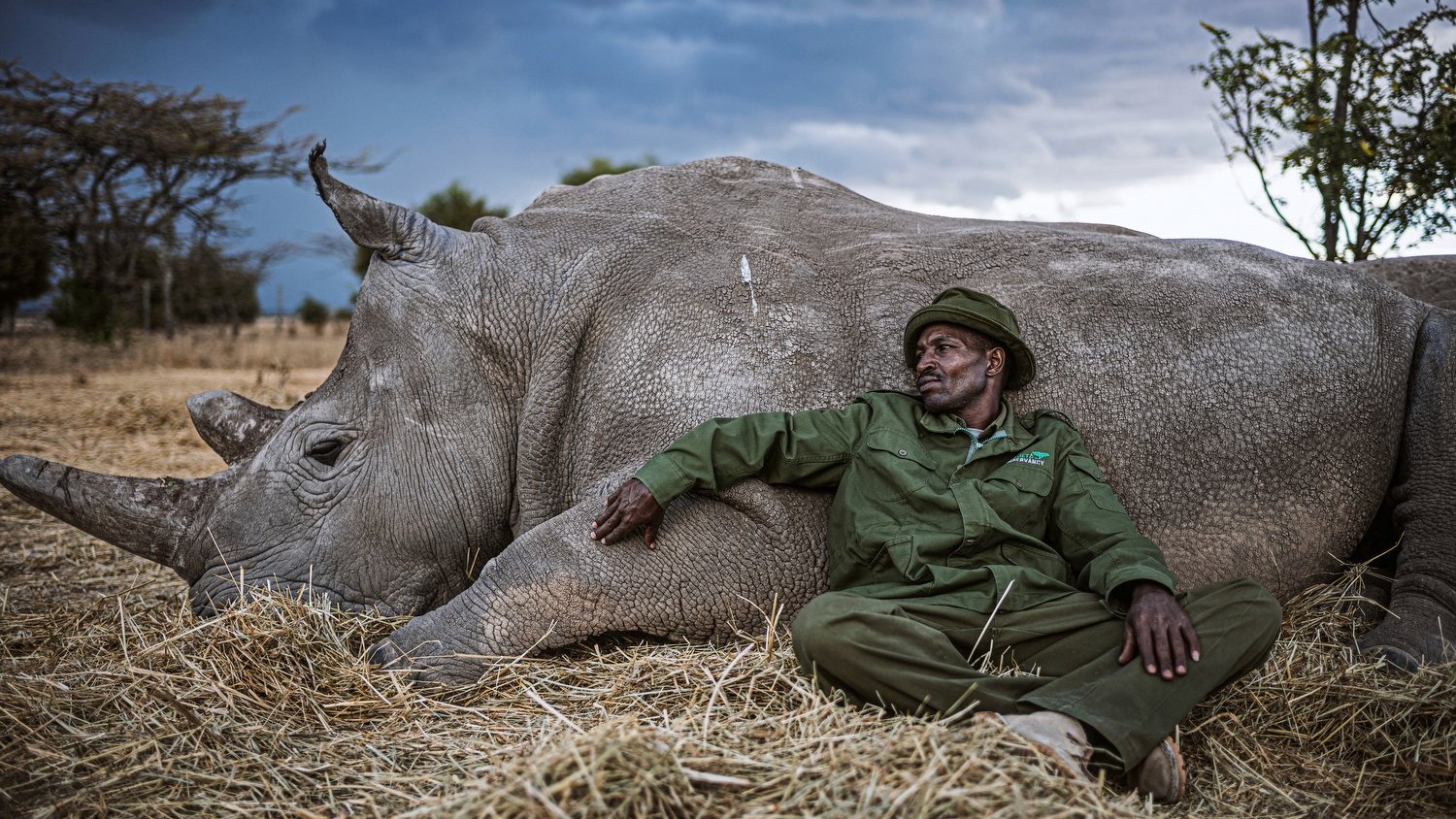
Two northern white rhinos are left in the world. Najin and Fatu are mother and daughter, born in 1989 and 2000, and they live at the Ol Pejeta Conservancy in central Kenya under armed protection around the clock. When Justin Mott photographs them the guard is usually somewhere in the frame: a rifle crossing the foreground, a hand on the animal, a man in green fatigues lying in the straw beside something the size of a car.
People object to those pictures. Mott has heard the objection enough times to answer it before it is finished.
"People say like, oh, you shouldn’t get close to rhinos. Well, of course not. The public shouldn’t get close to rhinos," he says. "But these rhinos grew up in captivity and they’re about to go extinct, the last northern white rhino. And so there’s a reason people get close."
The sentence is doing more than defending a photograph. It is the test Mott applies to every story in the project, and he applies it weeks before he books a flight.

Mott is 48 and has lived in Hanoi for around twenty years, most of that time shooting assignments across South East Asia for The New York Times. In 2009 he founded MottVisuals, a commercial photography and video production company, with his wife Quynh Anh Mott. The project that now occupies his personal work began later, when the editorial economy started drying up under him.
"When I turned 40 a while back, I decided that, you know, the editorial work first of all was just less of it, less assignments, less traveling as a photographer, less budgets," he says. The commercial company carried the business, and it tells stories too, for brands. What he no longer had room for were documentary stories of his own choosing.
He built Kindred Guardians instead, self-funded and self-assigned, a chapter at a time: orphaned elephants in Nairobi, the rhinos in Kenya, gibbons in Malaysia, a sloth rescue centre in Suriname. One country, one animal, one set of people. A book at the end of it.
Not a wildlife photographer, and particular about saying so
Asked why the camera points at the guardians instead of the animals, Mott corrects the premise before answering it.
"It’s not that I’m not pointing it at the animals. It’s just that I’m not pointing it at just the animal. I mean, I’m not a wildlife photographer. Wildlife photographers are great and they have their own place. It’s not what I do."
He calls what he does wildlife photojournalism, and the distinction rests on a fact he states without decoration. "I wish all animals lived in the wild and in their natural habitat, but the truth is they don’t."
That is the opening most wildlife photography has to work around and his project starts from. If the animals he is drawn to are in human care, then the people providing that care are part of the picture by definition.
"So I pick stories where people ethically interact with animals, you know, saving them, helping them, veterinarians, rescue centers, scientists, people working with animals to save them and help them," he says. "It’s capturing that bond that we humans have with animals."
His background explains the rest. He came up as a documentary photographer, which is to say a photographer of people, and the project is the two interests meeting in one frame.

The work that happens before he arrives
Photographing people at close quarters with animals is the most contested ground in the genre, and Mott states his boundary as a condition on the work.
"The ethical line for me is that if I’m going to photograph people getting close to animals, it should be for the benefit of the animals. It should be in an ethical way."
Applied to a single frame that is a judgment call. Applied to a project it becomes a research process, and this is the part of his practice he talks about most readily.
"I talk to people ahead of time before I do a project and research to make sure the centers and NGOs and people that work with these places are sort of above board on all these things," he says. "I talk to people that I trust in the industry and get their stamp of approval before I approach it."
The disqualifier he offers is a familiar one to anyone who has looked closely at wildlife tourism in Asia. "I don’t want to go photograph a place that says they rescue elephants, but they do elephant rides, you know. I don’t want that."
He walks through two situations that would look identical in a photograph and are not. A woman in Malaysia hand-feeding gibbons would be a problem if the animals were pets in her house. They are not; they lost their mothers to the wildlife trade and cannot feed themselves. The rhino keepers are physically close to animals that grew up in captivity and are the last of their kind.
Neither distinction survives in the image. He settles both before he goes, which is the point. "Most of the time I don’t have to worry about it once I get there because I’ve done the research ahead of time," he says.
It is an unglamorous description of ethics in photography, and a more honest one than most. He makes the call on the phone, weeks out, and he is willing to lose the story over it.

Where the access ends
Kindred Guardians supplies images to conservation organisations, which use them to raise money. That is also what campaign photography does, and Mott was asked directly whether the work crosses into advocacy. He does not dispute the overlap. He locates the difference in the terms he sets at the start.
He settles the terms before he arrives. "You have to give me access," he says. "We’re not doing a shot list like on a commercial photography or campaign photography would be like, okay, you need to get a shot of this person doing this. I don’t do it that way."
He describes an understanding both sides reach in advance. Once an organisation grants access, he documents what unfolds, under journalistic ethics, with no prescribed shots and no staged moments. The arrangement works only if they trust him to tell the story fairly and independently.
What replaces the shot list is time, and the amounts involved are the real difference between the two kinds of work. "I try to spend as much time as I can there. So, not one day like I might get on an assignment, but rather a week or two weeks. So the Rhino story I’ve gone back three separate times and each time it’s several weeks, and I’m going to photograph things as they unfold."
He works under the rules he trained under, and he lists them without being asked. "Not paying for access, which is not setting up things and say, oh, stand there or do this. Yeah, sure, a portrait I could set up, but I’m not going to set up a moment, or I’m not going to pay for access."
He draws a line between the two kinds of work he does. On a publication assignment, subjects do not approve images and do not get editorial control. On a personal project there is more room to talk an image through and make sure the context is right, and he takes that room. "I would be respectful towards that if they didn’t think it was portrayed the right way," he says of an organisation that felt a frame sent the wrong message.
What holds across both is fairness and accurate representation. What he will not do is trade the independence of the work for access on the way in.
His argument for why the method produces better pictures anyway is practical. "If I believe in the work they do and they believe in the work they do, if I go there for a week, I should be able to get a really raw story with a lot of moments in there and be able to tell their story truthfully."
Then, in the same breath, a line most people would have left off the end. "And I feel like I’ve done a good job at that. I hope I have."
"If I go there for a week, I should be able to get a really raw story with a lot of moments in there and be able to tell their story truthfully." - Justin Mott
The middleman
Kindred Guardians won an International Photography Award in 2019 and the rhino work has run in The Washington Post, in Slate and with Greenpeace. Asked what the recognition has meant, Mott gives an answer that is close to dismissive about the award and precise about the use.
"Awards to me, I don’t enter a lot of them. I don’t care about them so much at this point in my career, but I use them as a way to get these stories out," he says. "I always look at any project I do: the more eyeballs on it, the better."
The more interesting shift is what the project taught him about where photographs go. He came up inside a system where a newspaper commission was the only route to an audience, carried that assumption for most of two decades, and says Kindred Guardians taught him otherwise.
The alternative he describes took a deliberate shift for a photographer trained in the 2000s. He gives the images to the organisations to use themselves. He sells prints and puts some of that money back into the NGO. He publishes the work on his own channels, where other photographers write to say they want to make something similar and readers write to say they want to go and see the rhinos.
He has a word for the position this leaves him in, and it is a modest one. "So I’m just sort of the middleman."
The sentence describes a career decision, and it has consequences. A photographer who measures a project by eyeballs is free to work on stories no desk would commission, which covers most of Kindred Guardians.
"The awards aren’t important to me for my ego," he says. "They’re more important to me to just raise awareness."

A film that should be hard to watch
When the photo essay on the rhinos was finished, Mott went back to the same story in a different medium. Mott co-directed Wander Alone, a nine-minute documentary in black and white, with Joey Bania; Quynh Anh Mott produced it alongside him. The film uses voiceover sparingly and carries no conventional narration; sound design, ambient audio and music do most of the work. The producing side of the film sits with the Hanoi company the Motts built together, which is where their own projects have been based for close to two decades.
"I wanted to sort of talk about extinction, talk about isolation," he says. Leaving the subject largely unexplained was deliberate. "I just wanted people to look at that story and sort of think about where we’re going as a society and what we’re doing to our wildlife and to our environment, and have people draw their own conclusions."
He is clear-eyed about the cost of those choices, and clear about having made them anyway.
"It wasn’t the kind of project that is going to be commercially successful because it’s shot in black and white, but that wasn’t the goal. The goal is to try something different. That story had been told by many other people in different ways and often the same way, with narration and interviews. And we wanted to try something different and reach a different audience."
The film won the Best New Vision Program Award at the International Wildlife Film Festival, which Mott describes as the oldest wildlife film festival in the world. It is on YouTube. He is unapologetic about the experience it offers.
"It shouldn’t be easy to watch. It should be hard. It should make you think. And I just hope that people are impacted by it."
"It shouldn’t be easy to watch. It should be hard. It should make you think." - Justin Mott on the rhino documentary
What pays for an unpaid project
Asked how he decides which personal projects are worth years of unpaid time, Mott answers the question and then undercuts his own authority to answer it, which is the more useful half.
He started out making personal work, found his style through it, and then lost the habit. "That led to a lot of commercial work, led to years of work and me getting away from that a little bit, getting away from doing projects that I’m passionate about and care about because I didn’t have time."
He came back to it in his forties, and he names the reason plainly. "Now I’m older. I have the luxury of a little more financial freedom to do these projects." He returns to the point twice more unprompted. "I think it was harder when I was younger, but I got away from it in my 30s and got back to it in my 40s."
With that on the record, the advice follows. "Don’t do a project because you think it’s going to win an award or make you look good or enhance your portfolio. Do a project because it comes from your heart. I mean, that’s the biggest thing for me. If you’re passionate about it, that’s what’s going to sustain the years and the time you’re putting in without getting paid to do it."
His own filter is curiosity about the people, and he is explicit about where he places himself relative to them. "I’m curious about the people who are better than me that can spend their whole lives helping animals, and for me just to play a small part to tell the stories."
The second filter is editorial. Most of the stories he has chosen have been told before, including the rhinos. He asks one question about each. "Can I tell it differently, or can I reach a different audience?"

The question he asked himself at 40
The decision that produced all of this was a blunt one, and Mott repeats it the way people repeat things they have settled.
"I felt like at 40 years old, I wanted to, I’m 48 now, but I thought to myself, like, what am I going to be known for? What’s my legacy project? Do I want to be known for hotel photography, or just assignment work that someone else wrote a story and I covered it for a business story or something? Or do I want to be known for this work? And this work is truly me. It’s my passion. It’s my creativity."
Eight years in, the answer has chapters in Kenya, Malaysia and Suriname, an award, a film, and a book somewhere ahead of it. Najin and Fatu were in the world long before any of it began, and the reason the project exists at all is that there will be no third.

Justin Mott is an American photographer based in Hanoi, co-founder of the production company MottVisuals and founder of the photography education platform AskMOTT. Kindred Guardians is his ongoing personal project on people who devote their lives to animals. His editorial portfolio is at justinmott.com and his education platform at askmott.com.