How to Disappear Into San Sebastián Without Looking Like a Tourist
The city's rhythms are old and particular - written in tides, drizzle, and the cadence of bar-hopping. Here's how to learn them.
The Language of Belonging
There is a word in Euskera, the Basque language, that describes the fine mist that settles over San Sebastián almost daily: sirimiri. It is not quite rain, not quite fog, but something in between - persistent, gentle, inescapable. To live here, or even to visit well, is to accept this kind of ambiguity. The city operates on codes that are rarely spoken aloud, passed down through generations in the same way that recipes are, or the names of beaches.
At Global Chic Voyage, we've long believed that the most rewarding destinations are those that ask something of you - a willingness to observe, to defer, to learn the local grammar of pleasure. San Sebastián is precisely that kind of place. Its beauty is immediate: the scalloped curve of La Concha beach, the Belle Époque architecture, the pintxo bars glowing amber in the evening. But the city's real texture only reveals itself to those who pay attention to its rhythms.
Even among Spaniards, the Basque Country feels like a country within a country. The language predates Latin, its origins still debated by linguists. The food culture is intensely regional, fiercely proud. And the social rituals around eating and drinking are as codified as any tea ceremony, though far less formal in spirit. What follows is not a list of must-see sights, but a guide to moving through the city with a lighter step - to eating, drinking, and navigating San Sebastián the way a donostiarra would.
A Few Words Go a Long Way
The city has two names. In Spanish, it is San Sebastián; in Euskera, Donostia. Locals use both, but the latter signals a deeper affiliation. To greet someone with kaixo (pronounced KAI-show) rather than hola is a small gesture, but it registers. So does barkatu (bar-KAH-too), which means "excuse me" and will serve you well in a crowded bar when you're trying to catch the bartender's eye.
Euskera is not a Romance language. It shares no linguistic ancestry with Spanish, French, or Italian. It is older than all of them, and its survival is a point of intense cultural pride. You need not become fluent, but learning a handful of words is a sign of respect - and in a region where tourism has become a fraught subject, respect is currency.
The Geometry of Pintxos
Pintxo culture in San Sebastián is roughly a century old, which means it has had ample time to develop a set of unspoken rules. The tradition centers on small bites, often skewered with a toothpick (hence the name, derived from the Spanish pinchar, to pierce), consumed standing at the bar with a drink in hand. The ritual is social, peripatetic, and timed to the city's particular clock.
When you enter a bar, make eye contact with the bartender and order your drink first. This establishes you as a customer, not a browser. Some pintxos are displayed on the bar, within arm's reach; these you may take yourself. Others appear only on a chalkboard menu behind the counter and must be ordered. If you are handed a plate the size of a dinner service, you have likely wandered into a tourist trap. Authentic pintxos are eaten in two or three bites, often while standing.
The key is restraint. Locals rarely consume more than one or two pintxos per establishment. The pleasure lies in the movement - one bar, one drink, one bite, then on to the next. This is not a meal; it is a procession. And while certain bars have become so popular that lines form outside (Ganbara, Antonio, Nestor), you will not find many donostiarras waiting in them. The city has hundreds of pintxo bars. The best strategy is to keep walking.
The Architecture of the Day
San Sebastián runs on a schedule that can feel rigid to outsiders but is, in fact, a framework for pleasure. Lunch begins at one in the afternoon, dinner at half past eight or nine in the evening. Some kitchens close by quarter past ten, especially midweek. This is earlier than much of Spain, a concession to the city's proximity to France and its own internal logic.
To eat outside these hours is to find yourself adrift. Restaurants will be closed, bars serving only drinks. The city does not bend to the tourist's hunger; it expects you to adapt. And once you do, the rhythm begins to make sense. The long afternoon stretches out. Dinner feels unhurried. The night extends in a way that feels earned.
Drinking, too, follows a pattern. Wine accompanies meals. Vermouth is the classic aperitif, often served before lunch with an olive or a slice of orange. After dinner, the digestif of choice is a gin and tonic, though rum and cola runs a close second. These are not laws, but they are customs, and they shape the evening's arc.
Weather as a Way of Life
San Sebastián is not sunny Spain. Rain falls frequently - every other day, on average - and the coastal weather is famously unpredictable. Locals have developed a vocabulary for it. Sirimiri is the constant light drizzle. Galerna describes a sudden, wind-driven storm that sweeps in when the temperature rises too quickly. Both are facts of life here, and umbrellas are largely futile, especially when crossing the bridges or walking along La Concha in winter. The wind has claimed countless casualties.
The local solution is practical: a waterproof jacket with a hood. This is not a city that cancels plans for rain. Life continues - pintxo bars fill, surfers paddle out, cyclists navigate the bidegorri (the red-paved bike lanes that crisscross the city center). To visit San Sebastián is to accept that you will get wet, and to dress accordingly.
Tides, Cheesecake, and Other Essentials
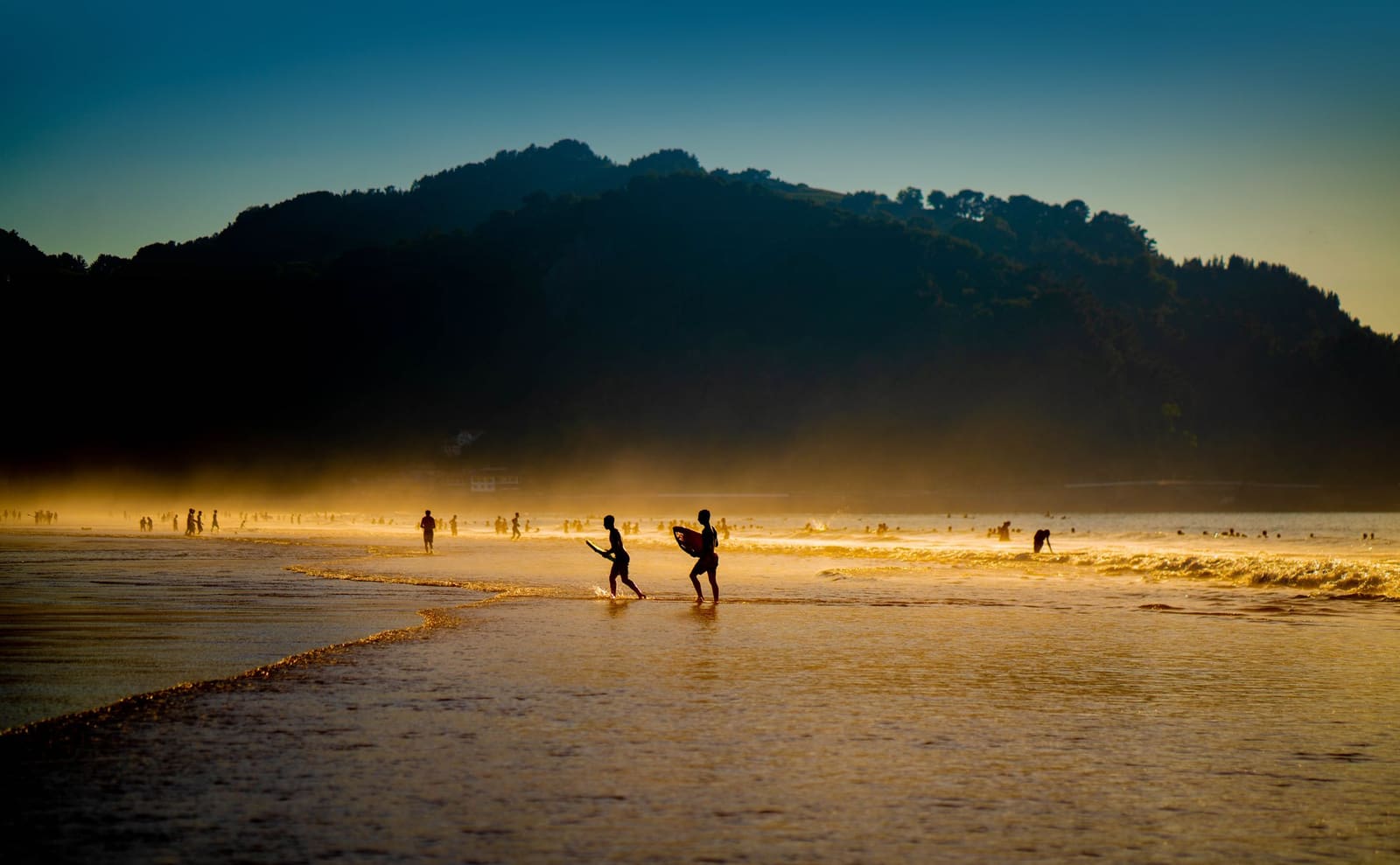
The beaches here are governed by the tides, and the tides govern much of daily life. La Concha, the city's most famous beach, shrinks dramatically at high tide, leaving only a narrow strip of sand overrun with bodies. Locals consult tide tables the way others check the weather, often via an app called Windguru. At high tide, the savvy move is to head to one of the city's other beaches - Ondarreta or Zurriola - or to time your visit for the ebb.
Zurriola is the surfers' beach, where winter swells can reach nearly twelve feet. The unwritten rule: defer to those more skilled than you, and respect the local crews. When Zurriola's waves grow too large, surfers migrate to La Concha, which is typically calmer.
And then there is the cheesecake. The burnt Basque cheesecake - crustless, caramelized on top, creamy within - has become a global phenomenon, but it was born at La Viña, a pintxo bar in the old town. The original is still worth seeking out, though a handful of imitators have proliferated. One other version merits attention: the ultra-creamy, almost savory rendition at Bertakoteka. The rest, especially the pop-up stalls hawking slices to tourists, can be ignored.
How to Move
San Sebastián is small and flat, and many residents prefer bicycles to cars. The bidegorri is sacred ground - stay to the right, pass on the left, and if you are on foot, look both ways before crossing or risk a collision and a scolding.
Taxis do not stop on the street. They pick up only from designated stands or by phone. During summer or weekend meal times, they are often unreliable. Uber exists but is similarly inconsistent. The city buses, by contrast, run with Swiss precision and are widely used by locals.
What the City Teaches
There is a particular kind of pleasure in moving through a place that does not explain itself - in learning by observation, by trial, by the occasional mistake. San Sebastián rewards this kind of attention. Its codes are not exclusionary, but they are real, and they reflect a culture that values ritual, seasonality, and the communal act of eating.
The hotels we return to in San Sebastián are rarely the largest or the newest. They are the ones where the concierge knows the tide tables, where the bartender speaks a little Euskera, where the breakfast room smells of toast and strong coffee and the sound of rain on the windows feels less like an inconvenience than a kind of music. To disappear into this city - to move through it with the lightness of someone who belongs, even briefly - is to understand that luxury is not always about comfort. Sometimes it is about learning the language of a place, even when that language is written in mist and tides and the unspoken etiquette of a crowded bar.