When Sailing Becomes an Address: The Rise of Seaborne Luxury Hotels
From butler-serviced suites to helipads and Michelin-starred kitchens, the newest generation of vessels is rewriting what it means to travel at sea.
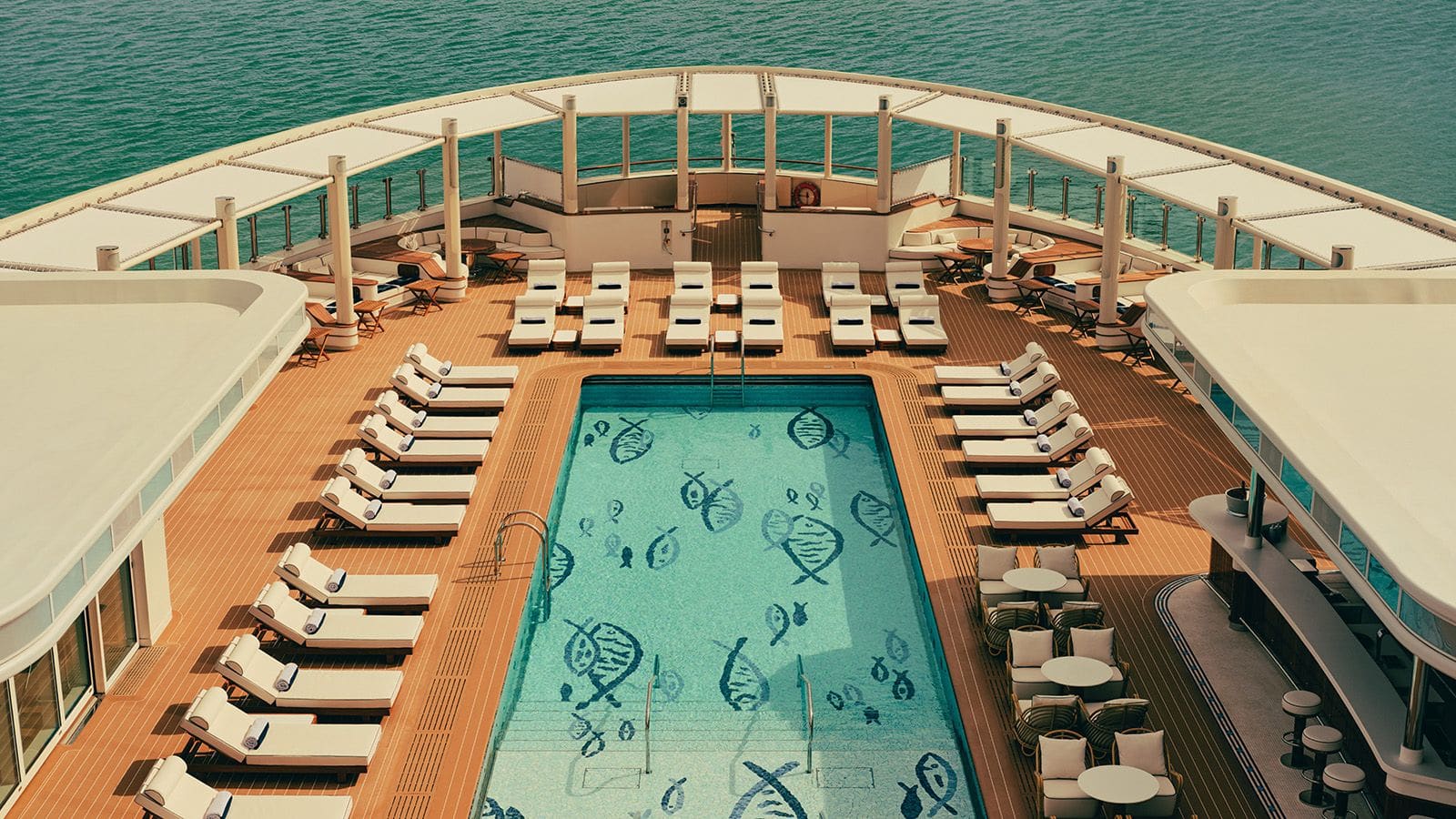
When the Ship Becomes the Destination
There is a moment, somewhere between embarkation and the first evening's aperitif, when the vocabulary shifts. You stop saying "cabin" and start saying "residence." The corridor becomes a hallway. The dining room, simply dinner. It happens quietly, this linguistic pivot, but it signals something larger: the vessel beneath your feet no longer behaves like a ship at all. It behaves like a very good hotel that happens to move.
The luxury cruise landscape has undergone a transformation so thorough that the term "cruise" itself feels inadequate. What was once the domain of established maritime operators has become a playground for hospitality brands, each bringing the design sensibility and service culture of their terrestrial properties to open water. The result is a category of travel that defies easy classification: too intimate for mass tourism, too mobile for traditional hospitality, too ambitious to be merely transport.
The Hotel Brands Set Sail
Four Seasons launched its first yacht in March 2026, a 95-suite vessel with a passenger-to-crew ratio of one to one. Every need, the logic goes, will be met before it is articulated. The ship skews residential rather than recreational, with suites spanning two to four bedrooms on the upper decks and eleven distinct culinary concepts. Breakfast is included in the fare; everything else operates on an à la carte model, an approach that invites guests to spend roughly 250 US dollars per person, per day, on food and beverage. It is luxury cruise's first experiment with unbundling the dining experience, a calculated wager that affluent travellers prefer choice to comprehensiveness.
A second Four Seasons vessel, with 79 suites, will arrive in May 2028 for further Mediterranean sailings. Late port stays and overnights anchor the itineraries, as do bespoke shore excursions and wellness programmes developed in partnership with Lanserhof, the Austrian medical spa group known for its longevity protocols.
Aman's entry, the 94-passenger Amangati, will set sail in spring 2027. The ship extends the brand's signature spatial generosity to the water: a two-deck spa with a Japanese serenity garden, host suites for passengers' personal staff or security details, and two helipads. The design is calibrated for full-ship charters, a floating iteration of the brand's private villas.
Ritz-Carlton operates three all-suite, all-inclusive vessels: the 149-suite Evrima, the 224-suite Ilma, and the 226-suite Luminara. Each features five restaurants, a watersports marina, and menus developed by the brand's Michelin-starred chefs. Personalised spa therapies and high-end boutiques, including Cartier, occupy the public spaces.
Orient Express has introduced vessels with three fully automated rigs capable of delivering entirely wind-powered propulsion under favourable conditions. The 54-suite Orient Express Corinthian features five restaurants under the direction of chef Yannick Alléno, whose establishments have earned multiple Michelin stars. The ship sails the Mediterranean until autumn; its twin, Orient Express Olympian, will launch next spring. Dynamic positioning and liquefied natural gas propulsion represent the line's environmental and energy-efficient commitments.
The Expedition Becomes Elegant
Luxury has migrated to the poles. Silversea extends its all-suite, butler-staffed, complimentary-caviar philosophy to four exploration vessels, including the 100-passenger Silver Origin, which sails exclusively in the Galápagos. Scenic Luxury Cruises & Tours operates two sleek 228-passenger yachts equipped for polar cruising, each with ten dining venues, a spacious spa, two helicopters, one submersible, and fleets of Zodiacs, kayaks, and paddleboards. The line will debut the 270-passenger Scenic Ikon in April 2028, adding two helicopters, a submersible, and fifteen dining venues.
Ponant operates Le Commandant Charcot, a 245-passenger icebreaker and the only luxury vessel capable of reaching the true North Pole. The ship features Le Nuna, the only Alain Ducasse fine-dining restaurant at sea. Ponant also maintains six bilingual explorer ships for warmer climates.
Seabourn sails the 264-passenger Seabourn Venture and its twin, Seabourn Pursuit. Both meet PC6 Polar Class standards, meaning they can push through ice. All-suite accommodations, refined dining, and attentive crew service accompany expeditions to remote itineraries. Each ship carries two submarines.
Silversea is opening The Cormorant at 55 South, the Earth's southernmost hotel, in Puerto Williams in October 2026. The property will serve as a waystation for Antarctica-bound passengers, softening the logistical edges of polar travel.
The Legacy Lines Adapt
The established operators have not stood still. Regent Seven Seas Cruises will unveil the Seven Seas Prestige in December, the newest addition to its seven-ship fleet. The vessel introduces suite categories with in-suite elevators, private gyms, and dedicated butlers. Regent is also reducing passenger counts on its Explorer Class ships to expand cabin sizes.
Crystal, which has dropped "Cruises" from its name, operates two vessels: the 740-passenger Crystal Serenity and the 606-passenger Crystal Symphony. Both feature butler service for all guests, pillow menus, a Nobu Matsuhisa-affiliated Asian restaurant, and 24-hour room service. The line, now owned by Abercrombie & Kent Travel Group, is readying the new-build Crystal Grace for June 2028.
Seabourn's three ocean liners favour quiet luxury over conspicuous opulence. The 600-passenger Seabourn Encore and Seabourn Ovation offer multiple fine-dining venues and a fee-based Retreat for additional privacy and service. The 458-passenger Seabourn Quest recently completed an extensive refurbishment. The line is also preparing a fleet-wide overhaul of its culinary programmes.
Explora Journeys operates three 922-passenger ships and will unveil Explora IV in summer 2027, with 461 suites, five heated pools, and seven restaurants. The ship and Explora III feature a private chef's table, a beach-club-style Shore Club eatery, a wine-tasting cellar, and an expanded children's club with family-oriented destination experiences. Near-twin Explora V will set sail in December 2027, followed by Explora VI in August 2028.
Oceania Cruises, with seven ships devoted to culinary excellence, will introduce the 238-suite Oceania Aurelia in November 2027 and Oceania Arietta in 2029.
SeaDream Yacht Club operates two twin mega-yachts, the 112-passenger SeaDream I and SeaDream II, both offering a relaxed yachting lifestyle with sophisticated cuisine, attentive crew, and a watersports marina platform. SeaDream III, promising a larger and more elevated experience, will launch in 2029.
Rivers, Reimagined
Riverside Luxury Cruises operates three all-suite ships in Europe, each designed to deliver exceptional gastronomic experiences. Included excursions might range from an alfresco candlelit dinner at a French winery to private palace concerts in Vienna.
Uniworld Boutique River Cruises will count some 24 distinctly designed ships by 2028, each reflecting its sailing region. The design-forward vessels mirror boutique hotels, with itineraries spanning Europe, Vietnam, Cambodia, and Egypt.
AmaWaterways recently launched an itinerary on Colombia's Magdalena River, the first of its kind since the era of steam ships. The line offers a more accessible entry point into luxury river cruising while maintaining intimacy and low-impact travel thanks to small ship sizes.
Viking River Cruises operates one of the world's most extensive fleets of river vessels. The line, known for Scandinavian design, exceptional service, Nordic spas, and an adults-only atmosphere, occupies the more accessible end of the luxury spectrum.
The Calculus of Choice
The proliferation of options has created a new calculus for travellers. Itineraries now extend into the Mediterranean shoulder season and winter, a scheduling shift that broadens the window for luxury voyages. Fewer passengers per vessel mean the experience skews closer to private charter than traditional cruise, with thoughtful approaches to dining, design, and pacing.
What emerges is not simply a market expansion but a conceptual shift. The ship is no longer a means to an end, a floating conveyance between ports. It is the architecture of the journey itself, a carefully composed environment where movement and stillness coexist. The best of these vessels understand that luxury at sea is not about replicating the land-based hotel experience but about creating something that could only exist on water: a sense of boundlessness paired with the comfort of enclosure, the thrill of remoteness softened by impeccable service.
The line between sailing and residing has blurred. In its place is something new: a category of travel where the vessel is both vehicle and destination, where the journey is measured not in nautical miles but in the quality of attention paid to every detail, every meal, every moment spent looking out at the horizon.