The Fisherman Sandal That Moves Between Boardwalk and Bistro
One pair of leather-woven sandals has quietly become the summer shoe that bridges utility and elegance - proof that the best travel gear often comes from the simplest silhouettes.
A Shoe Born on Water, Perfected on Land
There is something quietly satisfying about a piece of footwear that refuses to declare its allegiance. Not quite a sandal in the flip-flop sense, not quite a shoe in the closed-toe oxford tradition, the fisherman sandal occupies that rare middle ground where function and restraint meet. At Global Chic Voyage, we've watched this silhouette move from dock to dinner table over the past few seasons, and what strikes us most is not the trend itself but the way it has quietly solved one of travel's most persistent dilemmas: what to wear when you need to walk all day and still look intentional by evening.
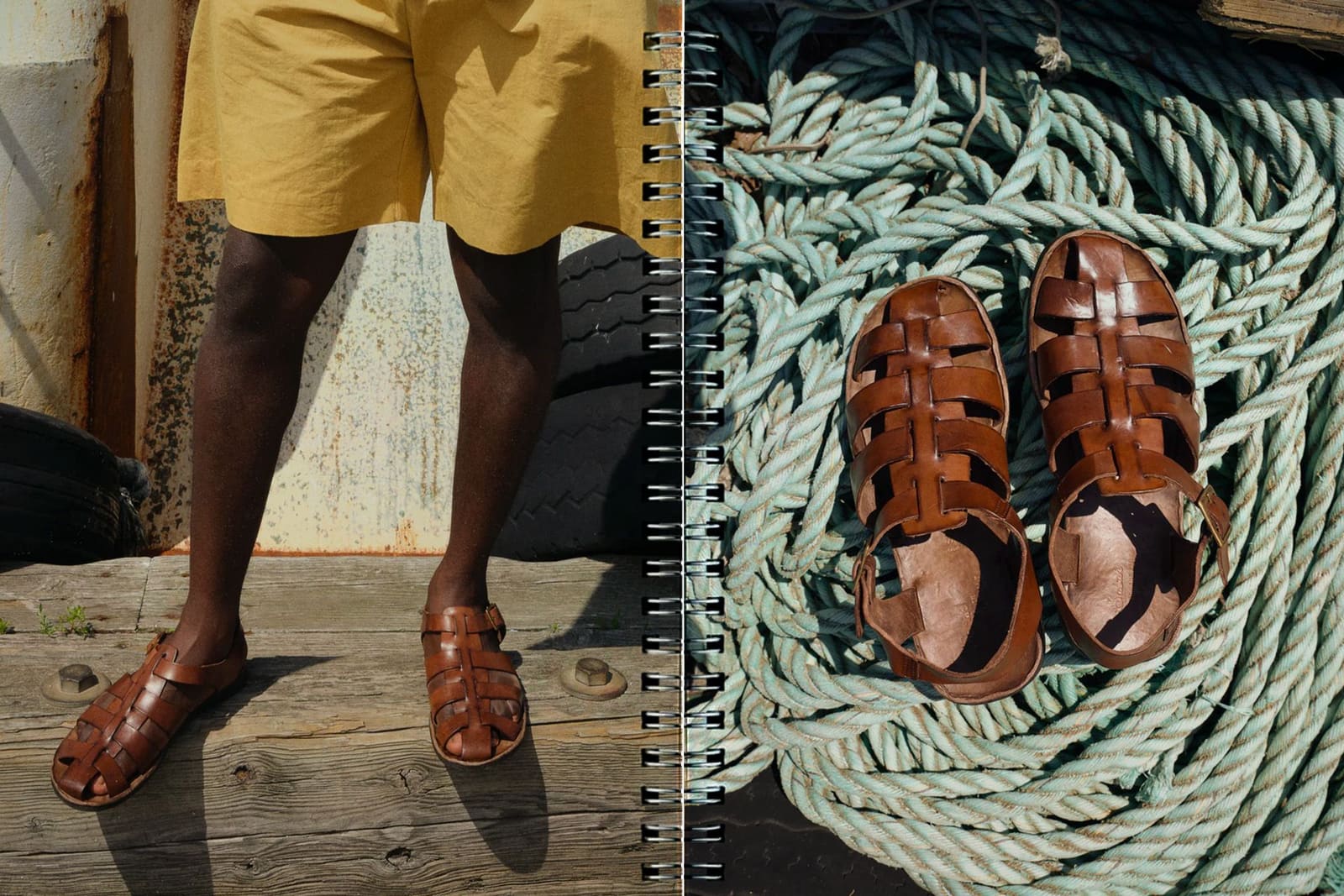
The fisherman sandal's anatomy is modest. Strips of leather woven across the toe box, a strap or closed heel, a sole that sits flat against the ground. The design originated in coastal communities where drainage mattered - seawater and rain needed somewhere to go - but the form has aged into something more versatile. In cities like New York, where sidewalk grates and unpredictable weather demand a shoe that can handle both, the fisherman sandal has become a summer uniform. On beaches from Rockaway to Bali, it reads as effortless. And in the cobblestoned quarters of Cartagena or the stone-paved lanes of Mediterranean harbor towns, it belongs without trying.
The Sabah Porto and the Question of Leather
Among the many iterations of this style, the Sabah Porto has distinguished itself through a single material choice: supple, thin leather that behaves more like fabric than hide. This matters because the break-in period - a notorious stumbling block for any woven shoe - compresses from weeks into days. The leather molds quickly, conforming to the foot's shape without the prolonged discomfort that often accompanies handmade footwear.
The Porto's strap heel leaves the back of the foot exposed, a detail that shifts the sandal's visual weight toward the front. The result is a shoe that feels airy but looks considered, a balance that works as well with tailored linen trousers as it does with swim shorts. The flatness of the sole is both a strength and a limitation. For travelers who log miles on foot each day, the lack of arch support may require insoles or a second pair in rotation. But for those who prioritize a low profile and ease of movement, the trade-off is reasonable.
Styling Across Contexts
The fisherman sandal's real utility emerges in its adaptability. Worn barefoot, it reads as casual - appropriate for beach walks, morning markets, or the kind of languid afternoon where plans dissolve into impulse. Add a sock, and the tone shifts. A white or contrast-colored sock introduces a deliberate informality, the kind that works in creative offices or weekend gallery visits. A black sock, matched to a black sandal, edges into more formal territory, turning the sandal into something closer to a loafer.
This flexibility extends to packing. A single pair can cover a range of occasions, reducing the footwear burden that often weighs down a suitcase. For a river cruise through Colombia or a long weekend in Puglia, the fisherman sandal handles both the unplanned scramble over rocky shorelines and the evening aperitivo on a terrace. It is, in this sense, the rare piece of travel gear that does not force you to choose between comfort and appearance.
The Search for Craft
The impulse to buy a fisherman sandal while traveling - to find it in its place of origin - is not misplaced. In Colombia, the tradition of leather-weaving is strongest in Bogotá, though other regions have turned to palm and fiber crafts. In Morocco, the souk stalls of Marrakech and Fez still produce handwoven leather sandals, each pair shaped by the maker's hands. In Greece, the island of Crete has maintained a lineage of sandal-making that stretches back centuries, with workshops in Chania and Rethymno producing styles that look nearly identical to those worn in antiquity.
But the global availability of well-made fisherman sandals - brands like Sabah, alongside Spanish and Portuguese makers - means the traveler need not wait for the perfect market encounter. The sandal can be sourced in advance, broken in at home, and carried confidently into any destination. This is not a diminishment of craft but an acknowledgment that good design, once refined, transcends geography.
Why the Fisherman Sandal Endures
At a moment when travel footwear oscillates between technical sneakers and flimsy slides, the fisherman sandal offers a third path. It does not announce itself with logos or bright colorways. It does not promise performance metrics or orthopedic innovation. What it offers instead is a kind of quiet competence, a shoe that works without demanding attention.
This is the quality that makes it suited to the Global Chic Voyage ethos. We are drawn to pieces that do not shout, that reveal their value through repeated use rather than first impression. The fisherman sandal, in its woven simplicity, fits that criterion. It is a shoe that can be worn on a dock in Taupo, on a subway platform in Manhattan, or at a table overlooking the Amalfi Coast, and in each setting it feels appropriate.
The best travel gear, we have found, often comes from the most elemental designs - the ones that have been tested not in focus groups but across generations, in places where utility cannot be faked. The fisherman sandal is one of those designs. It does not need to evolve dramatically because it was right from the start. What remains is simply to wear it, to let it age and soften, and to carry it with you into whatever summer brings next.