The Finnish Practice That Turns Every Forest Into a Gym
Long before wellness became an industry, cross-country skiers were moving through summer woods with poles in hand, training muscle memory for winter. Now the world is catching up.
A Childhood in the Turku Archipelago
Katja Presnal spent two decades studying global lifestyle movements before realising the richness she sought had surrounded her as a child. Growing up among the bays and forests of Finland's Turku archipelago, she moved through landscapes that would later become aspirational backdrops for wellness retreats marketed to travellers seeking slower rhythms. The irony surfaced only after years spent documenting trends for a platform that drew over 100,000 monthly readers: what felt ordinary in her early years had become extraordinary to the rest of the world.
She has since purchased a century-old dairy building tucked into the Finnish countryside, converting it into a year-round personal retreat. The choice reflects a broader shift in how people are redefining wellness, moving away from episodic escapes toward environments where everyday life itself becomes restorative. Surrounding her are lakes, trails, and the kind of unstructured access to nature that Scandinavian legal frameworks have long protected.
When Skiers Lost Their Snow
The origins of Nordic walking are practical rather than philosophical. In the 1930s, competitive cross-country skiers faced a problem: how to maintain conditioning when snow disappeared. Their solution involved running shoes and ski poles, a makeshift summer regimen that preserved the biomechanics of their winter sport. The practice remained confined to elite athletes for decades.
It was Leena Jääskeläinen, a physical education teacher, who brought the concept into public circulation in 1966. Her work marked the first documented use of ski poles outside competitive training, though the activity lacked a formal name or standardised technique. Three decades later, a Finnish sporting goods company would formalise what Jääskeläinen had introduced, designing poles specifically for the movement and coining the term that would eventually reach forty countries.
Engineering Accessibility
Aki Karihtala, now president of the International Nordic Walking Federation, was heading the sports division at Exel in the late 1990s when the company developed the first purpose-built Nordic Walker poles. The design addressed biomechanical concerns that trekking poles did not, incorporating ergonomic features to distribute effort across the upper body while reducing impact on knee joints. Within a year of the product's 1997 release, over half a million Finns had tried the activity, a remarkable penetration in a population of roughly five million at the time.
The federation, established in 2000, developed a progressive teaching method to standardise technique. Karihtala emphasises that the activity's appeal lies in its lack of barriers related to age, fitness level, or economic means. A pair of poles and a nearby trail are sufficient. The movement has since spread across Europe, Asia, and Australia, supported by instructor networks and country associations that organise group walks and annual events.
The Architecture of Nordic Wellness
What distinguishes Scandinavian approaches to wellbeing is not novelty but systemic support. Legal frameworks such as Sweden's Allemansrätten grant public access to private land for recreational purposes, embedding nature into daily routines rather than reserving it for special occasions. Government policies in the region prioritise egalitarian access, ensuring that wellness practices remain available regardless of income.
This structural foundation allows trends to scale without commercialisation distorting their essence. Finnish saunas, Norwegian friluftsliv, Danish hygge, and Icelandic cold-water bathing all share an underlying principle: holistic wellbeing sustained over decades, accessible to professional athletes and elderly citizens alike. Nordic walking fits seamlessly into this continuum, requiring minimal equipment and no membership fees.
The sustainability-focused mindset extends beyond environmental concerns to encompass lifestyle design. Practices are meant to reduce stress rather than add complexity, favouring simplicity and long-term adherence over intensity and short-term results.
Connectivity Beyond Fitness
Presnal identifies social connection as one of Nordic walking's underappreciated benefits. Group walks create low-pressure environments for interaction, a counterpoint to the isolation that often accompanies modern life. The activity's moderate pace allows conversation while still delivering cardiovascular and muscular engagement.
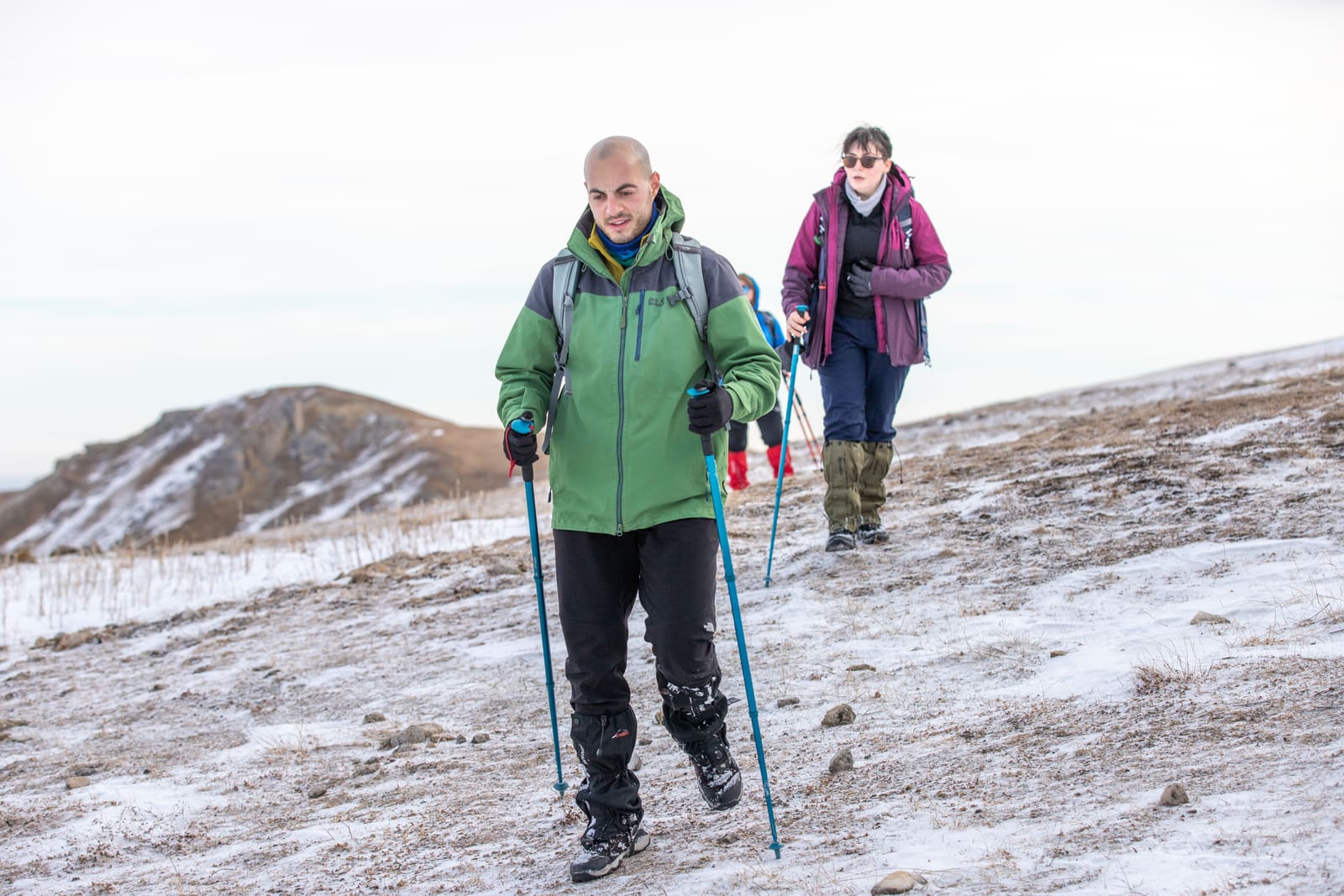
The whole-body involvement distinguishes Nordic walking from ordinary walking. Properly used poles activate the upper body, turning a lower-limb activity into one that recruits shoulders, arms, and core muscles. The technique is straightforward enough to learn within a single session, yet nuanced enough to refine over months.
For those accustomed to high-impact exercise, the practice may initially seem undemanding. Yet its effectiveness lies precisely in its moderation, a quality that aligns with Nordic cultural values around balance and sustainability. The goal is not peak performance but consistent participation across a lifetime.
Returning to What Was Always There
Presnal's pivot from trend forecasting to trend embodiment reflects a larger pattern: the recognition that wellness need not be pursued through exotic destinations or expensive programmes. The landscapes she once travelled to Tuscany to experience existed, in different forms, within reach of her childhood home. Her return to the Finnish countryside represents not escape but reclamation.
The global appetite for Nordic lifestyles continues to grow, yet those who grow up within these cultures often fail to recognise their distinctiveness until encountering alternative ways of living. What feels ordinary within one context becomes remarkable when transplanted elsewhere. This dynamic has fuelled the international spread of concepts like lagom and hygge, both of which codify attitudes that Scandinavians might struggle to articulate because they are so deeply embedded.
Nordic walking occupies a similar space. It is simultaneously unremarkable within Finland and increasingly noteworthy beyond it, a low-threshold entry point into a broader philosophy about how to inhabit time and landscape.
Beginning Where You Are
The International Nordic Walking Federation promotes an annual World Nordic Walking Day each May, but the activity requires no special occasion. Local associations across more than a dozen countries organise group walks led by certified instructors, offering structured introductions for those who prefer guidance. Alternatively, the practice can be self-taught, beginning with any familiar trail and a pair of properly designed poles.
The federation has compiled themed walk concepts, from charity challenges to meditative routes, though the essential experience remains unchanged: rhythmic movement through open air, poles extending the body's reach, the steady engagement of muscle groups that sedentary life allows to atrophy. It is exercise stripped of performance anxiety, nature engagement without requiring wilderness expertise.
What began as a pragmatic solution for off-season athletes has evolved into a practice that addresses contemporary needs around accessibility, social connection, and mental clarity. The poles that once mimicked ski season now serve a different purpose, transforming forests and parks into spaces of restorative movement, available to anyone willing to step outside and begin walking.